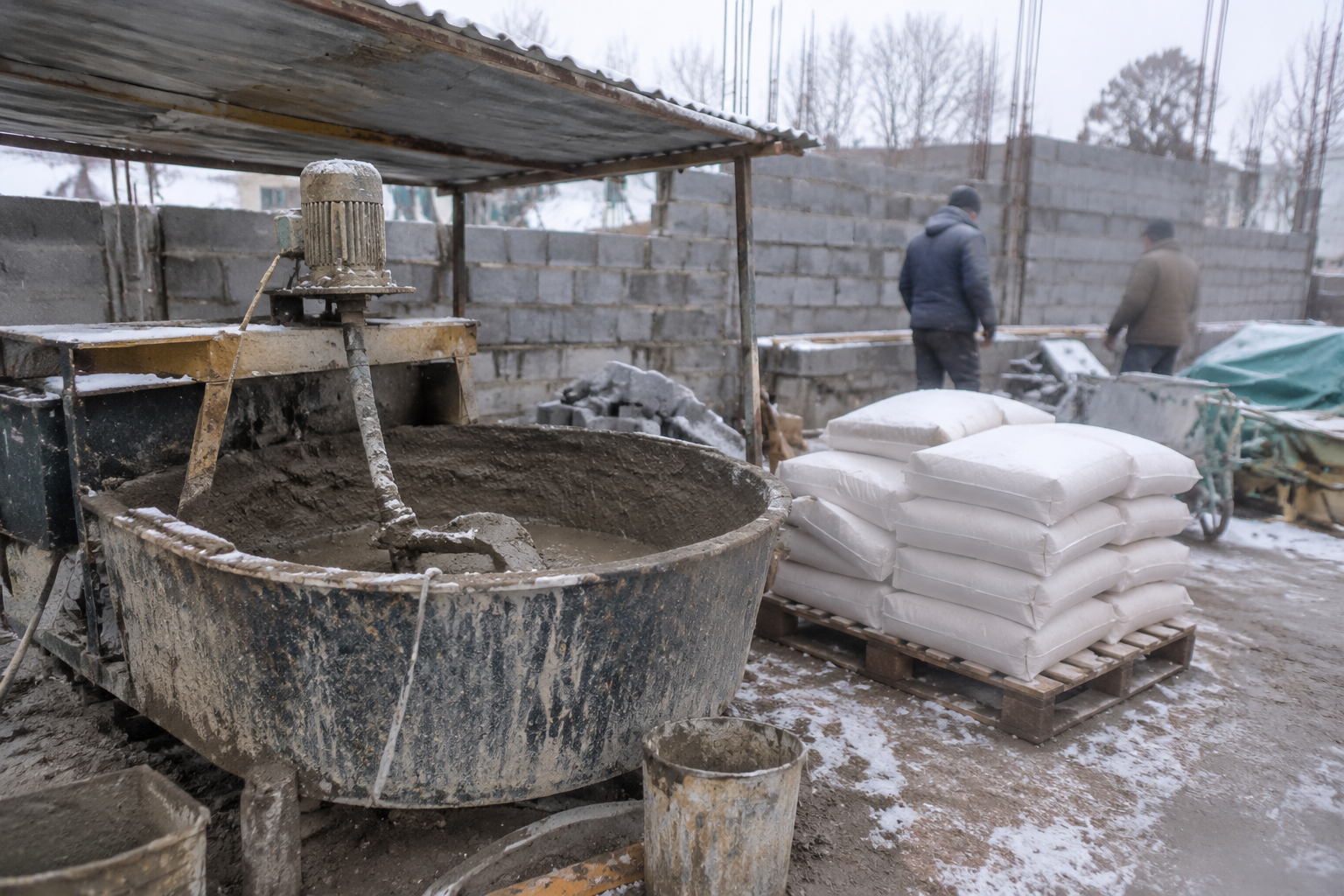
The problem. A crew that has used the same tile adhesive all summer adds calcium formate for the cold snap, and the mix turns strange. The paste stiffens at the rim of the bucket while the middle is still soft, the trowel drags instead of gliding, and the working window closes at exactly the moment the gang is trying to keep up. Nobody changed the formula, so nobody can say what changed.
Why it keeps happening. Three things moved at once and only one of them is visible. The air got colder, the water got colder, and a salt went into the powder. Each one shifts water retention, rheology and reaction rate, and they shift them together. Approved one at a time, none of the three looks wrong.
What this article does instead. It treats the winter mix as a single system — accelerator, cement, cellulose ether, water and mixing procedure — and it separates what the chemistry actually does from what the bag and the batch number usually get blamed for. Searches for HPMC calcium formate winter usually return a dose; the useful answer is a procedure. Where the evidence is thin, I say so, because a confident wrong mechanism costs more than an honest maybe.
1. What Is Calcium Formate Actually Doing in a Cold-Weather Cement Mortar?
Problem. The bucket is cold, the cement is cold, and the reaction is slow, so the formate goes in to get the mix moving. On site it gets talked about as though it were a heater for the mortar. It is not one, and that assumption is where most of the confusion starts.
Agitation / Answer: Calcium formate is a soluble calcium salt of a short organic acid. It changes the chemistry of the pore solution, which shifts how fast the binder dissolves and how its hydrates precipitate. In cement that tends to mean a faster start. In other binders the same salt has been shown to slow the reaction down.
Solution. Winter does not change the recipe, it removes heat. Hydration is a dissolution and precipitation process, and its rate depends on temperature, so a cold mix needs more time and more protection. An accelerator buys part of that time back by working on the water between the grains. The formate ion is small and mobile: it passes through the hydrate layers forming around the clinker grains, so the calcium-bearing phases dissolve and reprecipitate sooner, and the extra calcium raises the concentration in the pore solution.
That is where the mix starts to feel different, and it is the part people miss. The calcium and the formate do not talk only to the clinker. They sit in the same water the cellulose ether has to hydrate in, so they change the environment the ether works in: how much water it can hold, how its gel network builds, and how the paste flows at a given water addition. In my trials the same HPMC at the same addition has given me a shorter, more cohesive paste once the pore solution got saltier. I would not call that the two additives fighting. I would call it one water phase being asked to do two jobs.
The accelerator is not a fixed quantity of effect either. Published work shows its influence depends on how much sulfate the cement carries relative to its aluminate content, and that in a calcium sulfate binder the same salt was found to retard hydration and change the habit of the growing crystals [4]. So “accelerator” is not a property of the powder in the sack; it is a property of the powder plus the binder it lands in.
The reading is simple: the formate is doing real chemistry in the water, and the ether lives in that same water.
2. Why Must HPMC, Cement and Accelerator Be Verified as One System?
Problem. In most plants the three arrive on three purchase orders and are signed off against three separate documents. The ether is approved on viscosity and moisture, the cement on its certificate, the accelerator on its assay. Each one passes. The winter mix still behaves badly.
Agitation / Answer: Because the properties the trowel meets are outputs, not inputs. Water retention, cohesion, flow and set emerge from one pore solution, one population of particle surfaces and one dose of mixing energy. Approving the parts separately tells you nothing about the combination you actually sell.
Solution. A cellulose ether does its work at interfaces and in the water. It adsorbs on the surfaces available to it, it thickens water into something closer to a gel, and that gel keeps water in the paste long enough for the binder to use it. In a mortar the largest available surface area belongs to the cement grains and to the hydrate layers forming on them, and an accelerator changes both what sits on those surfaces and what is dissolved around them. Calcium, sulfate, aluminate and formate share the same small volume of water.
Temperature moves both sides at once. A cellulose ether solution is generally more viscous when cold and dissolves more slowly in cold water, while the binder also reacts more slowly. A cold mix can therefore be stiffer and slower at the same time. Hot weather reads differently: there the paste skins and stiffens because water is leaving, while here it stiffens with the water still in it, as this note on open time in hot climates sets out.
The standards are useful as long as they are used for what they are. The ISO and EN methods define controlled conditioning, a defined mixing procedure and defined characteristics [1][2]. That makes them good for comparing products, and it is why a declared class cannot say how the same product behaves in a cold bucket, with cold water, a different mixer and an accelerator approved later. What closes that gap is not a better datasheet but a document set that ties the lots together: what the COA claims, what the receiving inspection found, and what the retained sample does in the mix. Choosing the grade of ether for a dry-mix mortar belongs to the same decision, not to a separate one.
No specification I have seen predicts how a particular cement, formate addition and ether grade behave together.
3. Which Site Symptoms Point to Compatibility or Process Rather Than a Bad Batch?
Problem. Something is wrong, the sack is the easiest thing to blame, and a replacement pallet arrives. The behaviour does not change. Now the argument is about the supplier instead of about the mix, and a week has been spent.
Agitation / Answer: A real material fault follows the material: it appears wherever that sack goes, in any weather, with any crew. A compatibility or process problem follows the conditions. If the trouble tracks one elevation, one water source, one shift or one mixer, the sack is probably innocent.
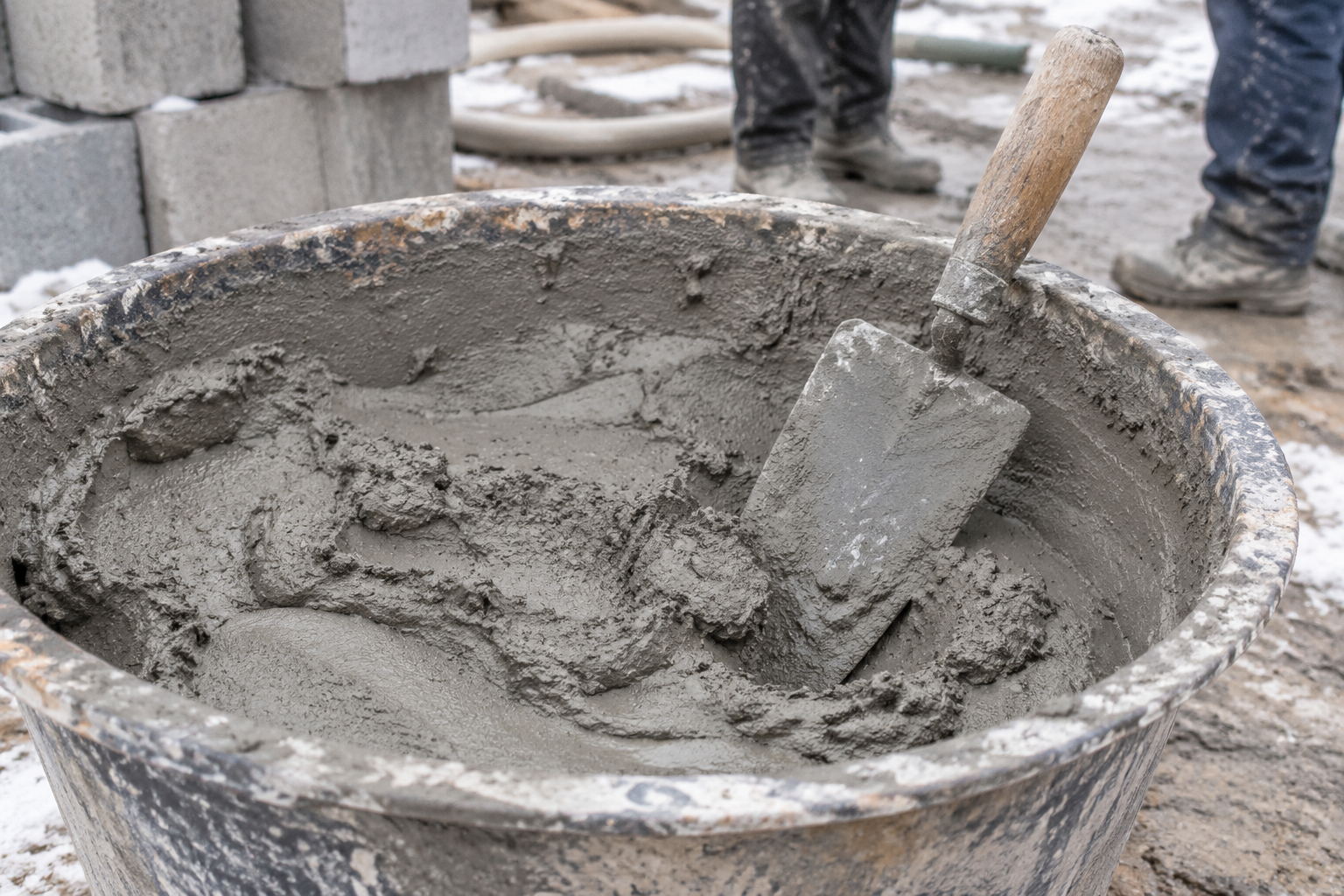
Solution. The way I read a complaint is by asking what the symptom follows. A paste that stiffens at the rim of the bucket while the middle stays soft is losing water at the exposed surface faster than the body can recover it, which points at wind, dry cold air and a water retention margin that was never generous. A mix that tightens in the tub between batches is about standing time plus chemistry. A trowel that drags and tears instead of spreading means cohesion is too high for the water present, and that often arrives with a grade change or a colder mix. A water sheen at the edge of the bed means water is leaving the paste. A mix that feels short and sandy at the same water addition suggests the ether has not fully dissolved. A long soft period followed by a sudden stiffening means two processes are running at different speeds.
None of those readings is a verdict on its own, so I put them beside the process questions. Same water, same source, same temperature? Powder into water, or water into powder? Same mixer, setting, duration and batch size? How long did it stand, and was it re-mixed? Did the sacks come off a cold pallet, or out of a container opened that morning? Cold powder carried into a warm room sweats, and a damp sack disperses differently.
Two related complaints should be kept apart. Sag on a vertical face is a rheology argument rather than a set argument, covered in this note on sag with high viscosity. A mix that will not stay open is a water argument. A winter mix can produce both, which is why the diagnosis has to start from what the symptom follows rather than from what is easiest to replace.

4. What Should You Check Before Changing the Accelerator, the HPMC Grade or the Water?
Problem. The instinct is to change something, and the three fastest things to change are already in the yard: a different accelerator, a higher-viscosity ether, a drum of warm water. Each change throws away the baseline, so the next trial proves nothing except that something moved.
Agitation / Answer: Check what costs nothing first. Water source and water temperature, dosing order, mixing energy, standing time in the tub, and how the sacks were stored. Fix those and write them down before a single ingredient is swapped, or the trial will measure your process instead of the material.
Solution. Start with the procedure, because it is free. Batch size, order of addition, mixer setting, mixing duration, standing time, and the rule for re-mixing. Weigh everything that goes in, including the accelerator and the water; a scoop is not a dose, and a bucket marked on the inside is not a scale. If two crews mix differently, that is two procedures and it needs two records.
Then look at the water, the variable most people forget because it never arrives on a purchase order. Winter water is rarely the water the trial used. It can be a different tap, a hose that sat in weak sun, a warmed drum, or melt water off a board. Water temperature changes how fast the ether dissolves and how fast the binder reacts, and warm water is a trade rather than a gift: it buys workability at the start and can cost working window later, when the mix has given that heat to a cold substrate.
Storage belongs in the same conversation. Sacks kept in a cold container and opened in a warm room take up moisture on the surface of the powder, and a slightly caked ether disperses at a different rate from a free-flowing one. The mechanics are set out in this note on HPMC storage in humid climates, and the same logic applies to a cold, damp site container.
Only then does it make sense to change one ingredient, and only one. A higher viscosity number is not the same thing as better water retention; retention and viscosity are separate properties, and a grade change also moves rheology, air content and water demand. If the reason is that the mix “feels thin”, that is a symptom, not a diagnosis. And a different salt is different chemistry, not a stronger version of the same chemistry.
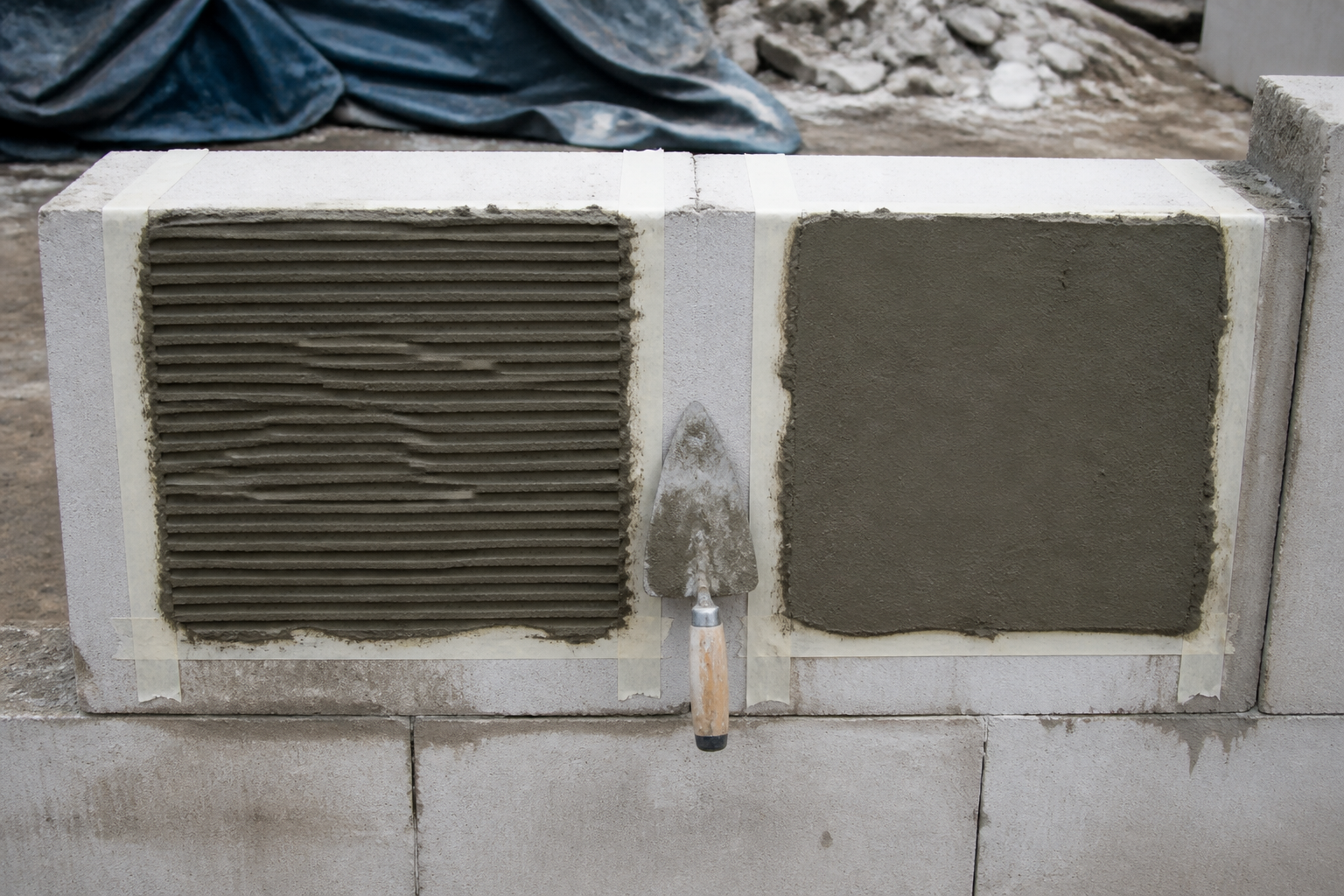
5. How Do You Prove a Winter Formula on a Controlled Mock-Up?
Problem. The trial happens in the yard at midday, in the open, with the technical manager doing the mixing. The work happens on an upper floor at the start of the shift, in wind, with a gang that has its own habits. The two situations have almost nothing in common, which is why the trial keeps passing and the site keeps failing.
Agitation / Answer: Reproduce the cold, the water, the mixer and the sequence, and run it at the hour the work really happens. Put the approved mix beside the candidate on the same substrate, with the same coat thickness and the same crew, and write down what you did while you are doing it.
Solution. Build the mock-up as a comparison, not a demonstration. Same substrate, prepared the same way, split into strips: the current approved formula, the candidate, and the candidate pushed into the worst condition the site will realistically meet. Anything that differs between the strips other than the variable under test ends up in the result, so keep the trowel, the coat thickness and the person the same.
Then run the sequence rather than the ideal. A cold start with cold water, the longest stand the site allows, the second batch, the re-mix, the bucket that waits while the gang moves floors. If one elevation is mixed by hand and another by paddle, test both, because mixing energy is part of the formula.
Judge the panels on two levels. The defined characteristics are the ones the ISO and EN methods describe, and they are what the product will be held to [1][2]. The site characteristics are the ones the crew will complain about: does it stay workable long enough to place, does it hang where it is put, does it skin before it is covered. Keep the setting behaviour of the binder in its own box, because a setting time measured on paste under controlled conditions describes the cement, not a mortar standing in wind [3].
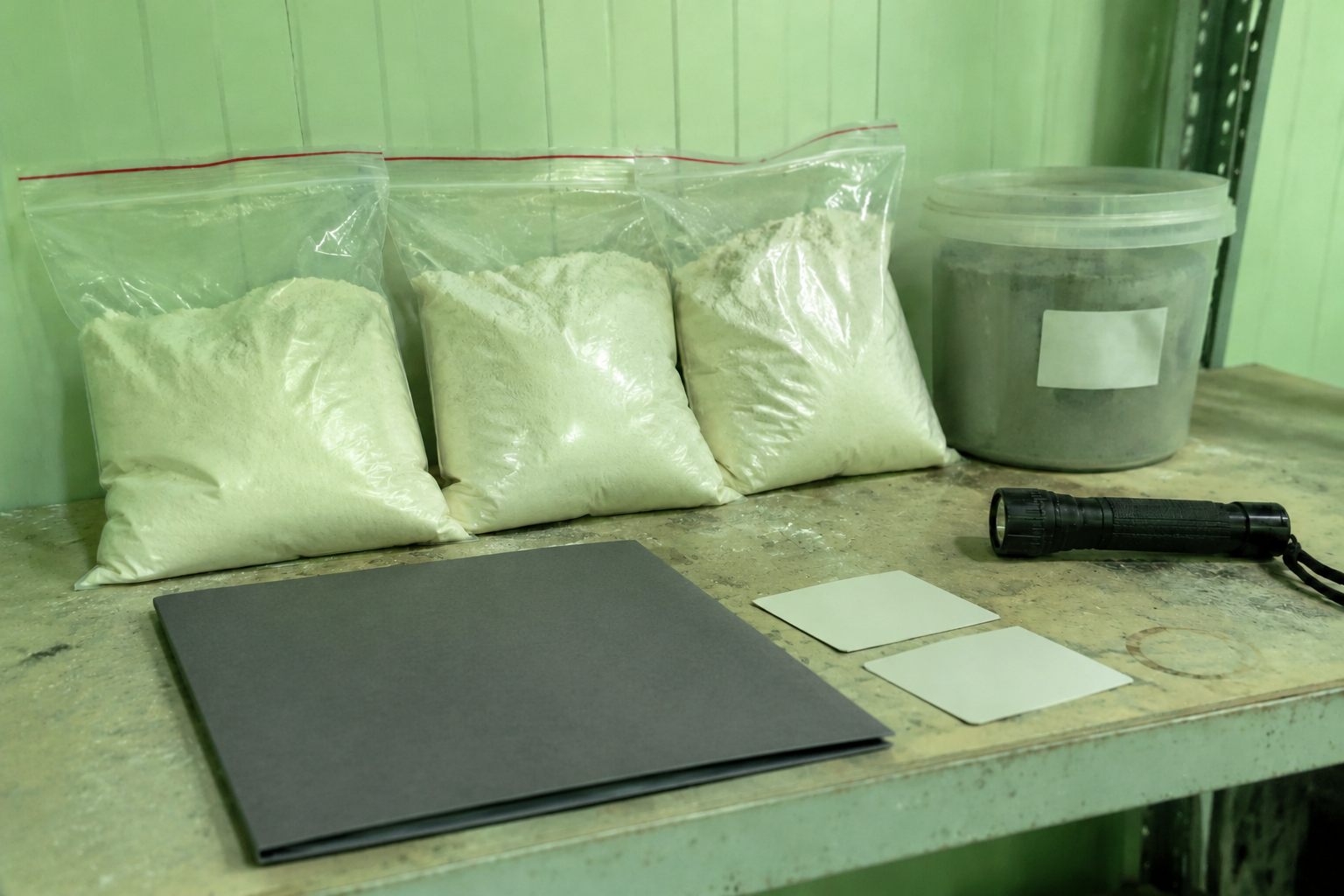
Retain everything: sealed powder samples from each lot, a labelled container of the mixed mortar, the mixing record, the conditions, and the panel until it has matured. When a complaint arrives months later, that set turns an argument into a comparison. It is also what our HPMC for tile adhesive customers are asked for first, and the polymer side of a winter formula sits on the RDP for dry-mix mortar page.
Close the loop by turning the result into the approved procedure, and send it to site with the delivery.
Frequently Asked Questions
Does calcium formate always accelerate a cement mortar? No. It usually speeds up the start in Portland cement, and published work shows the size of that effect depends on the sulfate balance of the cement; in a calcium sulfate binder the same salt has been found to slow hydration instead. Treat it as binder specific and confirm it in your own system.
Can I solve a cold-weather problem by adding more HPMC? Usually not. More ether thickens the paste, holds water and can lengthen the soft period, but it does not make the binder react, and past a point it makes the mix harder to spread and more air-entrained. If the complaint is about set, the ether is the wrong lever, as this note on sag with high viscosity also shows.
Why does the same formula work in the plant and fail on site? Because the plant trial is warm, short and run by the people who wrote the formula, while the site is cold, long and run by people who did not. Water, mixer, batch size, standing time and substrate all differ, and any one of them can be the difference.
Is warm water a safe way to keep a winter mix workable? It helps dispersion and the first minutes, but it changes the reaction rate and the working window, and the mix gives that heat back to a cold substrate soon enough. Decide it as part of the formula and record it, rather than leaving it to a bucket-side habit.
Do I need a laboratory to check a winter formula? No, but you need discipline: a written procedure, weighed additions, a reference panel, retained samples and a record of the conditions. A laboratory tells you what the material is; a mock-up tells you what the crew will actually get.
If you are putting a winter mix together, send us the formula, the accelerator you are using, the water source and a photograph of the tub at the moment it goes wrong, and we will tell you which part of the system we would examine first.
References
- International Organization for Standardization. *ISO 13007-1:2014 — Ceramic tiles — Grouts and adhesives — Part 1: Terms, definitions and specifications for adhesives.* https://www.iso.org/standard/60880.html
- European Committee for Standardization. *EN 12004-1:2017 — Adhesives for ceramic tiles — Part 1: Requirements, assessment and verification of constancy of performance, classification and marking.* https://standards.iteh.ai/catalog/standards/cen/48998e72-43b4-4ab9-9385-a9399c2c4689/en-12004-1-2017
- European Committee for Standardization. *EN 196-3:2016 — Methods of testing cement — Part 3: Determination of setting times and soundness.* https://standards.iteh.ai/catalog/standards/cen/e4921eca-8101-4261-b066-25d19b9b8e8a/en-196-3-2016
- Materials and Structures (RILEM), vol. 56, article 92, 2023. *The influence of calcium formate on the hydration of calcium sulfate hemihydrate.* https://link.springer.com/article/10.1617/s11527-023-02181-1