Tile adhesive open time can fall sharply when hot air, warm substrates, low humidity, and wind accelerate surface water loss. The adhesive may still look usable, yet it can no longer wet the tile correctly. I address this risk by examining the whole system and then testing HPMC under representative climate and application conditions.
Tile adhesive loses open time in hot climates because water evaporates and absorbs into the substrate faster, causing the combed adhesive surface to form a skin. HPMC can improve water retention and working behavior, but manufacturers must also control the formulation, substrate, climate, mixing procedure, application area, and installation timing.
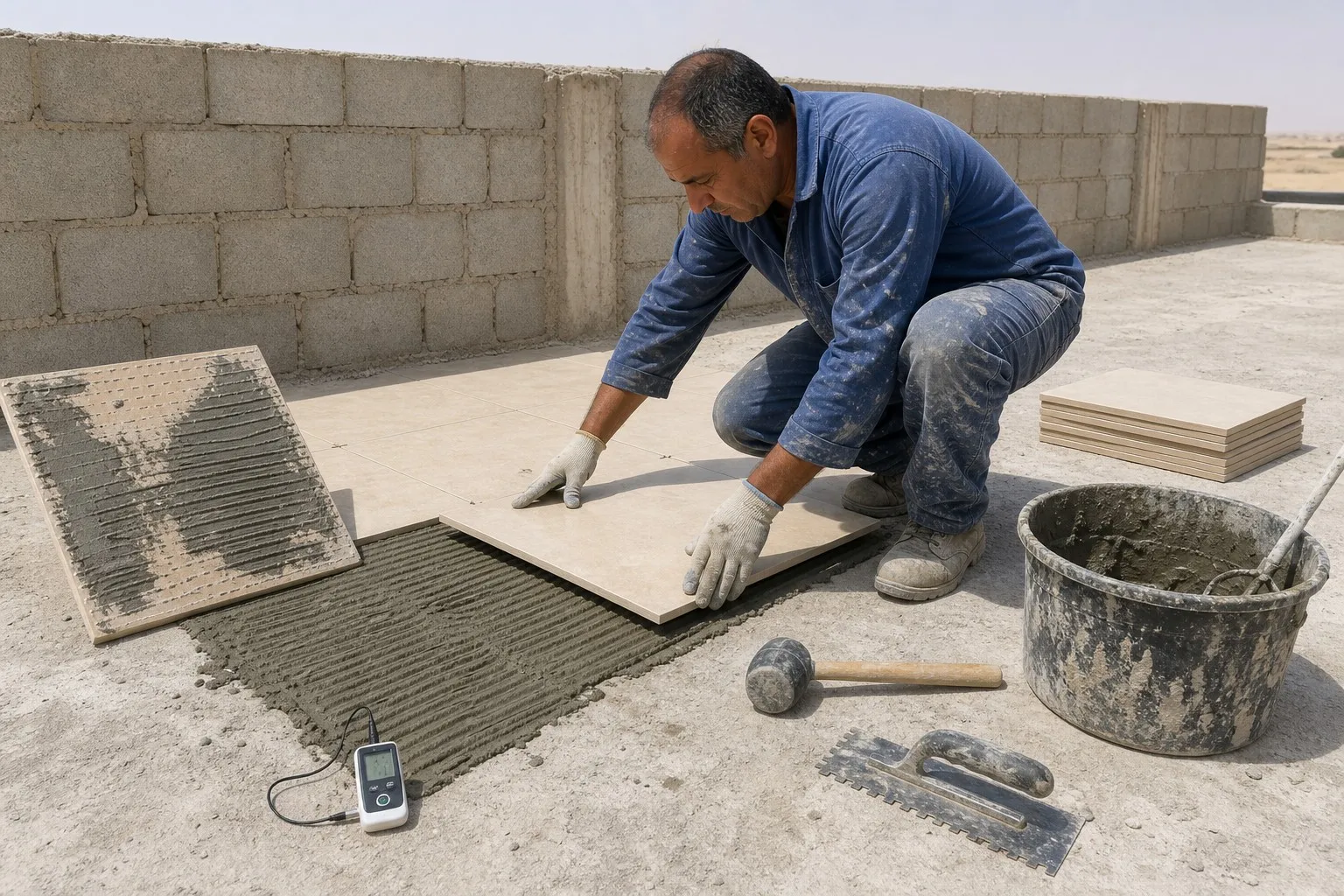
I do not treat early skinning as a viscosity problem alone. I first separate environmental, formulation, substrate, and workmanship factors. This approach helps buyers determine whether they need a different HPMC grade, broader formulation changes, better site controls, or a combination of all three.
Why Does Tile Adhesive Open Time Decrease in Hot Climates?
A tile adhesive can remain soft in the bucket while the combed surface has already become unsuitable for tile placement. This hidden difference often leads to poor wetting, hollow spots, and reduced bond strength. I therefore diagnose the actual exposure before I recommend any additive change.
Tile adhesive open time decreases when high temperature, low relative humidity, airflow, and an absorbent substrate remove water from the adhesive surface1. Cement hydration, aggregate grading, water demand, bed thickness, and application method also influence the rate. The combined conditions matter more than air temperature alone.
Open Time Is Not the Same as Pot Life
I often see these terms used as if they mean the same thing. They describe different installation windows:
- Pot life2 is the period during which mixed adhesive remains usable in the container.
- Open time3 is the period after spreading during which the adhesive can still wet and bond the tile adequately.
- Adjustment time4 is the period after tile placement during which the tile can still be repositioned without unacceptable loss of adhesion.
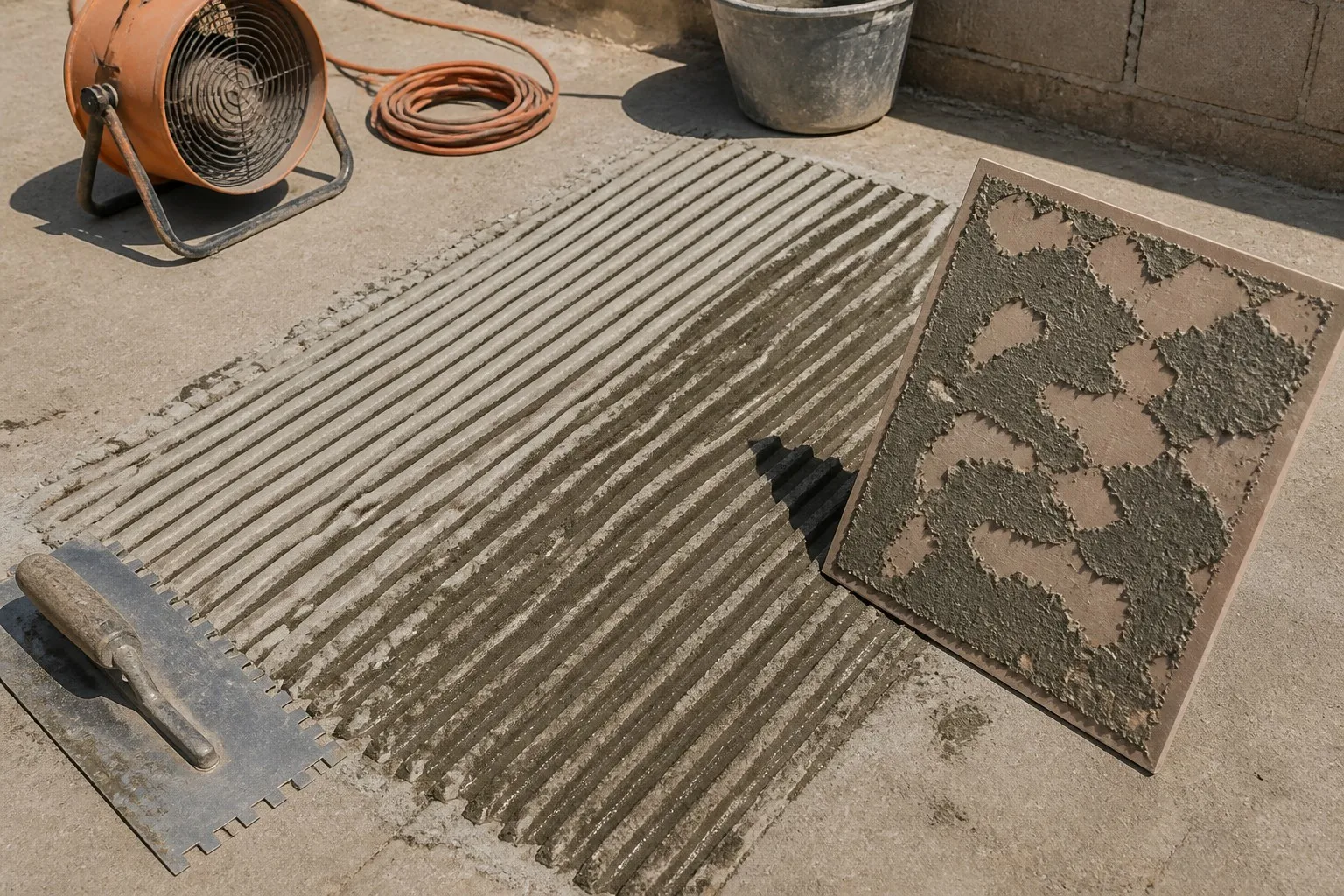
A mortar can pass a basic pot-life observation and still have inadequate tile adhesive open time. The material inside the bucket loses water more slowly because it has less exposed surface area. Once a contractor spreads and combs the mortar, the ridges create a much larger area for evaporation.5
Four Exposure Factors Work Together
I assess four main environmental and substrate variables before drawing conclusions.
| Factor | What it changes | Typical procurement or site question |
|---|---|---|
| Air temperature | Increases evaporation and can accelerate chemical reactions | At what temperature was open time tested? |
| Substrate temperature | Pulls heat and moisture through the adhesive bed | Was the test panel stored in the same climate? |
| Relative humidity | Controls how readily air accepts moisture | Was humidity reported with the result? |
| Airflow | Removes the moist boundary layer above the adhesive | Was wind or ventilation present during testing? |
| Substrate absorption | Draws liquid water into concrete, render, or blockwork | What substrate and preparation method were used? |
A reported test at 23°C and 50% relative humidity cannot automatically predict behavior on a façade or floor at 35°C to 45°C, especially when the substrate has been heated by direct sun. Airflow from open doors, fans, or desert wind can make the difference even larger.
I once reviewed an anonymized customer-supplied case in which the mixed mortar remained workable, but the installer reported poor transfer after waiting before tile placement. I did not treat that report as witnessed site evidence. However, the pattern suggested surface skinning rather than premature thickening in the bucket.
What Happens at the Adhesive Surface?
Fresh adhesive needs enough mobile water to wet the back of the tile. As the surface loses water, several changes can occur:
- The surface becomes dull instead of moist.
- A thin film or skin begins to form.
- The tile contacts the ridge tops but does not wet the fresh mortar below.
- Ridge collapse and transfer become incomplete.
- Voids or hollow areas remain beneath the tile.
- Bond strength can fall even though the mortar later hardens.6
Installers can sometimes identify this condition with a practical transfer check. They can place a tile, press it using the intended method, remove it promptly, and inspect adhesive coverage. However, project acceptance should follow the relevant installation standard and qualified professional guidance rather than one informal check.
Formulation Variables Also Affect Water Loss
Climate is only part of the system. I also review:
- Cement type, fineness, and chemistry
- Limestone or other filler content
- Aggregate grading and maximum particle size
- Polymer powder type and dosage
- Starch ether or other rheology modifiers
- Water-to-powder ratio
- Mixing energy and resting time
- HPMC dissolution and distribution
- Trowel notch and applied bed thickness
This is why I avoid diagnosing tile adhesive open time from temperature or viscosity data alone. Two products with the same nominal HPMC viscosity can behave differently when the cement source, filler absorption, polymer system, or water demand changes.
How Does HPMC Improve Tile Adhesive Open Time?
Fast water loss creates a narrow installation window, but simply adding more thickener can introduce new problems. I use HPMC to support water retention and rheology while monitoring workability, wetting, sag resistance, mixing behavior, and final adhesion as part of the same formulation.
HPMC can extend tile adhesive open time by retaining water within the mortar and slowing its movement into the air and substrate. It also modifies consistency, troweling, sag resistance, and ridge stability. However, HPMC cannot fully compensate for severe heat, strong wind, poor substrate preparation, or delayed tile placement.
HPMC Holds Water Within the Mortar System
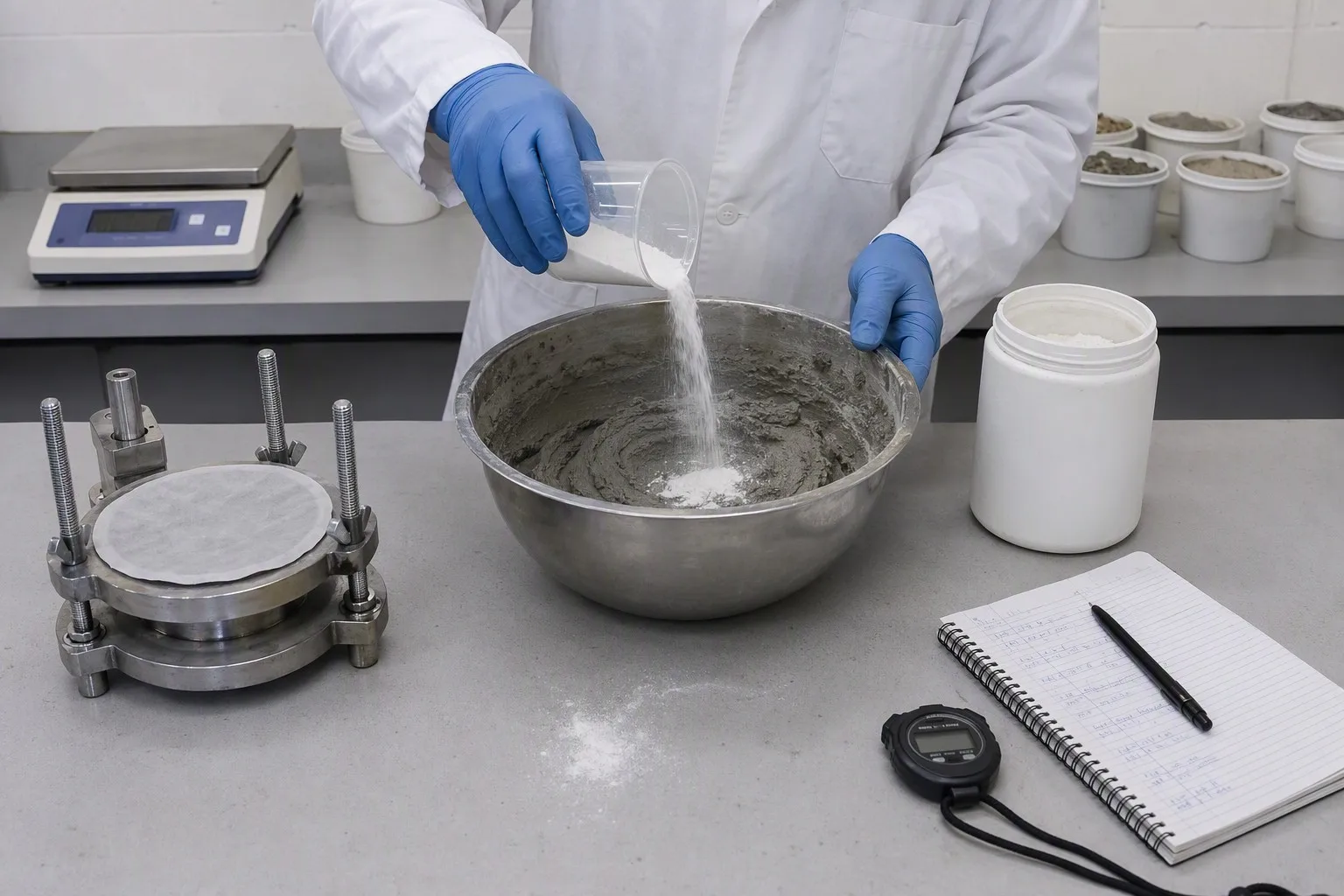
Hydroxypropyl methylcellulose dissolves in the mixing water and increases the viscosity of the aqueous phase.7 Its water-retention effect can reduce rapid suction into porous substrates and slow moisture migration to the exposed surface.8
This retained water supports two important processes:
- It gives the cement more opportunity to hydrate.9
- It helps the combed adhesive remain capable of wetting the tile for longer.
Our construction-grade HPMC is manufactured with a reported water-retention level above 95% under our specified internal test conditions. I present that figure as manufacturer-controlled quality data, not as a guarantee of a particular open time in every tile adhesive. Buyers should request the test method, formulation, temperature, humidity, substrate, and batch documentation before comparing such numbers.
Water Retention and Viscosity Are Related but Not Interchangeable
A common purchasing mistake is to select a grade only by its viscosity label. Nominal viscosity is useful, but it does not fully describe application behavior.
The following properties can also matter:
- Degree and pattern of chemical substitution
- Particle size and dissolution rate
- Gel temperature behavior
- Moisture and ash content
- Consistency between production batches
- Interaction with cement and other additives
- Effective water retention in the buyer’s formulation
Two HPMC grades can have similar viscosity results in a standard solution yet produce different troweling, wetting, and hot-climate performance in mortar. Test concentration, spindle, speed, temperature, and equipment also affect viscosity values.10 Buyers should never compare supplier data without checking these conditions.
| Evaluation item | What it can indicate | What it cannot prove alone |
|---|---|---|
| Solution viscosity | General thickening range | Finished adhesive open time |
| Water-retention result | Ability to limit water loss in a defined test | Performance on every substrate |
| Moisture content | Storage and quality-control status | Application suitability |
| Ash content | Product purity and process consistency | Bond strength |
| Open-time test | Performance under stated conditions | Universal performance in all climates |
| Batch certificate | Conformity of the supplied lot | Suitability without formulation trials |
Higher Dosage Is Not Always Better
Increasing HPMC can improve water retention in some systems, but excessive thickening may reduce ease of mixing or make the adhesive feel sticky. It can also affect tile wetting, ridge collapse, entrained air, and application speed.
I therefore do not prescribe one fixed viscosity or dosage for every formula. A practical trial should evaluate several connected properties:
- Mixing and lump formation
- Initial consistency
- Trowel drag
- Sag resistance
- Ridge stability
- Open time at planned intervals
- Tile transfer and wetting
- Adjustment time
- Adhesion after the specified curing period
- Performance after relevant conditioning
HPMC can be an important part of the solution, but this problem cannot be solved by additives alone. The contractor may still need to shade the work area, cool or prepare the substrate, spread smaller areas, and place tiles sooner.
HPMC Must Work With the Full Additive Package
Redispersible polymer powder, HPMC, starch ether, set regulators, and air-management additives can influence each other. For example, an HPMC change that improves apparent water retention may also alter mortar consistency. The formulator may then change the water level, which can affect strength, sag, and polymer film development.
I prefer controlled comparisons in which the team changes one major variable at a time. This method makes the result easier to interpret and reduces the chance of selecting a grade based on appearance alone.
How Should Buyers Select HPMC for Tile Adhesive Open Time in Hot Markets?
Buyers often receive viscosity values, certificates, and general claims from several suppliers. These documents help with screening, but they do not reproduce the buyer’s cement, climate, substrate, or mixing process. I recommend a staged evaluation that connects supplier quality control with application testing.
Buyers should select HPMC for hot-climate tile adhesive by comparing candidate grades in the intended formulation under representative temperature, humidity, airflow, substrate, and application conditions. They should evaluate water retention, open time, tile transfer, workability, sag resistance, adhesion, and batch consistency instead of choosing by viscosity or price alone.
Start With a Clear Performance Brief
I can recommend a more relevant sample when a buyer provides specific operating information. A useful brief should include:
- Target market and seasonal temperature range
- Expected relative humidity
- Indoor or outdoor application
- Typical airflow or wind exposure
- Cement type and source
- Filler and sand grading
- Polymer powder and other additives
- Current HPMC grade and dosage
- Mixing-water range
- Target standard or customer specification
- Tile type, size, and absorption
- Substrate type and absorption
- Existing complaint, such as skinning or poor transfer
Without this information, a supplier may offer a grade that creates the desired laboratory viscosity but does not solve the real installation risk.
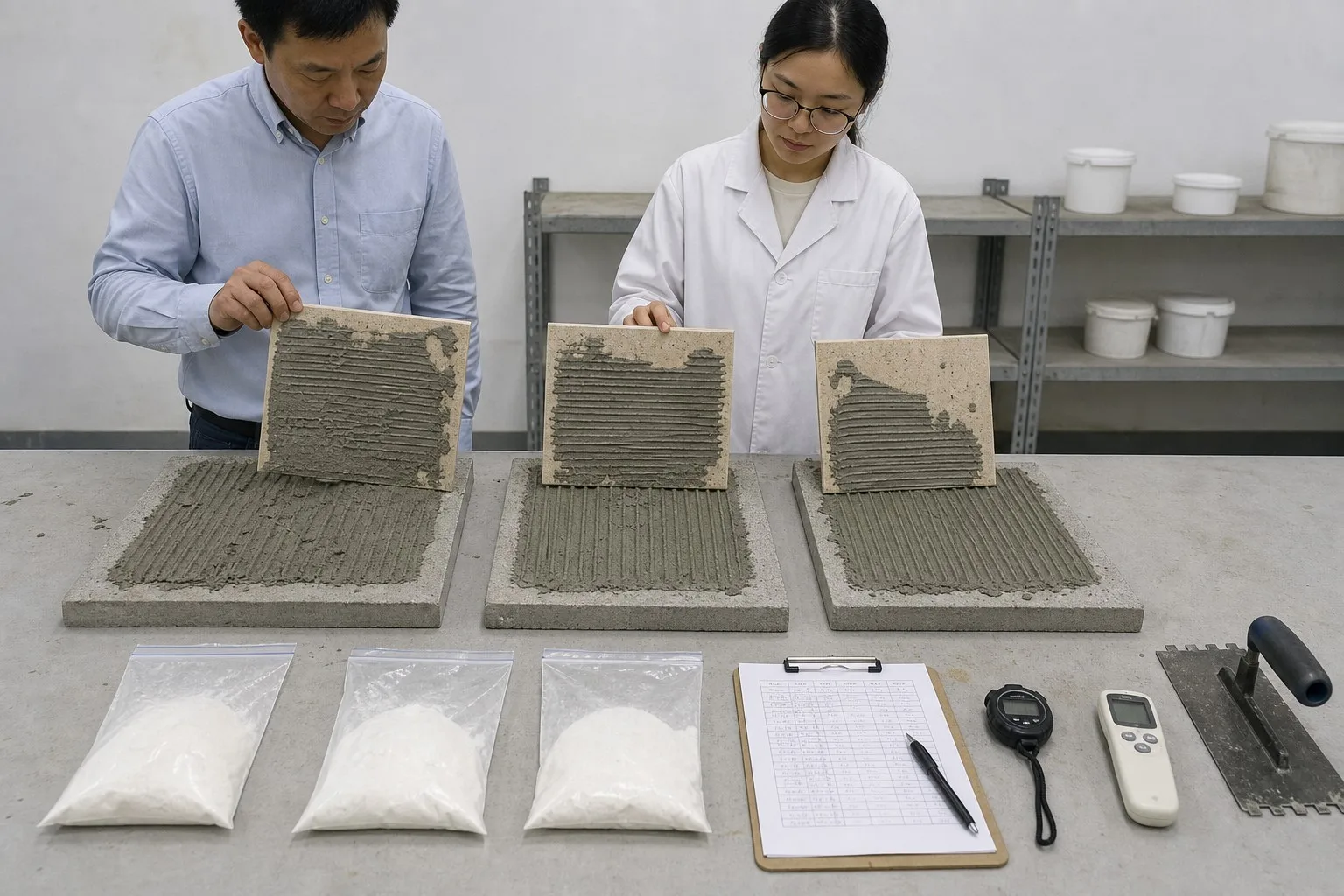
Use Side-by-Side Testing
I recommend testing the current HPMC against two or more candidate grades while keeping the base formulation stable. The team should record all relevant conditions rather than describing the trial only as “hot.”
A basic comparison sheet can include:
| Test variable | Control | Candidate A | Candidate B |
|---|---|---|---|
| HPMC dosage | Recorded | Recorded | Recorded |
| Water demand | Recorded | Recorded | Recorded |
| Air temperature | Same | Same | Same |
| Substrate temperature | Same | Same | Same |
| Relative humidity | Same | Same | Same |
| Airflow | Same | Same | Same |
| Trowel notch | Same | Same | Same |
| Open-time intervals | Same | Same | Same |
| Tile transfer | Measured | Measured | Measured |
| Sag/slip | Measured | Measured | Measured |
| Adhesion | Tested | Tested | Tested |
The trial should include a normal reference climate and a representative high-temperature condition when the equipment and applicable method allow it. A qualified laboratory or technical professional should define application-specific acceptance criteria.
Where relevant, buyers may use methods associated with standards such as EN 12004 and EN 1346, or other applicable national standards. They should verify the current standard edition, conditioning requirements, tile type, substrate, test timing, and pass criteria. A supplier’s internal screening test should not be presented as third-party certification.
Review Supplier Quality Controls
A successful sample does not guarantee that later shipments will behave the same way. I advise buyers to examine the manufacturer’s process controls and lot documentation.
At Jinghong Chemical, our automated production lines and professional laboratory test each batch for:
- Viscosity
- Water retention
- Moisture
- Ash content
We use these checks to support batch-to-batch consistency. Buyers should still verify our certificates and conduct incoming quality control based on their own risk level.
A useful supplier audit should also cover:
- Raw-material traceability
- Sampling procedure
- Test equipment and calibration
- Retained sample policy
- Change-control process
- Production capacity
- Packaging and moisture protection
- Lead time and export documentation
- Complaint handling and technical support
A certificate is a document to verify, not a substitute for application testing.
Evaluate Total Formulation Cost
A lower HPMC price per kilogram may not produce the lowest tile adhesive cost. A grade that requires higher dosage, increases water demand, slows production, or causes complaints can be more expensive overall.
I compare candidates by:
- Cost per metric ton of finished adhesive
- Required dosage
- Water demand
- Mixing efficiency
- Application productivity
- Rework and complaint risk
- Batch consistency
- Technical support
- Delivery reliability
This procurement approach links price to performance and supply risk. It also prevents a team from approving a sample that works once but lacks dependable production consistency.
What Site Measures Help Protect Tile Adhesive Open Time?
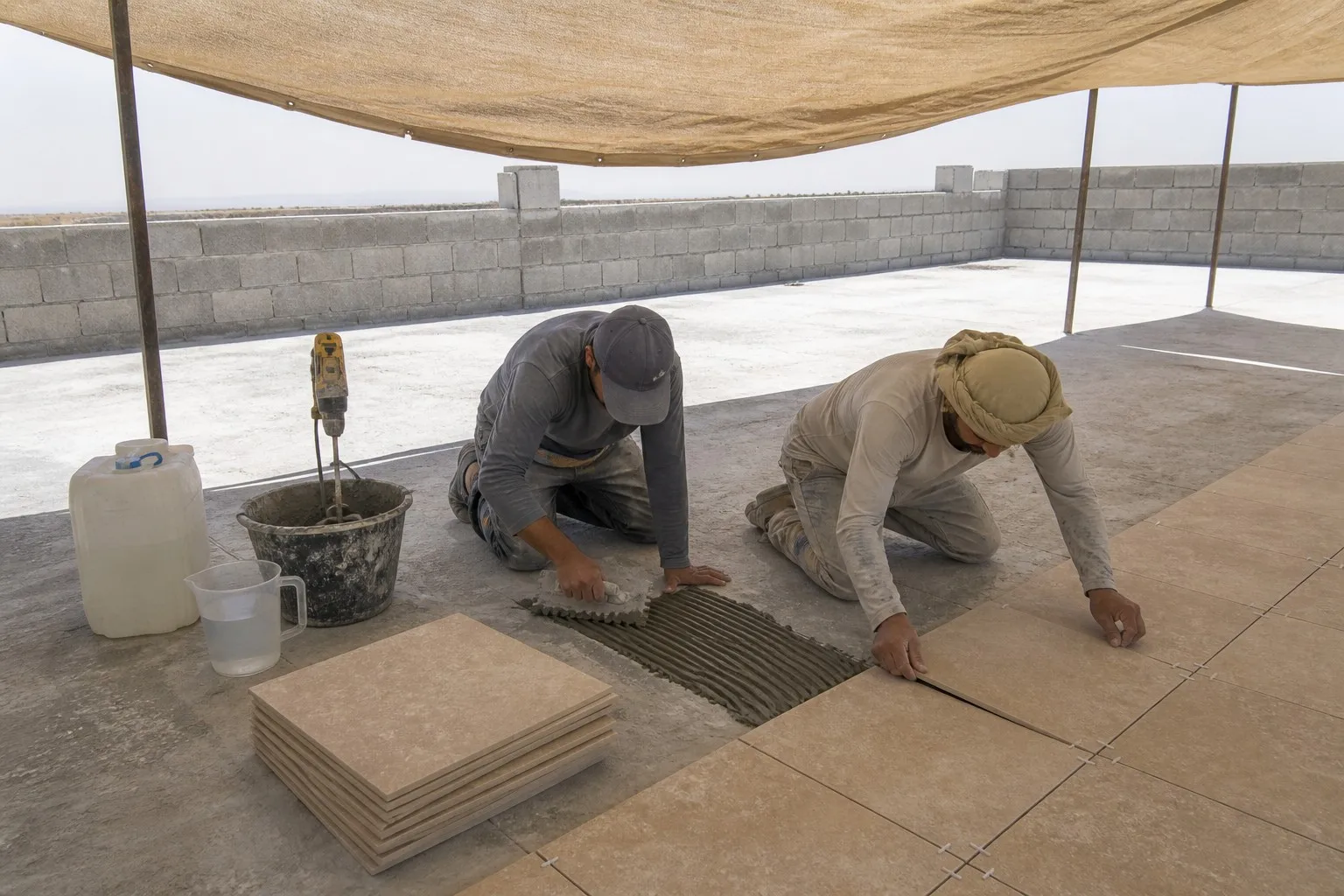
Even a well-designed formulation can fail when installers spread too much material on a sun-heated surface or wait too long before placing tiles. I treat site practice as part of performance control because HPMC cannot remove the effects of unlimited heat, airflow, absorption, or delay.
Contractors can protect tile adhesive open time by shading and preparing the substrate, following the specified water ratio, mixing correctly, spreading smaller areas, placing tiles promptly, and checking adhesive transfer. They should avoid application outside the manufacturer’s stated climate limits and seek project-specific guidance for severe conditions.
Control the Substrate Before Mixing
A substrate can be much hotter than the surrounding air. Direct sunlight can heat concrete, screed, render, and masonry surfaces, which then accelerate water loss from the adhesive.
The project team should consider these controls:
- Shade the work area where practical.
- Schedule work during cooler periods.
- Measure substrate temperature rather than relying only on air temperature.
- Remove dust, laitance, oil, and loose material.
- Assess substrate absorption.
- Use an approved preparation or primer when the system requires it.
- Follow the adhesive manufacturer’s instructions for dampening, if permitted.
Installers should not add uncontrolled surface water. Standing water can interfere with adhesion, while an unsuitable primer can create another weak interface. A qualified project professional should determine the correct preparation for the substrate and adhesive system.
Follow the Water Ratio and Mixing Procedure
Crews sometimes add extra water to make a hot mortar feel easier to spread. This adjustment may temporarily improve flow, but it can alter sag resistance, strength, curing, and polymer performance.
The installer should:
- Measure clean water accurately.
- Add powder and water in the specified order.
- Mix for the stated time.
- Allow the required maturation or resting period.
- Remix without adding unapproved extra water.
- Use the mortar within its stated pot life.
- Never restore partially set mortar by adding more water.
Correct mixing also helps HPMC dissolve and distribute consistently. Poor mixing can produce lumps, uneven thickening, and misleading assessments of the selected cellulose ether.
Spread Only an Installable Area
A large combed area may look efficient, but it exposes more adhesive to heat and air. Installers should spread only as much material as they can cover within the verified installation window.
I recommend a simple on-site sequence:
- Spread and comb a controlled area.
- Place the tile promptly.
- Move the tile as required to collapse the ridges.
- Lift occasional tiles to inspect transfer.
- Reduce the spread area if the surface becomes dull or skinned.
- Remove and replace skinned adhesive rather than wetting or reworking its surface.
Large-format tiles, textured tile backs, external work, and high-load areas may require additional measures such as back-buttering. The installer should follow the adhesive supplier’s instructions and the applicable installation standard.
Treat Site Feedback as Evidence, Not Proof
Customer-supplied site feedback can reveal useful patterns. For example, repeated reports of poor transfer during afternoon work but acceptable performance during morning application may point toward climate exposure. However, that pattern does not prove that heat is the only cause.
I ask for:
- Site photographs
- Batch numbers
- Mixing-water records
- Air and substrate temperatures
- Relative humidity
- Application time
- Trowel size
- Tile and substrate details
- Time between combing and placement
- Coverage observations
- Curing conditions
I then compare those records with retained samples and controlled internal tests where possible. I label the sources clearly. Our laboratory findings are internal manufacturer data. Customer reports are customer-supplied evidence. Independent laboratory results remain third-party evidence only when the laboratory and method are identified.
The final remedy may include an HPMC adjustment, a polymer or filler change, a revised water level, improved substrate preparation, smaller spread areas, or different work scheduling. In hot climates, the safest conclusion is usually that formulation and site controls must work together.
Frequently Asked Questions
How can an installer tell whether tile adhesive has lost open time?
An installer can place and press a tile, lift it promptly, and inspect how well the adhesive has transferred to the tile back. Dry ridge tops, poor wetting, or limited ridge collapse can indicate skinning. Formal acceptance should still follow the applicable standard, project specification, and qualified technical guidance.
Can a higher-viscosity HPMC always extend open time?
No. Higher viscosity may change consistency and water retention, but it does not automatically produce longer open time. HPMC chemistry, dosage, dissolution, cement type, filler grading, polymer additives, water demand, substrate absorption, temperature, humidity, and airflow all affect the final result.
Can pot life remain acceptable when open time is too short?
Yes. The mortar in the bucket has much less surface exposed to air than combed adhesive. It may remain workable while the thin surface of the applied ridges loses moisture, forms a skin, and becomes unable to wet the tile adequately.
What documents should an HPMC buyer request?
I recommend requesting a technical data sheet, safety data sheet, certificate of analysis, viscosity test conditions, water-retention method, moisture and ash results, batch traceability information, and available compliance documents. Buyers should verify these records and confirm performance through formulation trials and incoming quality control.
Should a buyer test HPMC at the hottest expected temperature?
A buyer should test representative operating conditions, including realistic temperature, humidity, airflow, substrate, and application method. An extreme-temperature test alone may not represent normal use. A qualified laboratory or formulation professional should define the test matrix and acceptance criteria for the target market.
Conclusion
Tile adhesive open time in hot climates depends on far more than HPMC viscosity. Heat, humidity, wind, substrate absorption, formulation design, mixing, spread area, and tile-placement timing all affect skinning and transfer. HPMC can improve water retention and working behavior, but additives alone cannot solve every hot-weather problem. Buyers should compare grades under disclosed, representative conditions and verify supplier batch controls.
For a free HPMC sample suited to your hot-climate market, send us your formulation, target viscosity, substrate, and expected climate conditions at hpmc@jinghonghpmc.com or WhatsApp +86 157 3315 6958.
<!-- JH_HPMC_APPLICATION_LINKS_START --><p class="jh-related-applications"><strong>Related HPMC applications:</strong> For climate-specific guidance on tile installation, review our <a href="https://jinghonghpmc.com/hpmc-for-tile-adhesive/">HPMC for tile adhesive</a> and <a href="https://jinghonghpmc.com/hpmc-for-hot-humid-climates/">HPMC for hot and humid climates</a> application pages.</p><!-- JH_HPMC_APPLICATION_LINKS_END -->
"Moisture induced length changes of tile adhesive mortars ...", https://www.academia.edu/30896597/Moisture_induced_length_changes_of_tile_adhesive_mortars_and_their_impact_on_adhesion_strength. Studies and standardized adhesive test methods recognize that water loss from fresh cementitious tile adhesives is affected by exposure conditions and substrate characteristics, with consequences for the adhesive's usable open time. Evidence role: mechanism; source type: paper. Supports: Environmental drying conditions and absorbent substrates can remove water from fresh cementitious adhesive, reducing the period in which the adhesive surface can achieve adequate tile contact.. Scope note: The magnitude of the effect depends on the particular mortar formulation, bed thickness, substrate, and test or site conditions. ↩
"Shelf life, Pot life and Open time for dry-mix mortar & tile ...", https://www.linkedin.com/pulse/shelf-life-pot-open-time-dry-mix-mortar-tile-adhesive-joe-chow-uvjrc. Technical terminology for cementitious adhesives defines pot life as the period during which a mixed product remains usable in the container under specified conditions. Evidence role: definition; source type: institution. Supports: Pot life denotes the usable working period of a prepared adhesive or mortar in its mixing container.. ↩
"Assessment of Cementitious Ceramic Tile Adhesives in ... - PMC", https://pmc.ncbi.nlm.nih.gov/articles/PMC10301792/. Standards for ceramic-tile adhesives describe open time as the interval after application during which the adhesive retains the capacity to form an adequate bond with the tile. Evidence role: definition; source type: institution. Supports: Open time is assessed after adhesive application and concerns the period during which a tile can still be placed with adequate adhesion.. Scope note: Exact definitions, test assemblies, and acceptance thresholds vary by the applicable standard edition and product classification. ↩
"Assessment of Cementitious Ceramic Tile Adhesives in ... - PMC", https://pmc.ncbi.nlm.nih.gov/articles/PMC10301792/. Ceramic-tile adhesive standards distinguish adjustment time from open time by evaluating the permissible period for repositioning a tile after it has been placed. Evidence role: definition; source type: institution. Supports: Adjustment time concerns the period after tile placement during which repositioning is possible without unacceptable adhesion loss.. Scope note: The applicable measurement procedure and pass criterion must be confirmed in the governing standard or project specification. ↩
"Evaporation Rate Of Volatile Liquids.", https://nepis.epa.gov/Exe/ZyPURL.cgi?Dockey=94003M8L.TXT. Mass-transfer principles show that evaporation occurs at exposed interfaces; increasing the exposed area of a wet material can therefore increase its opportunity for moisture loss. Evidence role: mechanism; source type: education. Supports: For otherwise similar conditions, a larger exposed liquid surface promotes greater evaporative mass transfer than a smaller exposed surface.. Scope note: This general physical principle does not quantify drying rates for a specific combed tile adhesive, whose behavior also depends on airflow, humidity, and formulation. ↩
"Assessment of Cementitious Ceramic Tile Adhesives in ... - PMC", https://pmc.ncbi.nlm.nih.gov/articles/PMC10301792/. Open-time adhesion testing of cementitious tile adhesives evaluates whether a tile placed after a defined delay can still achieve adequate tensile adhesion, reflecting the importance of maintained surface contact and wetting before curing. Evidence role: mechanism; source type: paper. Supports: Loss of surface workability during the open-time interval can impair contact between tile and adhesive and is associated with reduced measured adhesion.. Scope note: Later bond strength is also affected by substrate preparation, tile characteristics, curing, adhesive composition, and installation technique. ↩
"Hydroxypropyl Methylcellulose—A Key Excipient in ... - PMC", https://pmc.ncbi.nlm.nih.gov/articles/PMC12196896/. Reference sources describe hydroxypropyl methylcellulose as a cellulose ether that dissolves or disperses in water to form solutions with viscosity dependent on polymer grade and concentration. Evidence role: mechanism; source type: encyclopedia. Supports: Hydroxypropyl methylcellulose is a water-soluble cellulose derivative that forms viscous aqueous solutions.. Scope note: Solution viscosity does not by itself predict the rheology or open time of a cementitious adhesive containing aggregates, cement, and other additives. ↩
"Water Retention Mechanism of HPMC in Cement Mortar - PMC", https://pmc.ncbi.nlm.nih.gov/articles/PMC7372461/. Research on cellulose ethers in cementitious mortars reports that these polymers modify pore-solution rheology and water transport, contributing to improved water retention in fresh mortar. Evidence role: mechanism; source type: paper. Supports: Cellulose ethers used in cement-based mortars can increase water retention and modify water transport, including water loss to absorbent substrates.. Scope note: The resulting open-time improvement is formulation-specific and may not be proportional to HPMC dosage or solution viscosity. ↩
"HYDRATION OF PORTLAND CEMENT", https://www.nist.gov/document/b97002pdf. Cement-hydration research establishes that adequate moisture availability is necessary for continued hydration, making water retention relevant to the early development of cementitious mortar. Evidence role: mechanism; source type: research. Supports: Cement hydration requires available water, and premature moisture loss can affect hydration development in cement-based materials.. Scope note: Water retention alone does not guarantee improved hydration or strength, because cement composition, water-to-cement ratio, temperature, and curing history also govern hydration. ↩
"State‐Of‐The‐Art Quantification of Polymer Solution Viscosity ...", https://pmc.ncbi.nlm.nih.gov/articles/PMC8519067/. Viscosity-measurement guidance specifies temperature control and instrument operating conditions because reported viscosity values depend on the measurement method and the material's rheological response. Evidence role: mechanism; source type: institution. Supports: Rotational-viscosity measurements are conditional on test parameters, including temperature, instrument configuration, and rotational speed or shear rate.. Scope note: Comparable test conditions improve comparison of solution-viscosity data but do not establish equivalence of finished tile-adhesive performance. ↩