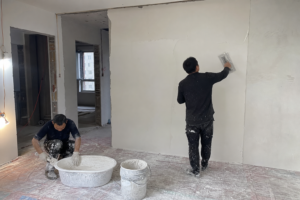
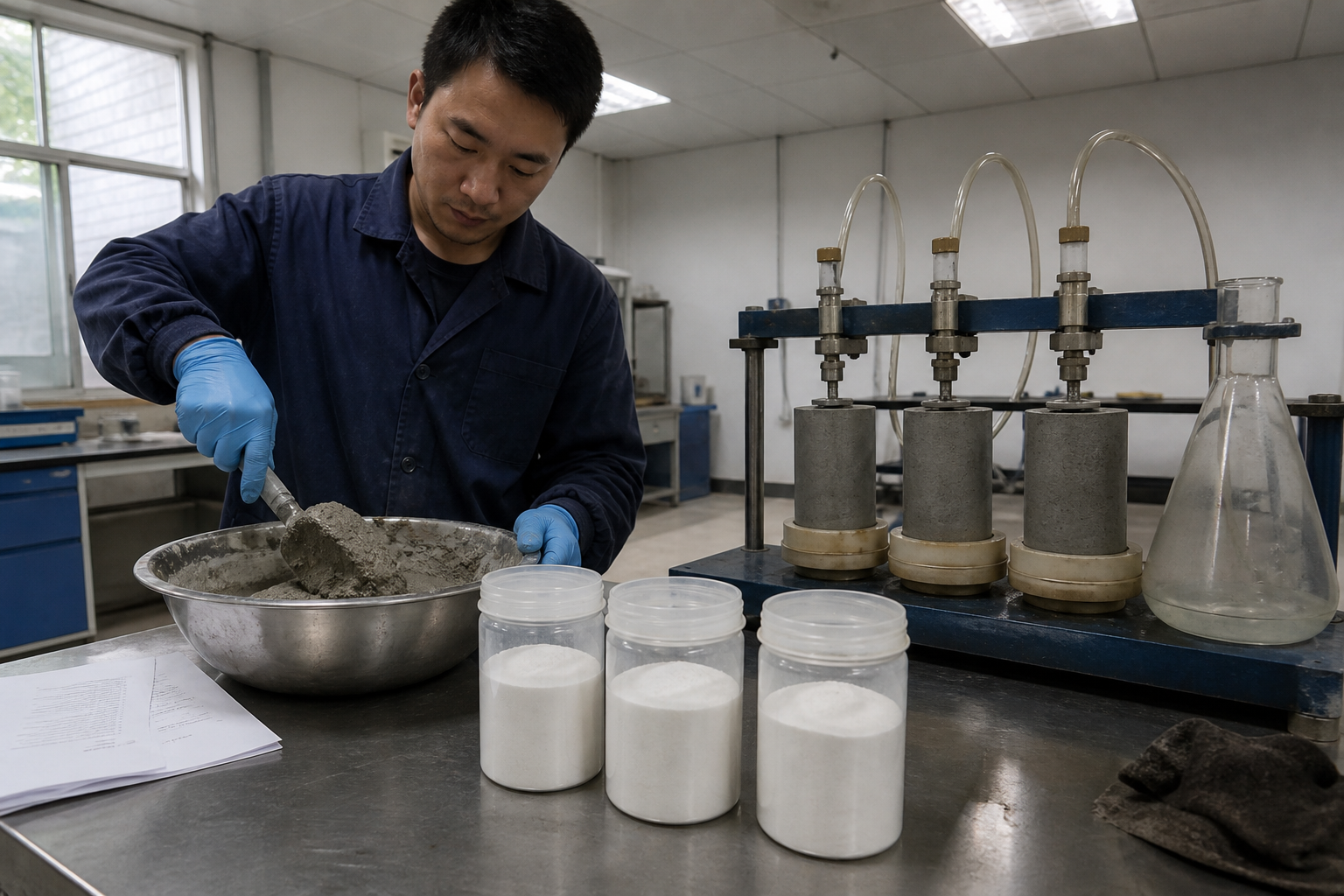
When I receive two HPMC water-retention results from different laboratories, the larger number can look like the obvious purchasing signal. That shortcut is the problem. A reported percentage is not an intrinsic, method-free property of an HPMC sample; it is the outcome of a defined formulation, preparation procedure, conditioning history, suction system, timing rule, equipment set, and calculation.
The risk is practical as well as statistical. If buyers rank suppliers before aligning those variables, they may reject a suitable material, approve the wrong one, or spend weeks investigating a difference created by the laboratories themselves. My approach is simple: I first make the methods comparable, then interpret the laboratory result alongside application performance. This article explains the five controls I use to turn isolated numbers into decision-quality evidence.
1. Why Must I Lock the Mortar or Plaster Formula and Substrate First?
Problem: A laboratory may describe a test only as “HPMC water retention,” leaving the binder, aggregate grading, fillers, other additives, and substrate unspecified. Those variables control water demand and water movement. If they change between laboratories, I cannot tell whether the reported difference belongs to the HPMC or to the test system.
Answer: I compare HPMC water-retention results only after both laboratories use the same mortar or plaster recipe, raw-material lots where practical, and a defined substrate or suction condition. Binder chemistry, aggregate grading, fillers, co-additives, and substrate absorption all affect water movement, so an unmatched matrix makes supplier rankings technically unreliable.
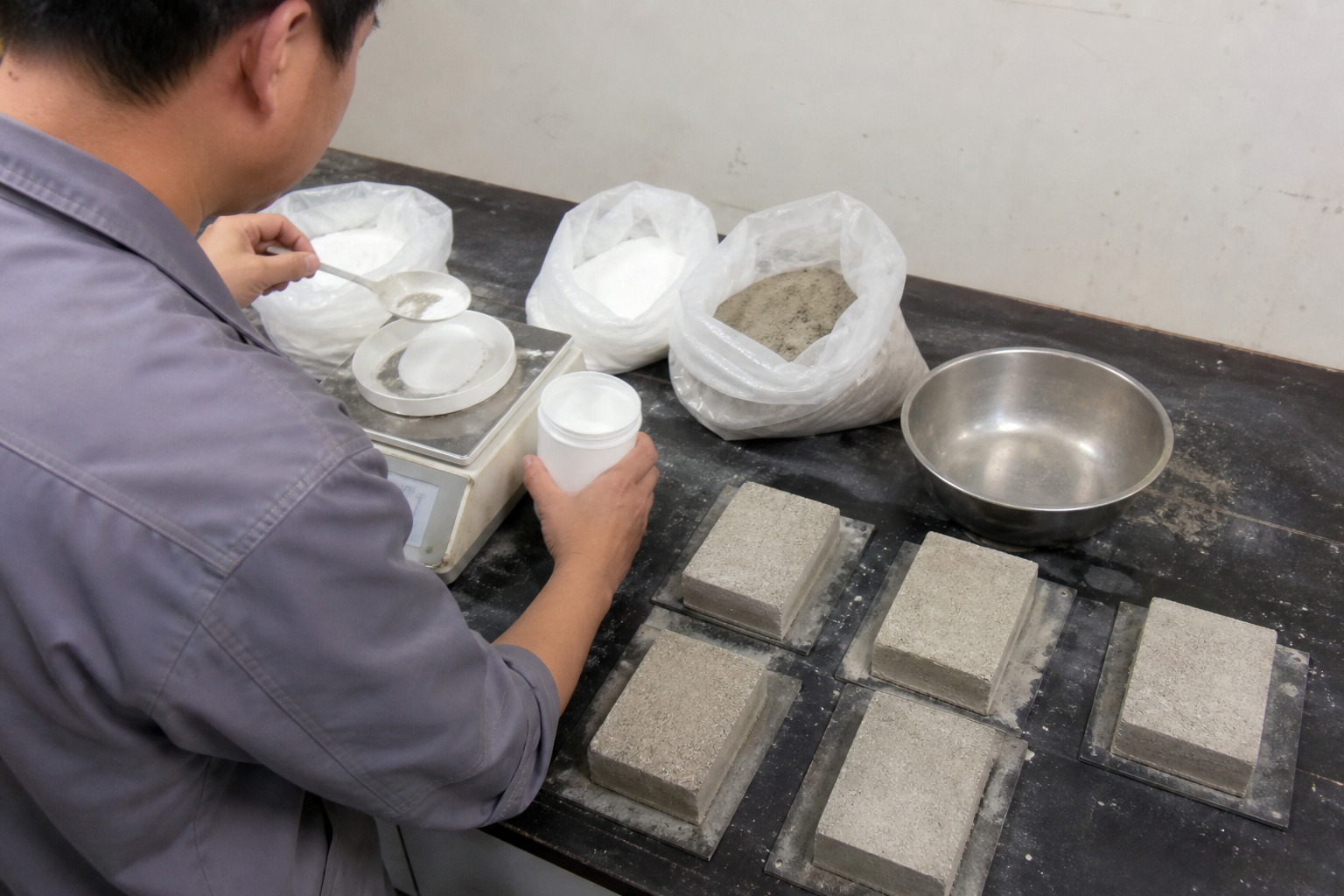
Solution: I begin with a controlled comparison sheet, not with the reported percentage. It identifies the intended product—such as a cement mortar or plaster—and records every dry component by mass basis, including binder, aggregate, mineral filler, polymer, starch ether, defoamer, retarder, and any other functional additive. I also record supplier, grade, and lot for each raw material. If identical lots cannot be shared, I ask both laboratories to homogenize and split a common master dry mix.
Next, I define the receiving surface. A porous board, masonry unit, filter medium, and suction apparatus do not remove water in the same way. Even nominally similar boards can differ through density, moisture history, surface treatment, and reuse. I therefore specify material, face orientation, conditioning, pre-treatment, and whether each specimen is new. For direct supplier screening, I prefer a common reference medium; for application confirmation, I add the buyer’s actual substrate as a separate trial.
This distinction matters because ASTM C1506-24 addresses hydraulic cement-based mortars and plasters under suction and explicitly warns that laboratory retention does not necessarily represent absorption by masonry units or an existing plaster coat.[1] I do not present that standard as an HPMC specification. I use its scope and cautions to reinforce a broader rule: define the complete system before comparing results.
Buyers who need mechanism context can review how HPMC improves water retention. For sourcing decisions, I still insist that the comparison formula and substrate be frozen in the written protocol.
2. Why Must HPMC Addition, Dosage, Water, and Mixing Match?
Problem: Two laboratories may use the same ingredient list yet prepare it differently. One may pre-disperse HPMC in water while another adds it through a dry blend. Differences in addition order, dosage basis, water quantity, mixer geometry, mixing energy, or scraping can change dispersion and hydration before testing begins.
Answer: I require both laboratories to use the same HPMC addition route, dosage basis, water quantity, ingredient order, mixer, mixing stages, and scraping procedure. HPMC hydration depends on how the material is dispersed and wetted; therefore, a solution-based preparation and a dry-mix preparation cannot support a direct numerical comparison unless equivalence is demonstrated.
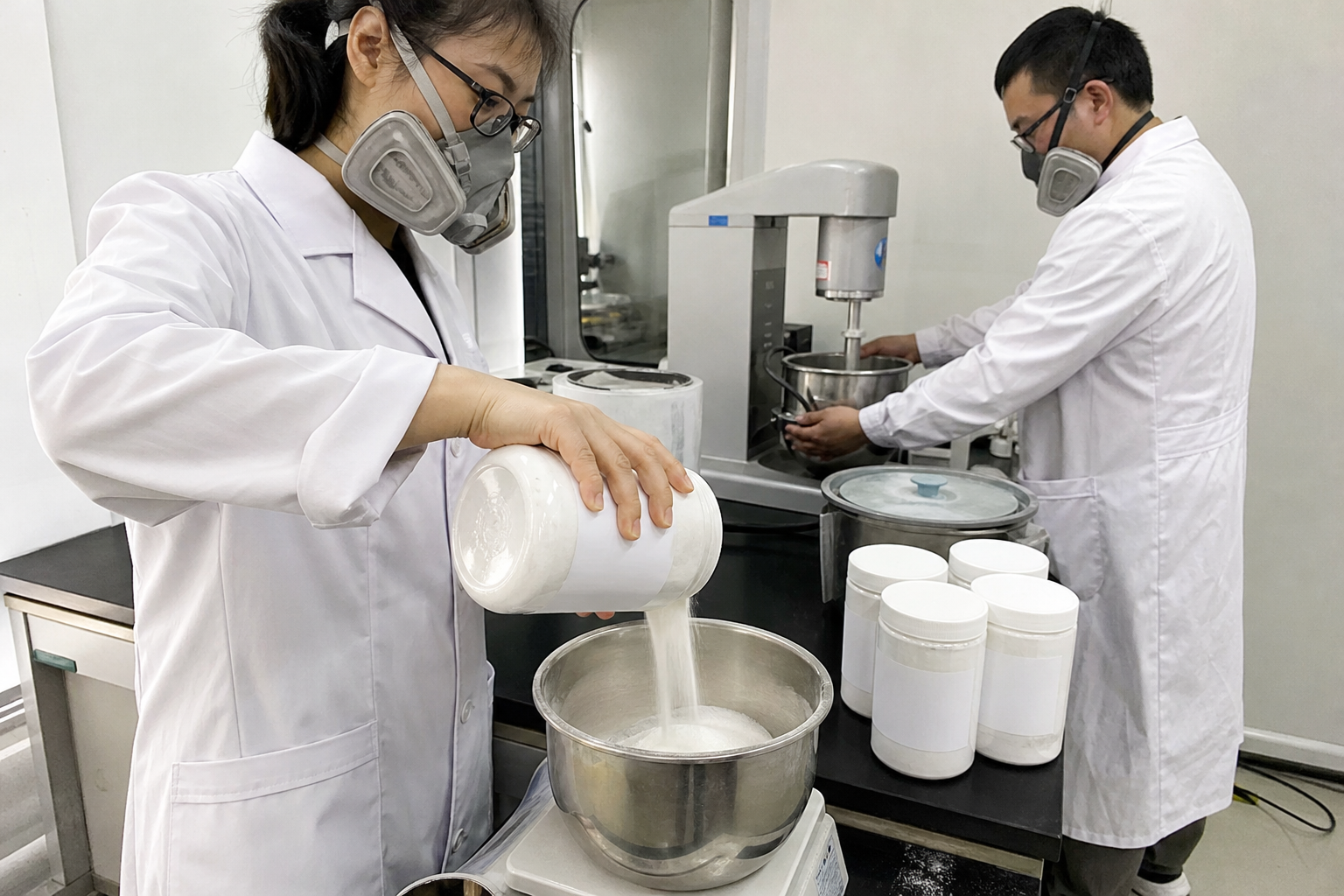
Solution: I write the preparation sequence as an executable procedure. The document states whether the test uses an HPMC solution or a dry blend. For a solution route, it defines the water allocation, addition order, dispersion and hydration endpoint, vessel, agitation device, and transfer practice. For a dry-mix route, it defines pre-blending, the point at which HPMC enters the mix, dry blending, water addition, wet mixing, bowl scraping, resting, and remixing. I never silently convert one route into the other.
Dosage also needs a shared basis. I state exactly what mass the HPMC fraction is referenced to and whether moisture corrections apply. The same discipline applies to water: I distinguish total water charged from water already carried by damp raw materials or a prepared solution. Rather than adjusting water by feel, each laboratory follows the agreed quantity or an agreed consistency-control procedure and records any permitted adjustment.
Equipment details matter because a different bowl shape, blade, batch size, speed setting, or operator scraping pattern can produce different dispersion and entrained air. I use equipment identifiers and a stepwise sequence that operators can reproduce. I also ask for observations of lumping, wall deposits, incomplete wetting, or unusual temperature rise instead of treating the mixer as a black box.
My general HPMC product overview describes the material as a white or almost-white ultrafine powder, but appearance does not prove dispersion in a wet formulation. The more relevant procurement question is whether each sample was incorporated identically. For application-focused screening, the HPMC for dry-mix mortar page helps frame the intended system, while the signed comparison protocol governs the laboratory work.
3. Why Must Consistency, Air, Resting, and Test Timing Be Controlled?
Problem: Fresh mortar continues changing after water meets the dry mix. HPMC hydrates, air can be incorporated or released, particles wet out, and consistency evolves. If laboratories test at different fresh consistencies or at different points after mixing, the specimens reaching the retention apparatus are not in the same state.
Answer: I align initial consistency, fresh air content where relevant, resting and remixing steps, specimen filling, and elapsed time from water contact to measurement. These controls define the fresh state presented to the apparatus. Without them, a water-retention difference may reflect maturation, aeration, density, or handling rather than a meaningful difference between HPMC samples.
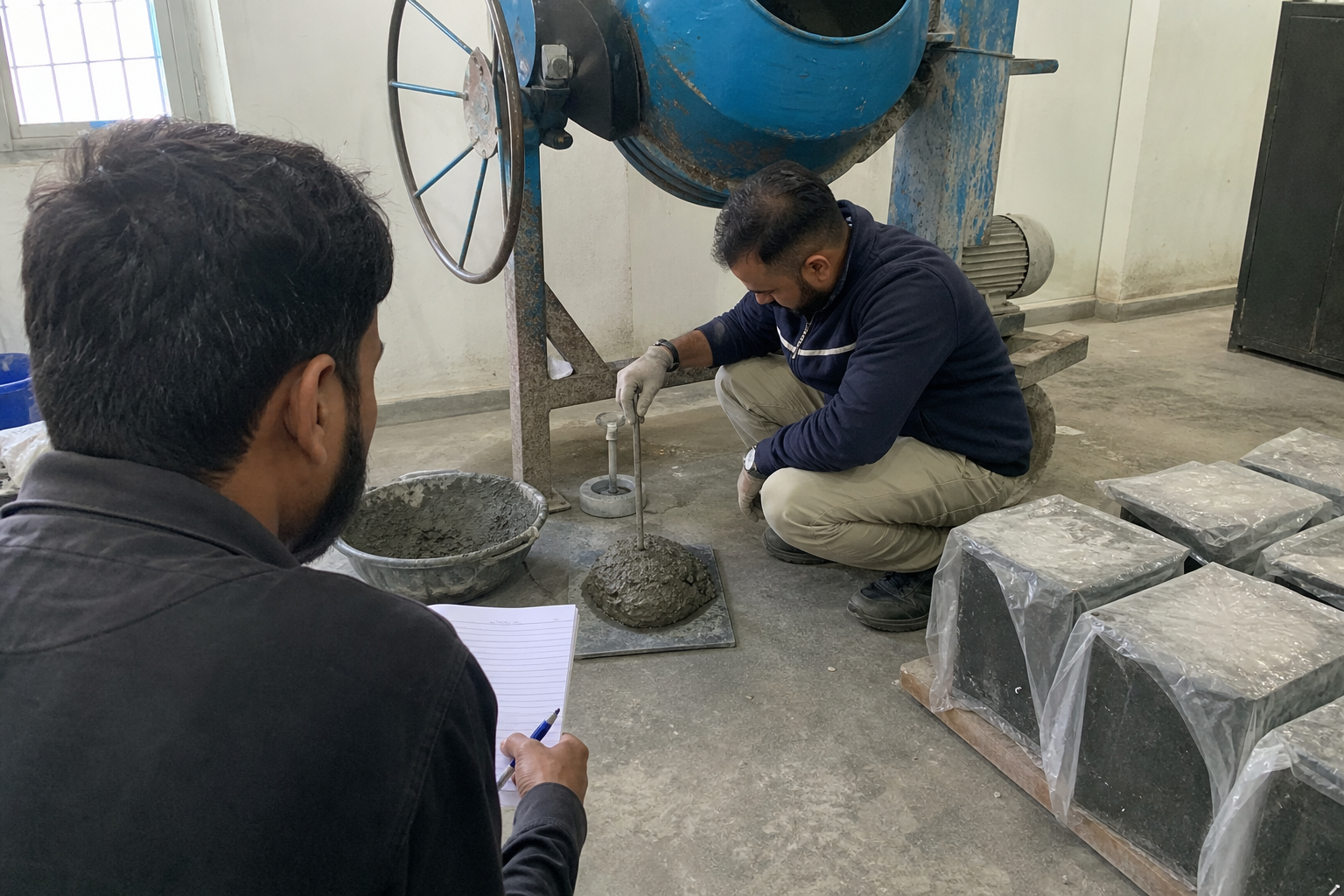
Solution: I put a timing map beside the mixing procedure. Its reference point is the first contact between water and dry material. From there, the protocol identifies mixing stages, any rest, remixing, consistency measurement, air assessment, specimen placement, surface finishing, and initiation of the retention test. Operators record actual timestamps rather than writing “tested promptly.”
Consistency is not merely a convenience check. It affects specimen structure and the way water responds to suction. I specify the consistency method, equipment, specimen preparation, and acceptance rule chosen for the product. If water may be adjusted to reach a target consistency, that rule is agreed before samples are unblinded, and both the final water amount and resulting consistency are reported.
Where entrained air is relevant, I use the same fresh-air method and record density as a supporting diagnostic. Air changes the volume and structure of fresh mortar; it can also reveal differences caused by mixing or additive interactions. I do not automatically “correct” a retention result for air unless the selected method requires it. Instead, I use air and density data to decide whether the specimens were truly comparable.
Resting and remixing receive the same control. A rest period can allow hydration and viscosity development, while remixing can redistribute liquid and alter air. Sample filling, compaction, strike-off, and handling should be scripted so operators do not impose different shear histories.
These controls reflect the wider principle behind ISO/IEC 17025: competent laboratories need controlled methods and valid results.[2] For incoming checks before comparative application work, I also use a documented HPMC receiving-inspection checklist to protect sample identity and traceability.
4. Why Must the Suction Medium, Apparatus, and Calculation Be Identical?
Problem: “Water retention” can describe fundamentally different measurement principles. A filter or absorbent medium removes liquid by contact, while a vacuum apparatus imposes controlled suction; other procedures infer retention from flow or direct water loss. Results can differ even when the same mortar is used because the measurand itself changes.
Answer: I compare numbers only when the laboratories match the test principle, absorbent medium, suction or vacuum condition, apparatus geometry, specimen preparation, timing, weighing practice, and calculation equation. The method name and edition must accompany every result. A percentage without that metadata is an isolated output, not evidence for ranking HPMC suppliers.
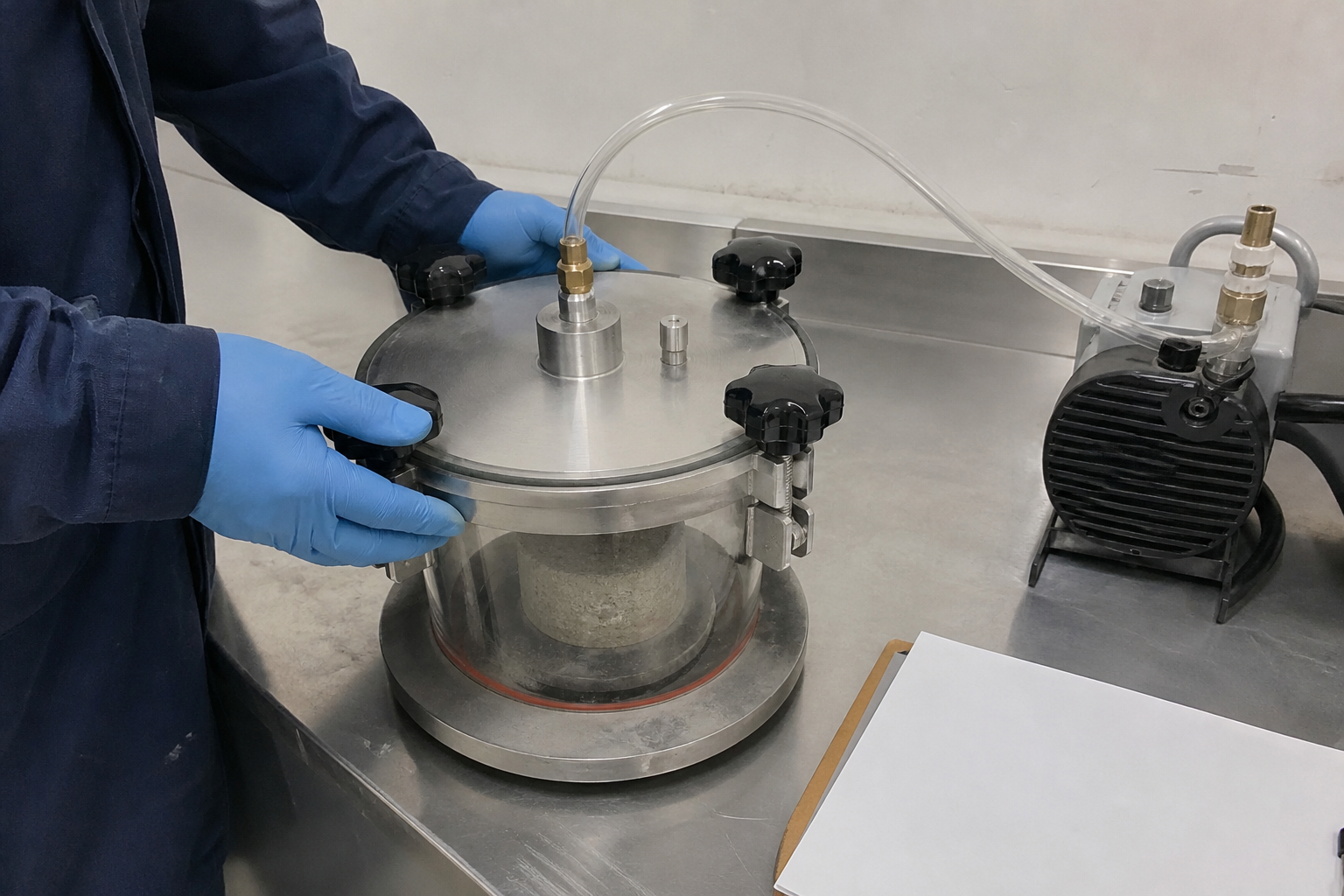
Solution: I ask each laboratory for its controlled test method before reviewing results. The protocol names the standard or internal method, edition, deviations, apparatus model or configuration, consumables, calibration or verification status, environmental conditioning, specimen dimensions, and calculation. A photograph of the setup can help identify differences, but it does not replace the written method.
For absorbent-media procedures, I define medium type, grade, dimensions, conditioning, orientation, number of layers if applicable, contact arrangement, and rules for handling or weighing. For vacuum or suction procedures, I define the pressure-control system, verification practice, seal check, specimen support, suction sequence, and apparatus cleaning. I do not transfer a limit established for one principle to another.
Calculation details deserve equal scrutiny. Laboratories should show raw observations, units, tare treatment, rounding, replicate handling, and the exact equation. I want individual replicate results, not only an average, because spread may expose poor sealing, inconsistent filling, variable media, or timing errors. Any invalid-result rule must be written before testing.
ASTM identifies C1506-24 as active and describes a value based on mortar flow under suction.[1] That is useful where its scope fits, but it is not a universal HPMC-only method. Likewise, ASTM C270-26 is currently listed as an active specification for unit masonry mortar and illustrates why defined laboratory flow and scope matter; it is not an HPMC water-retention specification.[3]
When method metadata are missing, I pause the comparison and request them. The HPMC quality-testing guide provides a broader context, but only aligned apparatus and calculations make two retention numbers directly comparable.
5. How Do I Connect a Laboratory Result to Open Time and Field Validation?
Problem: Even a perfectly aligned retention test answers only a bounded laboratory question. Buyers may assume that the highest result automatically gives the longest open time, best workability, or strongest jobsite performance. That leap ignores rheology, air, binder chemistry, substrate absorption, weather, application thickness, and installer technique.
Answer: I use an aligned water-retention test to screen HPMC candidates, then verify consistency retention, workability, open time, wetting or transfer, and the relevant finished-property tests in the buyer’s formulation. I finish with controlled production and field validation. Laboratory retention supports a decision, but it does not replace application-specific evidence or define performance alone.
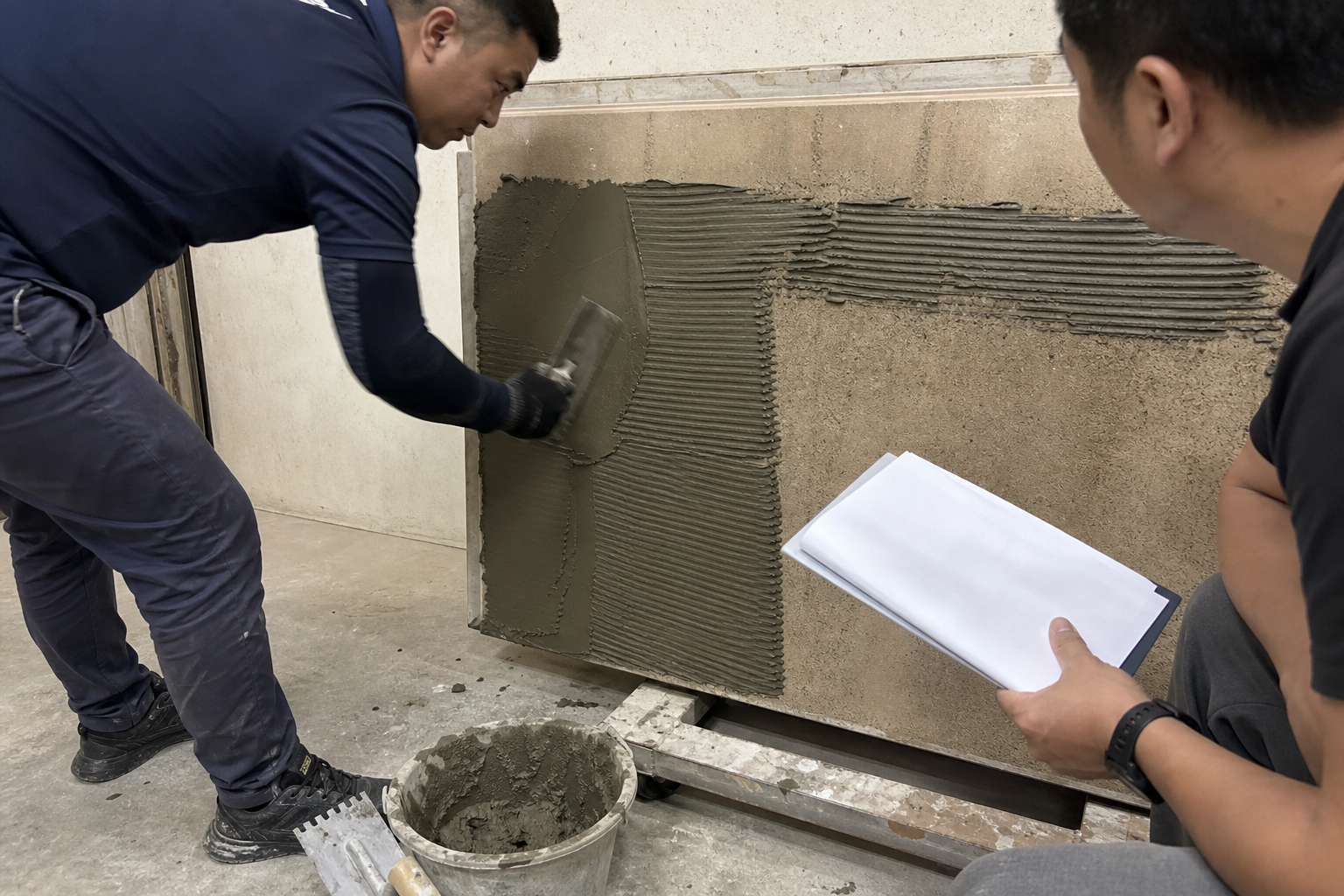
Solution: I build a staged evidence chain. First, the aligned retention method determines whether samples behave differently under one controlled water-removal condition. Second, I run application-relevant laboratory checks on the same formulation and conditioning basis. Depending on the product, these may include consistency development, trowel or finishing behavior, resistance to premature stiffening, open-time behavior, substrate wetting or adhesive transfer, sag, and relevant hardened performance.
I interpret relationships rather than assuming equivalence. Better retention under a selected method may support moisture availability, but it does not guarantee acceptable open time or application feel. A formulation can become difficult to spread, carry different air, or respond differently to a porous substrate even when its retention result looks favorable. I therefore keep retention, rheology, workability, and open time as separate response variables.
Third, I scale the shortlisted candidate through the buyer’s normal production process. That step checks whether raw-material feeding, dry blending, packaging, storage, and site mixing reproduce the laboratory behavior. Finally, I use a controlled field trial with documented substrate condition, weather, water addition, mixing, application method, layer geometry, and evaluation criteria. The scenario remains anonymous; the value lies in the process, not an unsupported success claim.
I also preserve samples, raw data, method revisions, equipment records, and decision criteria so a later complaint can be reconstructed. If the parties cannot align methods, I report the results as method-specific and decline to rank them on a single scale.
For buyers evaluating whether gel behavior may be another hidden variable, I keep it separate and follow the HPMC gel-temperature test method. To establish a matched retention protocol and application-validation plan, contact our technical team.
Frequently Asked Questions
1. Can I compare two HPMC water-retention percentages if both reports cite a standard?
Only after I confirm the same standard, edition, scope, deviations, formulation, preparation, conditioning, equipment, timing, and calculation. Merely citing a standard number does not prove that the execution or test matrix matched.
2. Is ASTM C1506-24 an HPMC specification?
No. It is a test method for water retention of hydraulic cement-based mortars and plasters. I may use it when its scope suits the tested system, but I do not treat it as a product specification for HPMC.
3. Should both laboratories adjust water to the same consistency?
That depends on the agreed comparison objective. I either fix water or use a pre-agreed consistency-control rule. I never let laboratories improvise different adjustments, and I always report both water input and measured fresh consistency.
4. Does the highest laboratory retention result identify the best HPMC?
No. I interpret retention with workability, air, open time, substrate interaction, and relevant finished performance. The best choice is the candidate that meets the buyer’s complete formulation and application requirements under controlled validation.
5. What should a buyer request with every retention result?
I request the method and edition, complete formula, raw-material identities, HPMC dosage basis, water, mixing and timing records, fresh-state data, substrate or suction details, apparatus and verification records, raw observations, replicates, equation, deviations, and operator traceability.
CTA: Turn Two Numbers into One Defensible Comparison
If your supplier and buyer laboratories report different HPMC water-retention values, do not debate the percentages in isolation. Send both method packages, the intended mortar or plaster formula, and the application target. I can help structure a matched protocol, identify uncontrolled variables, and define the laboratory-to-field validation sequence before your team makes a sourcing decision.
References
- ASTM International, “ASTM C1506-24, Standard Test Method for Water Retention of Hydraulic Cement-Based Mortars and Plasters.” The ASTM page lists this edition as active and limits its scope to hydraulic cement-based mortars and plasters; it is not an HPMC-specific specification. https://store.astm.org/c1506-24.html ↩
- International Organization for Standardization, “ISO/IEC 17025 — Testing and calibration laboratories.” The ISO page describes the standard as requirements supporting laboratory competence and valid results, not as a product test method. https://www.iso.org/ISO-IEC-17025-testing-and-calibration-laboratories.html ↩
- ASTM International, “ASTM C270-26, Standard Specification for Mortar for Unit Masonry.” The ASTM page listed the 2026 edition as active when checked; users should verify current status before contractual use. Its scope is unit masonry mortar, not HPMC. https://store.astm.org/c0270-26.html ↩