What is MHEC used for? If you are sourcing cellulose ethers for dry-mix mortars, tile adhesives, or putties, you have probably asked this question — and received vague answers. Buying the wrong grade wastes money and delays production. In this article, I will explain what MHEC actually does in building materials and how to match the right grade to your formulation.
MHEC (methyl hydroxyethyl cellulose) is a cellulose-ether additive used in building materials such as tile adhesives, wall putties, gypsum products, and dry-mix mortars. It provides water retention, thickening, improved workability, longer open time, and anti-sag performance. The correct MHEC grade depends on your formulation, application conditions, and performance targets.
As a Chinese MHEC manufacturer, I answer this question from buyers almost every week. The short answer is simple. The useful answer is not. Below, I will walk you through the main applications, the functions behind them, and the practical questions you should ask before placing an order.
What Is MHEC and How Does It Work in Building Materials?
Many buyers first encounter MHEC as a line item on a competitor's formula sheet. They know it is "some kind of cellulose ether," but they are not sure what it contributes. That uncertainty leads to mismatched purchases. Let me clarify the basics first.
MHEC is a non-ionic, water-soluble cellulose ether made by chemically modifying natural cellulose. In cement- and gypsum-based systems, it controls water behavior and rheology. It helps the mortar hold water long enough for cement hydration, thickens the mix for better application, and improves consistency during spreading and troweling.
The Core Functions of MHEC
In my production and QC work, I evaluate MHEC against a handful of functional properties. These are the same properties your formulation depends on:
- Water retention: MHEC slows water loss into absorbent substrates and into the air. This gives cement enough time and moisture to hydrate properly.
- Thickening: It increases the viscosity of the wet mix. This stabilizes the mortar and reduces segregation.
- Workability: It makes the mortar smoother and easier to spread, which matters to the applicator on site.
- Open time: In tile adhesives, it extends the window during which tiles can still be adjusted after spreading.
- Anti-sag resistance: It helps adhesives and renders hold their position on vertical surfaces.
What MHEC Is Not
I want to be direct about one common misunderstanding. MHEC is not an adhesive, and it is not the primary source of strength in your product. Cement, gypsum, and polymer binders (such as redispersible polymer powder) carry that role. MHEC's value lies in how it supports processing and application behavior. A mortar can have excellent final strength and still fail in the market because it dries too fast, sags on the wall, or feels rough under the trowel. That is the gap MHEC fills.
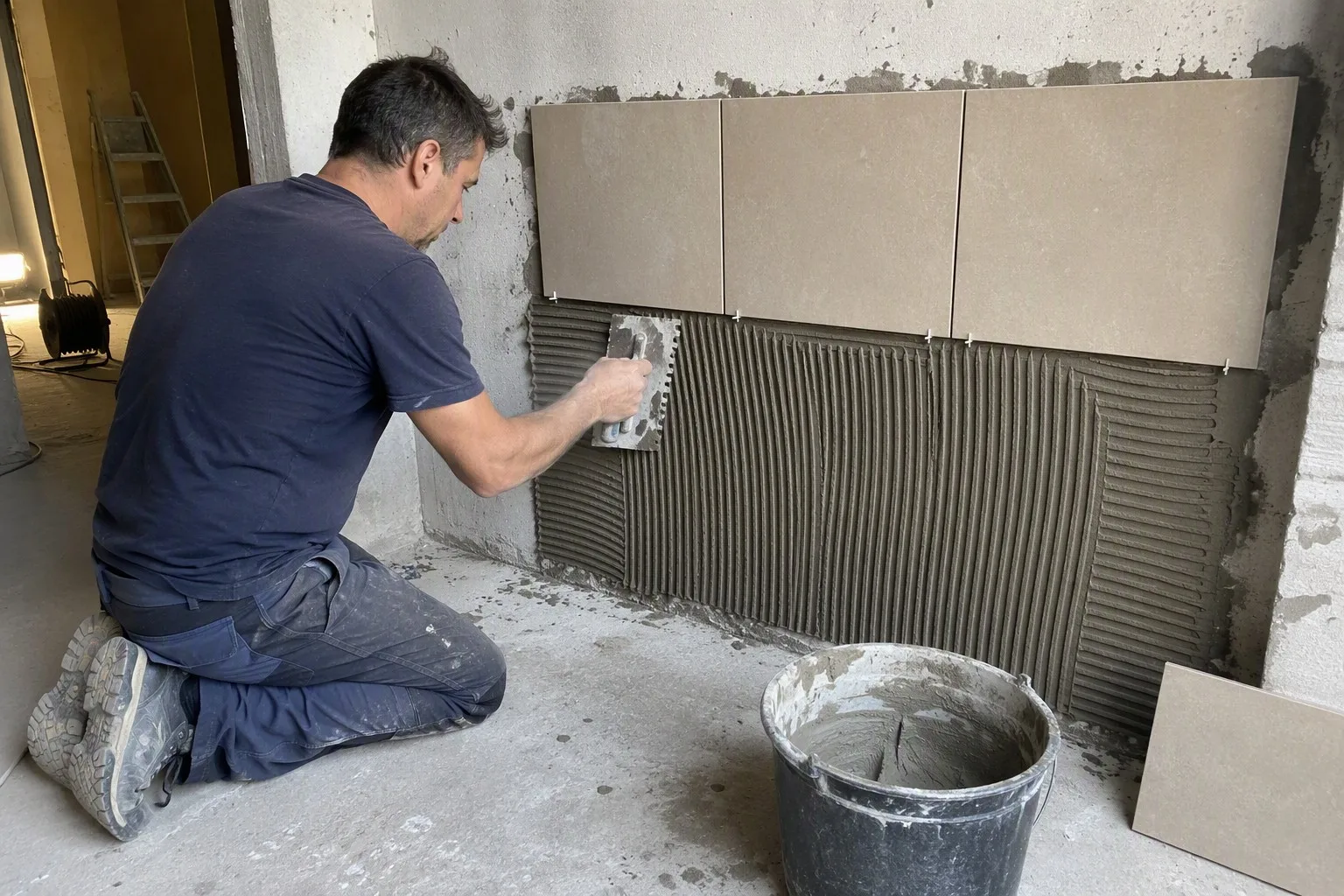
What Is MHEC Used For in Tile Adhesives?
Tile adhesive is one of the most demanding applications for cellulose ethers. Buyers often ask me whether one MHEC grade can cover all their adhesive products. The honest answer is no — and understanding why will save you from costly reformulation.
In tile adhesives, MHEC is used to provide water retention, extended open time, anti-sag performance, and smooth troweling. These properties help the adhesive meet standard classifications and perform reliably on absorbent substrates and vertical surfaces. Grade selection depends on the adhesive class, tile size, and local climate.
Why Tile Adhesives Demand So Much from MHEC
A tile adhesive faces a difficult situation. The tiler spreads a thin layer over a large, often absorbent surface. Then the tiler may wait several minutes before placing the tile. During that wait, the adhesive must stay workable. After placement, it must hold a heavy tile on a wall without slipping.
MHEC supports each of these stages:
- Before placement: Water retention keeps the adhesive surface from skinning over too quickly. This preserves open time.
- During placement: Proper viscosity lets the tiler comb the adhesive evenly with a notched trowel.
- After placement: Anti-sag behavior keeps tiles in position on vertical surfaces.
A Practical Lesson from Customer Feedback
A few years ago, a dry-mix producer in a hot, dry region contacted me about premature skinning in their C1-grade adhesive. Their existing cellulose ether performed acceptably in mild weather but failed during summer. We supplied samples of a higher-viscosity MHEC grade, and their lab trials showed improved open time under their local conditions. I want to be careful here: their lab result was evidence for their formulation, not a universal guarantee. Your raw materials, cement type, and climate will differ. That is why I always recommend running your own trials before switching grades.
Questions to Ask Before Choosing an MHEC Grade for Adhesives
- What adhesive class are you targeting (for example, C1 or C2 under EN 12004)?
- What is your typical substrate absorption and job-site temperature range?
- What open time and sag resistance does your market expect?
- Have you tested the grade in your actual formulation, not just a standard mortar?
What Is MHEC Used For in Wall Putty and Skim Coats?
Wall putty looks like a simple product, but buyers tell me it generates more application complaints than almost anything else they make. The complaints usually trace back to workability and water retention — exactly the properties MHEC controls.
In wall putty and skim coats, MHEC is used to improve workability, water retention, and surface smoothness. It helps the putty spread evenly, resist drying too fast on absorbent walls, and sand cleanly after curing. Putty formulations typically use different viscosity grades than tile adhesives.
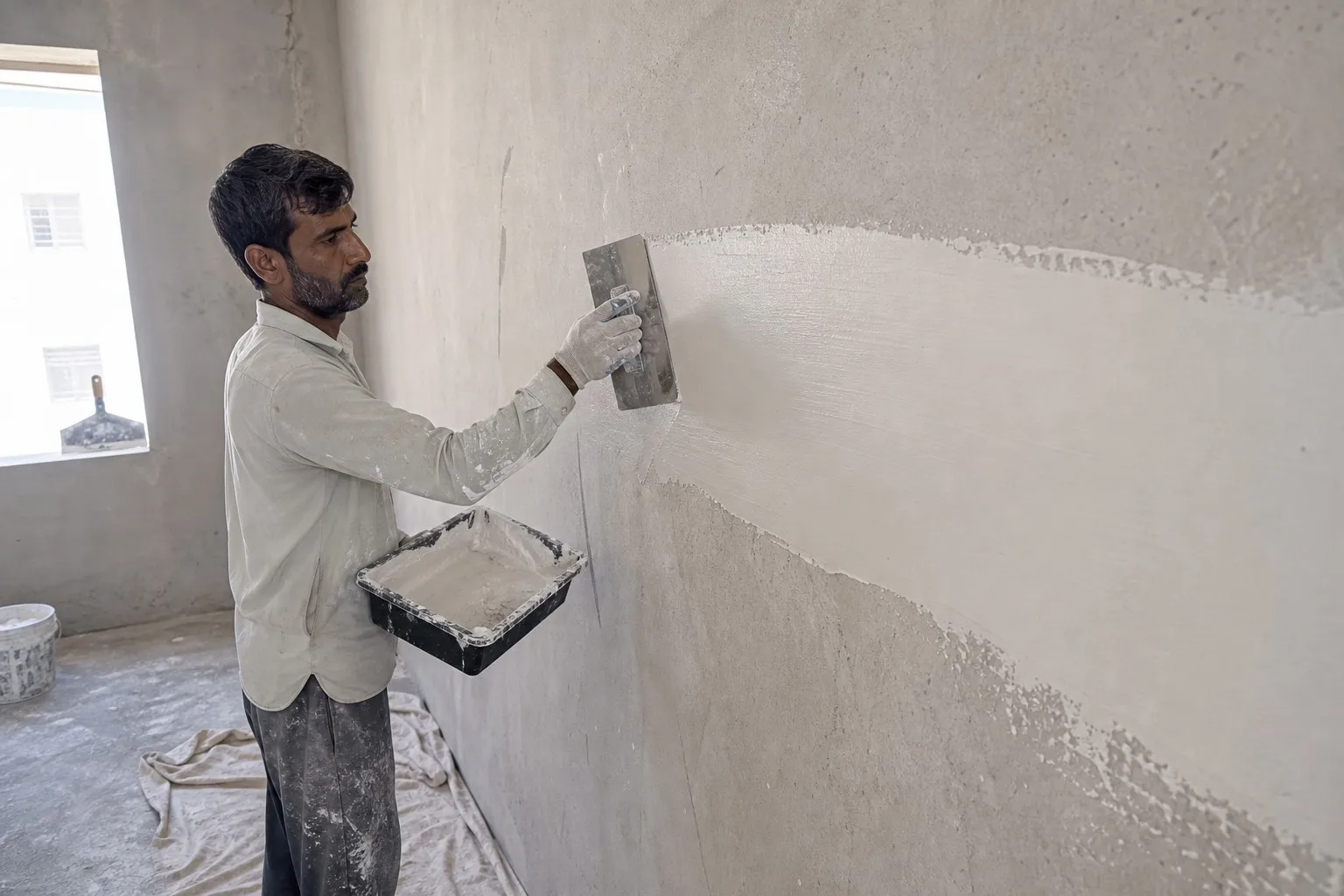
The Workability Problem in Putties
Putty is applied by hand, often by workers who judge a product within the first few minutes of use. If the putty drags under the trowel, sticks to the tool, or dries before the worker can smooth it, the product gets a bad reputation — regardless of its final hardness.
MHEC addresses these issues in several ways:
- Lubricity and smoothness: The right grade gives the putty a creamy, easy-spreading feel.
- Water retention on absorbent substrates: Gypsum plasterboard and old cement walls pull water out of the putty fast. MHEC slows that loss and prevents surface powdering and poor curing.
- Reduced cracking: Better water retention means more controlled drying, which reduces shrinkage cracks in thin layers.
Viscosity Selection Matters More Than Buyers Expect
Here is a pattern I see often in sampling requests. A buyer asks for "MHEC for putty" without specifying viscosity. But putty formulations commonly use different viscosity ranges than tile adhesives, and the wrong choice creates real problems:
| Property | Too Low Viscosity | Too High Viscosity |
|---|---|---|
| Workability | Watery, poor body | Heavy, sticky, hard to spread |
| Water retention | Insufficient | Good, but may trap air |
| Surface finish | Tearing, roughness | Trowel marks, slow application |
This is why I ask buyers about their application method, layer thickness, and substrate before recommending a sample. A specification sheet alone cannot tell you whether a grade fits your putty. Only a trial batch can.
What Is MHEC Used For in Gypsum Products and Dry-Mix Mortars?
Beyond adhesives and putties, MHEC appears across a wide range of gypsum- and cement-based products. Each system interacts with cellulose ethers differently, so I treat each application as its own evaluation.
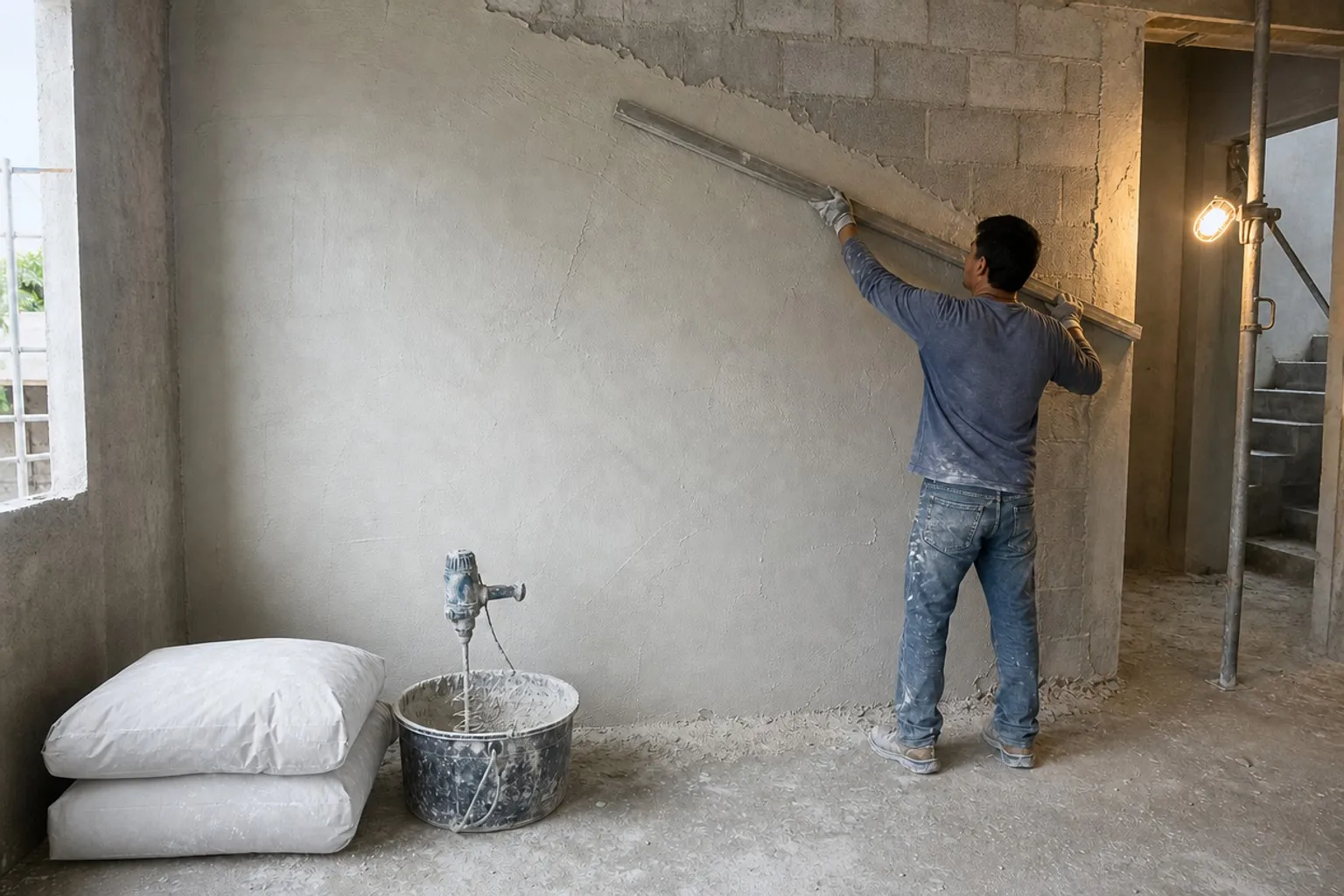
In gypsum plasters, gypsum-based fillers, and general dry-mix mortars, MHEC is used for water retention, consistency control, and improved application behavior. In gypsum systems, it helps manage setting behavior and surface quality. In cement-based mortars, it supports hydration and workability.
Gypsum-Based Products
Gypsum systems behave differently from cement systems. Gypsum sets through crystallization, and its working time is sensitive to additives. In gypsum plasters and joint fillers, MHEC contributes:
- Consistency control: A stable, lump-free mix that applies evenly.
- Water retention: Protection against rapid water loss on absorbent backgrounds, which can cause weak, chalky surfaces.
- Surface quality: Smoother finishes with fewer pinholes and less tool drag.
One caution from my experience: cellulose ethers can influence gypsum setting time. The effect varies with grade, dosage, and the other additives in the system. If you formulate gypsum products, verify setting behavior in your own lab rather than assuming it transfers from a cement-based test.
Other Dry-Mix Mortars
MHEC also appears in:
- Renders and base coats: Water retention and anti-sag for vertical application.
- Repair mortars: Workability and adhesion support in thin layers.
- EIFS/ETICS base coats: Consistency and open time for embedding reinforcement mesh.
- Self-leveling compounds: Selected grades can support stability, though these systems have very specific rheology demands.
In each case, the question is never "does MHEC work here?" The question is "which grade, at what dosage, verified under which conditions?" I do not publish a universal dosage table, because formulation, raw materials, process, climate, and performance targets all change the answer. Any supplier who gives you a single number without asking about your system is guessing.
Can MHEC Replace HPMC or HEC in Your Formulation?
This is the most commercially important question buyers ask me, and it deserves a careful answer. Substitution decisions made on price alone cause most of the reformulation problems I hear about.
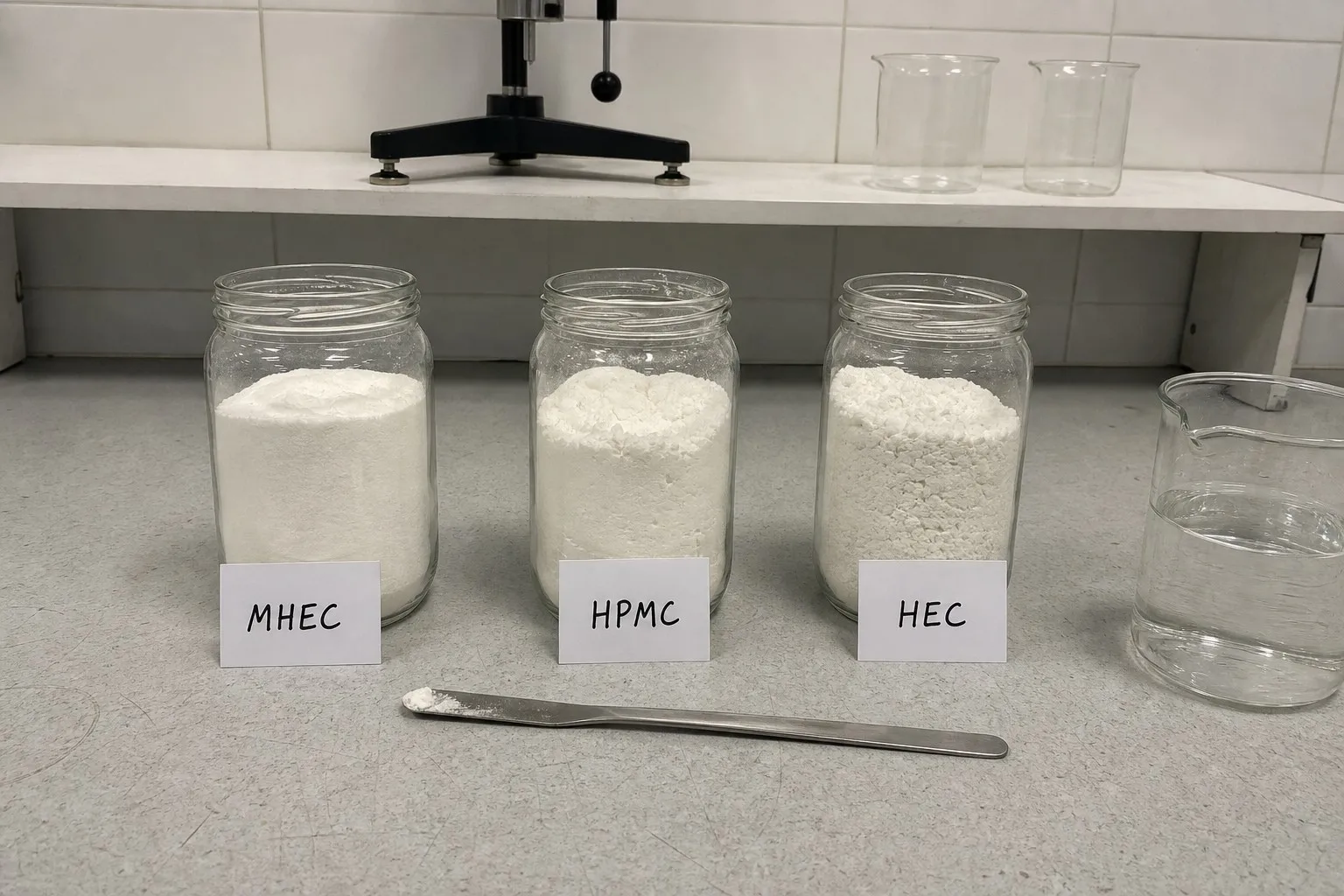
MHEC, HPMC, and HEC are related cellulose ethers with overlapping but not identical properties. MHEC can serve as an alternative to HPMC in many cement-based applications, but substitution is not automatic. Buyers should compare specifications, request samples, and run application-specific trials before replacing one cellulose ether with another.
How the Three Cellulose Ethers Differ
| Property | MHEC | HPMC | HEC |
|---|---|---|---|
| Common use | Cement/gypsum dry-mix | Cement/gypsum dry-mix | Paints, some construction |
| Water retention | High | High | Moderate |
| Thermal gelation behavior | Differs by grade | Differs by grade | No typical gelation |
| Workability feel | Often described as smooth, creamy | Varies by grade | Different rheology profile |
These are general tendencies, not guarantees. Two MHEC grades from two factories can differ more than an MHEC and an HPMC from the same factory. Manufacturing process, substitution degree, viscosity control, and batch consistency all matter.
How I Recommend Buyers Approach Substitution
When a buyer asks me whether our MHEC can replace their current HPMC, I suggest this sequence:
- Compare specifications first. Viscosity, moisture, ash content, pH, and particle size give you a starting filter.
- Request samples and run lab trials. Test water retention, open time, sag resistance, and workability in your actual formulation.
- Run a pilot production batch. Lab results do not always survive scale-up.
- Test under real conditions. If your market is hot and humid, test in heat and humidity.
- Discuss price only after technical fit is confirmed. A cheaper cellulose ether that fails in the field is the most expensive option you can buy.
I also encourage buyers to verify supplier documents. Ask for a COA for each batch, review the MSDS, and confirm that the factory's quality control system matches what the paperwork claims. Certifications and test reports are documents you should verify, not decorations on a website.
Frequently Asked Questions
Is MHEC the same as HPMC?
No. Both are cellulose ethers used in construction, but they have different chemical substitutions and somewhat different performance profiles. MHEC can replace HPMC in many cement-based formulations, but only after comparative testing in your specific product and conditions.
What dosage of MHEC should I use in tile adhesive?
There is no universal dosage. The right amount depends on your formulation, raw materials, target open time, climate, and performance requirements. Start with your supplier's recommended range, then optimize through lab trials in your own system.
Does MHEC provide adhesive strength?
No. MHEC is a functional additive, not a binder. Strength comes from cement, gypsum, and polymer binders such as redispersible polymer powder. MHEC supports water retention, workability, open time, and anti-sag behavior during application.
How do I verify MHEC quality before bulk purchase?
Request a COA for the specific batch, review viscosity and moisture specifications, and test samples in your own formulation. Ask about the factory's QC process and batch-to-batch consistency. Internal QC data shows manufacturing consistency, but only your trials confirm field performance.
Can one MHEC grade work for both putty and tile adhesive?
Sometimes, but do not assume it. Putties and adhesives have different viscosity and workability demands. Test each application separately, and treat grade selection as a per-product decision rather than a one-size-fits-all purchase.
Conclusion
So, what is MHEC used for? It is a functional cellulose-ether additive that provides water retention, thickening, workability, open time, and anti-sag performance in tile adhesives, wall putties, gypsum products, and dry-mix mortars. But the real answer goes deeper: the value of MHEC depends on matching the right grade to your formulation, your raw materials, and your local conditions. Treat substitution and dosage as validation questions, not assumptions.
If you are evaluating MHEC for your products, I am happy to help. Contact me with your application details, and I will recommend suitable grades, provide samples, and supply COA/MSDS documentation so you can verify fit in your own trials before committing to an order.