

A gypsum plaster that suddenly loses its working window after HPMC is introduced creates an immediate production problem: operators rush, application quality becomes unstable, and purchasing teams may blame the newest raw material. The pressure grows when yesterday’s formula worked but today’s batch does not. I recommend resisting a one-variable verdict. HPMC can alter water retention, wetting, dispersion, and rheology, but it does not independently control gypsum hydration. The practical way forward is a controlled reconstruction of gypsum activity, additive interactions, water conditions, mixing history, fillers, and batch evidence.
1. Is the Gypsum Binder More Reactive Than the Previous Lot?

Problem: A new plaster batch stiffens early, and the HPMC delivery is treated as the obvious cause because it was recently added or changed.
Agitation / Answer: Fast set can begin with the binder, not the cellulose ether. Changes in hemihydrate form, soluble anhydrite, residual dihydrate nuclei, fineness, aging, or storage exposure can shift gypsum dissolution and crystallization. HPMC may change the observed working feel, yet the gypsum phase composition and raw-material activity must be checked first.
Solution: I start by separating “loss of workable consistency” from measured setting time. A plaster can feel thicker because rheology changed while its hydration endpoint moves differently. Conversely, an unusually active gypsum can generate rapid crystal growth even when the HPMC is within its agreed specification. This distinction prevents a purchasing dispute from replacing diagnosis.
Create a receiving comparison using retained materials and one agreed test procedure. Compare the suspect gypsum lot with the last acceptable lot under identical water, temperature, mixing, vessel, operator, and additive conditions. Then repeat with HPMC omitted only as a diagnostic control—not as proof that HPMC is irrelevant. Guidance on the broader function of cellulose ether in gypsum is available in Jinghong’s gypsum plaster and joint filler overview.
| Binder evidence to record | Why it matters |
|---|---|
| Supplier lot and production date | Connects the event to traceable material |
| Declared gypsum phase or process route | Indicates potential reactivity differences |
| Fineness and moisture condition | Can influence dissolution and nucleation |
| Storage duration and packaging condition | Flags aging or moisture exposure |
| Control-mix behavior | Tests the binder under matched conditions |
Use a contractually agreed setting-time method. ASTM C472 covers physical testing of gypsum products, including setting-related procedures,1 while EN 13279-2 provides reference test methods for gypsum binders and plasters.2 The applicable edition, specimen preparation, endpoint, and conditioning must be aligned before suppliers compare numbers. Preserve both raw observations and calculated results.
2. Are the Retarder, Accelerator, and HPMC Interacting Differently?

Problem: Every ingredient passes an individual certificate check, but the complete dry mix sets faster than the approved benchmark.
Agitation / Answer: Retarders, accelerators, HPMC, and gypsum operate as a formulation system. A small change in retarder chemistry, accelerator carryover, cellulose-ether dissolution behavior, or addition accuracy can alter nucleation and the apparent working window. Passing isolated raw-material checks does not establish compatibility in the customer’s actual plaster recipe.
Solution: I recommend a small factorial screen rather than increasing one additive by instinct. Keep the gypsum lot fixed, then compare the approved and suspect HPMC against the approved and suspect retarder or accelerator packages. Use the same weighing resolution, water, conditioning, mixing sequence, and endpoint. This reveals whether the shift follows one material or a specific combination.
Do not infer setting behavior from viscosity alone. Viscosity is method-dependent, and two cellulose ethers with similar solution viscosity can differ in substitution pattern, particle dissolution, air entrainment, or interaction with salts. Jinghong’s HPMC CoA buyer’s guide explains why test method and specification context matter, while its HPMC quality-testing guide helps structure incoming checks.
Use this screening matrix without assigning invented target values:
- Reference gypsum + reference additive package + reference HPMC.
- Reference gypsum + reference package + suspect HPMC.
- Reference gypsum + suspect package + reference HPMC.
- Reference gypsum + suspect package + suspect HPMC.
- Relevant blanks, changed one factor at a time.
Record dry-blend uniformity, wetting, lumping, consistency evolution, agreed initial/final endpoints, and application feel. If an accelerator is present through recycled dust or shared equipment, include that pathway. Include replicate runs and randomize the trial order where practical so warming equipment or operator learning does not become a false material effect. Only change a retarder after the interaction is demonstrated; otherwise, compensation may hide a drifting gypsum lot and create delayed or weak batches later.
3. Did Water Demand, Water Temperature, or Site Conditions Change?

Problem: Laboratory retain samples appear normal, but crews report that the plaster becomes unworkable much sooner on site.
Agitation / Answer: Water conditions can compress or distort the perceived setting window. A changed water-to-powder ratio, warm mixing water, hot bags, absorbent tools, or unmeasured site additions may make HPMC hydrate and the plaster stiffen differently. Reconstruct both the prescribed recipe and the actual field practice before assigning material fault.
Solution: Begin with mass balance. Confirm how much dry mix entered the vessel and how water was measured; bucket marks, hose timing, and operator judgment are not equivalent to a calibrated mass or volume. Too little water can create high early consistency, while extra water can change handling and subsequent structure. Neither observation, by itself, proves a chemical acceleration.
Temperature must be captured at the point of use, not inferred from weather data. Record dry-mix, water, room, substrate, and equipment conditions without relying on a photograph of an unreadable gauge. If bags were stored in sun or against a hot wall, allow a defined conditioning comparison. HPMC’s water-retention role is explained in how HPMC improves water retention, but retained water should not be confused automatically with a longer chemical set.
A useful field reconstruction checklist is:
- identify the water source and any change in treatment or dissolved salts;
- verify the actual water addition method and calibration status;
- log water and dry-mix temperatures at mixing;
- inspect vessel dryness, residue, and tool cleanliness;
- note substrate suction and pre-wetting practice;
- seal and label representative dry-mix, water, and raw-material retains.
Run paired trials under conditioned laboratory temperature and reproduced field temperature using the same lot. If behavior separates only under warm conditions, address storage, water control, and work instructions before reformulating. For moisture-sensitive warehousing, the HPMC storage guide for humid climates provides additional receiving and storage controls.
4. Did Mixing Energy, Addition Order, or Residence Time Shift?
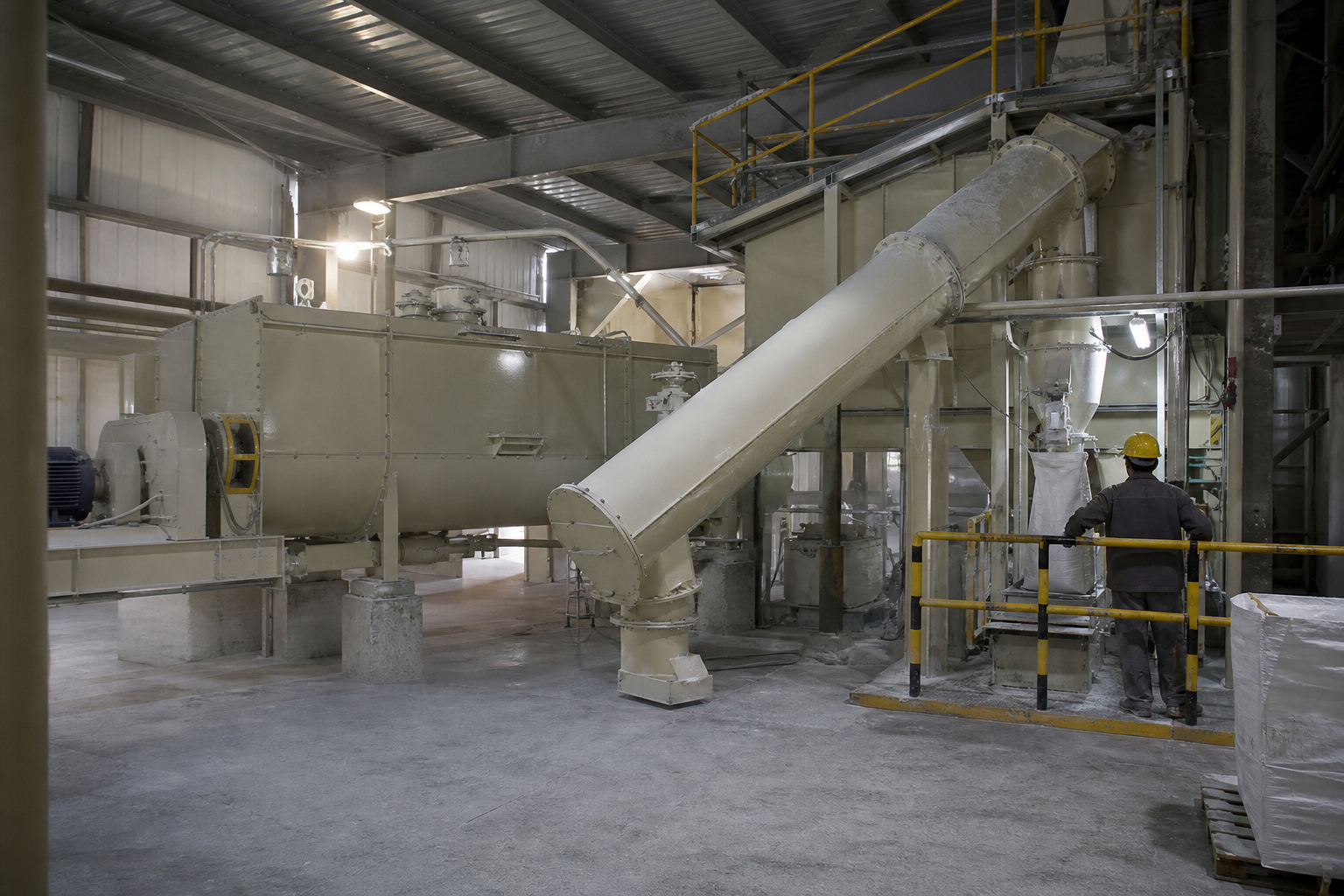
Problem: The formula and raw-material lots are unchanged, yet one line, shift, mixer, or application crew sees a shorter window.
Agitation / Answer: Process history can change both HPMC dispersion and gypsum nucleation. Higher shear, longer mixing, altered addition order, wet hold time, recirculation, or hardened residue may accelerate structure development or make thickening appear earlier. A formula comparison is incomplete unless mixer load, energy, sequence, residence time, and equipment cleanliness are matched.
Solution: Map the process from bag opening to wall application. Record when HPMC enters the dry blend, dry-mixing duration, mixer fill level, water contact point, wet-mixing duration, transfer delay, pump recirculation, and time before application. Avoid reducing this history to “mixed as usual.” A maintenance change, new blade, underfilled mixer, or slower queue can produce a different energy input or residence time.
Then run a staged replay. Use one retained dry-mix lot and hold all inputs constant while comparing the approved process with the observed process. Do not change speed, time, and sequence simultaneously. Assess dispersion and consistency alongside the agreed setting endpoint. Jinghong’s HPMC receiving inspection checklist can support traceability before production, and its water-retention test-method comparison illustrates why procedural differences can alter conclusions.
| Process checkpoint | Evidence to capture |
|---|---|
| Dry addition order | Timestamped sequence, not operator memory |
| Mixer fill and condition | Load identity, residue, blade status |
| Dry and wet mixing | Defined time and equipment setting |
| Transfer or recirculation | Actual hold duration and route |
| Application start | Elapsed time from first water contact |
Prevent cross-contamination from set gypsum, accelerator dust, or returned wet material. Even small residues can provide nucleation sites, so clean equipment and a fresh vessel are essential controls. Review automatic dosing and sequence logs against manual additions, including stoppages that extend wet residence. Once the replay identifies a process-linked difference, lock the relevant operating window and train shifts before asking a supplier to alter HPMC.
5. Can the Batch Be Reconstructed With Fillers, Impurities, and Retains?

Problem: Teams have opinions about the failure, but samples, timestamps, and formulation records are too fragmented to test those opinions.
Agitation / Answer: Sand, limestone, lightweight filler, recycled fines, soluble salts, and contamination can change water demand, nucleation, or apparent consistency. A defensible root-cause review links site observations to exact lots and retained samples, then reproduces the event in a controlled matrix. Supplier communication should carry comparable evidence, not a presumed HPMC verdict.
Solution: Freeze the affected material and build a lot genealogy before adjusting production. Include gypsum, HPMC, retarder, accelerator, sand, fillers, packaging time, silo or mixer path, water source, and dispatch destination. Check whether filler moisture, grading, surface area, or soluble impurities changed. A “same supplier” description is insufficient when mineral sources or recycled streams can vary.
Use an anonymous complaint workflow that protects commercial details while preserving technical facts:
- Isolate the affected finished-goods lot and all relevant retains.
- Capture site chronology, mixing practice, temperatures, substrate, and observed symptoms.
- Confirm raw-material lot links and production records.
- Reproduce the reference and complaint conditions with blinded sample codes.
- Change one factor at a time, then confirm any suspected interaction.
- Share method, conditioning, raw data, photos without readable labels, and chain of custody with suppliers.
Procurement teams can use the reliable HPMC manufacturer guide to frame technical capability discussions. Ask the HPMC supplier for the agreed certificate data, sample identity, test methods, storage history, and a matched retain—not an unsupported statement that the product “cannot affect set.”
For laboratory confirmation, predefine acceptance criteria and follow the contract or applicable standard. ASTM explains why standards support reproducible, consensus-based testing,3 but a standard name alone does not harmonize apparatus, conditioning, endpoint interpretation, or edition. Close the investigation only when the suspected cause survives a repeat test and explains both acceptable and affected batches. If evidence remains mixed, document uncertainty and continue controlled monitoring rather than declaring a convenient cause.
Frequently Asked Questions
1. Does HPMC always delay gypsum plaster setting?
No. HPMC commonly changes water retention, consistency, dispersion, and application feel, but the net setting response depends on the gypsum phases, additive package, water conditions, and test method. Compare matched controls before deciding whether chemical set, apparent stiffening, or both changed.
2. Can a normal HPMC viscosity result rule out HPMC as a contributor?
No. A viscosity result reflects a specified solution method, not complete performance in gypsum plaster. Compatibility, dissolution behavior, moisture condition, air entrainment, and interactions with retarders or salts still require application testing under matched conditions.
3. Which setting-time standard should our factory use?
Use the method named in the contract or the standard applicable to your market and product. ASTM C472 and EN 13279-2 are relevant references, but all parties must align the edition, conditioning, mixing, apparatus, and endpoint before comparing results.
4. What samples should we retain after a fast-set complaint?
Retain the affected finished dry mix, an acceptable comparison lot, gypsum, HPMC, retarder, accelerator, fillers, and—when relevant—a sealed water sample. Preserve labels, chain of custody, storage conditions, production records, and site chronology.
5. Should we immediately increase the retarder level?
Not before a controlled diagnosis. An immediate increase may mask active gypsum, accelerator contamination, warm water, or a mixing change, and it can create a different failure later. First reproduce the event, isolate variables, and confirm the interaction.
CTA — Build an evidence-based gypsum troubleshooting plan
If your gypsum plaster sets too fast after HPMC is added, send Jinghong’s technical team your anonymous formulation framework, applicable test method, raw-material lot map, water and mixing conditions, and retained-sample plan. We can help organize a comparison matrix and discuss an HPMC sample for validation—without treating cellulose ether as the only cause.
References
- ASTM International, “ASTM C472-20: Standard Test Methods for Physical Testing of Gypsum, Gypsum Plasters and Gypsum Concrete.”1
- Standardization Institute of the Republic of North Macedonia, “EN 13279-2:2014—Gypsum binders and gypsum plasters, Part 2: Test methods.”2
- ASTM International, “About ASTM International.”3
- ASTM C472 is an official standards page; the contract should identify the required edition and procedure.
- EN 13279-2 describes reference test methods for gypsum binders and plasters; use the adopted edition applicable to the market and agreement.
- ASTM’s overview explains the organization’s consensus standards framework; it does not replace product-specific test instructions.