In the competitive world of construction, the quality of wall putty directly impacts the final finish and durability of any building project. A superior wall putty not only provides a smooth, flawless surface but also ensures long-term adhesion and resistance to environmental factors. At the heart of achieving such high performance lies the judicious use of additives, with Construction Grade Hydroxypropyl Methylcellulose (HPMC) being paramount.
Are you a formulator struggling with wall putty that dries too quickly, sags during application, or fails to provide a consistent finish? Perhaps you’re a procurement manager seeking to understand how to differentiate between HPMC grades to ensure your products meet stringent quality standards. The challenge often stems from a lack of in-depth understanding of HPMC’s multifaceted role and how to leverage its properties effectively.
This comprehensive guide from Jinghong Chemical will demystify the critical functions of HPMC in wall putty, offering insights into how it optimizes workability, prevents common surface defects, and what to look for when selecting the right grade. By understanding the science behind HPMC, you can elevate your wall putty formulations, ensuring superior performance, enhanced customer satisfaction, and a competitive edge in the market.
Construction Grade HPMC is a vital additive for wall putty, primarily enhancing water retention, workability, and sag resistance. Its proper selection and application are crucial for achieving a smooth, durable, and defect-free finish, directly impacting project quality and efficiency.

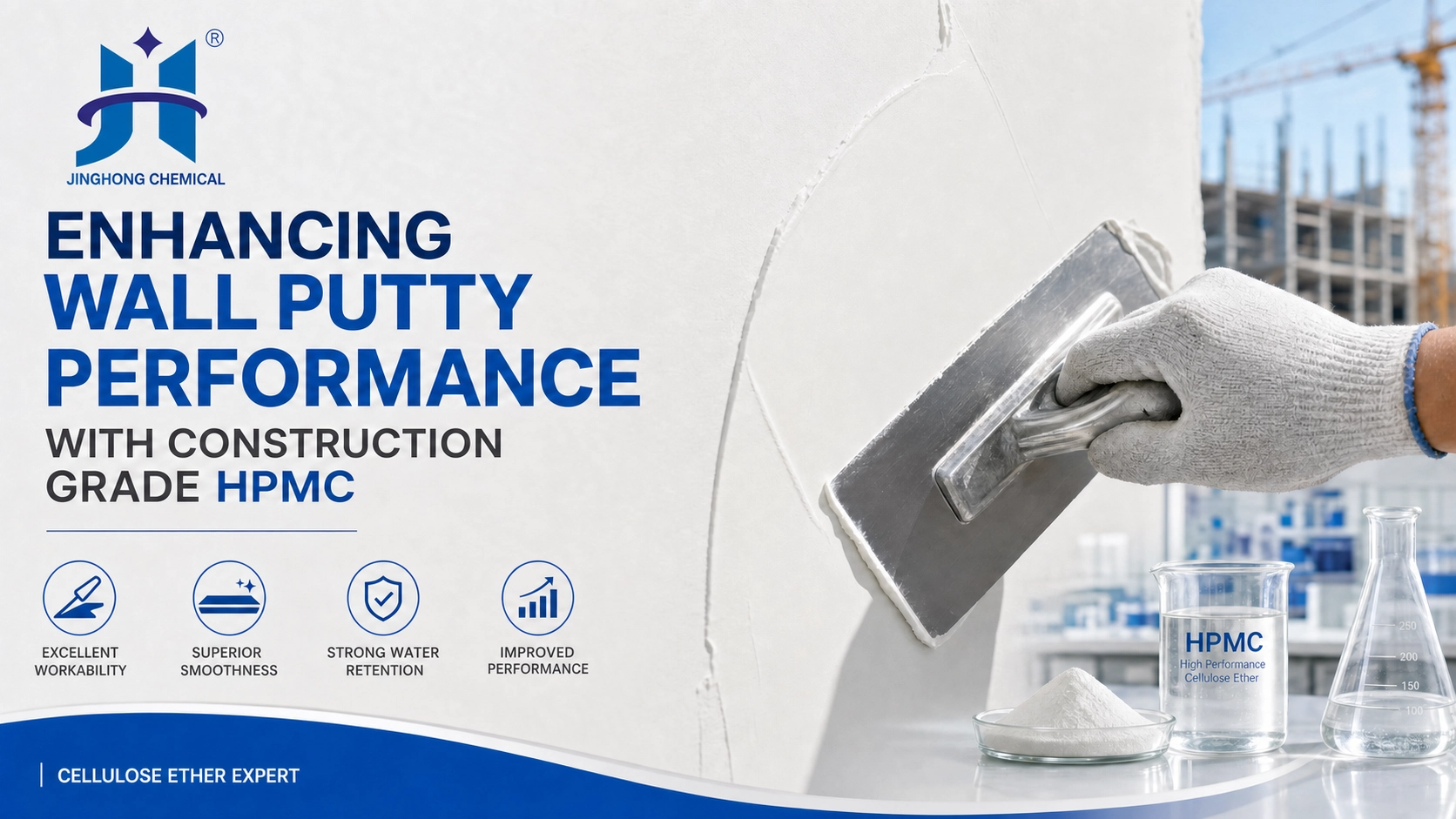
A professional B2B article cover showcasing the smooth application and superior finish of wall putty enhanced by construction-grade HPMC.
1. Optimizing Workability: The Role of HPMC in Water Retention and Open Time
Workability is the cornerstone of a high-quality wall putty. It dictates how easily the putty can be mixed, applied, and finished, directly influencing labor efficiency and the final aesthetic. HPMC plays an indispensable role in optimizing these fresh properties, primarily through its exceptional water retention and ability to extend open time.
Water Retention: The Foundation of Performance
Wall putty, typically cement- or gypsum-based, requires water for the hydration process of its binders. However, porous substrates (like concrete or brick) and environmental conditions (heat, wind) can rapidly draw water out of the fresh putty. This premature water loss leads to incomplete hydration, rapid drying, and cracking.
Construction Grade HPMC forms a viscous, colloidal solution when mixed with water. This solution creates a protective film around the binder particles, effectively slowing down the evaporation and absorption of water. The result is a prolonged and controlled water release, ensuring that binder hydration is optimized and consistency is maintained throughout the application.
Open Time: Maximizing Application Efficiency
Open time refers to the period during which the freshly applied putty remains workable and can be adjusted or further manipulated without compromising its final properties. An extended open time is critical for large surface areas, complex applications, and reducing material waste.
HPMC’s superior water retention directly contributes to extending the open time. By keeping the water within the mix, HPMC ensures the putty retains its plasticity and adhesive properties for an adequate period, facilitating a more efficient and error-free application process. This is particularly valuable in hot or dry climates where rapid drying is a significant challenge.

Scientific infographic illustrating how HPMC improves water retention and extends open time for superior wall putty workability.
2. Solving Surface Defects: Preventing Cracking, Peeling, and Chalking in Skim Coats
Beyond optimizing workability, Construction Grade HPMC is a powerful ally in combating common and frustrating surface defects in wall putty, such as cracking, peeling, and chalking. These issues not only compromise the aesthetic appeal of a finished surface but also indicate underlying structural weaknesses.
Preventing Cracking and Peeling
Cracks in wall putty can arise from rapid drying, excessive shrinkage, or insufficient flexural strength. HPMC addresses these challenges by ensuring a more gradual and uniform drying process, which significantly reduces internal stresses. Simultaneously, it enhances the internal cohesion and improves adhesion to the substrate, creating a stronger bond that resists the forces leading to cracking and peeling.
Mitigating Chalking
Chalking, the formation of a powdery layer on the surface, is typically a sign of incomplete binder hydration. HPMC helps to mitigate chalking by maintaining sufficient water for an extended period, ensuring that the cementitious or gypsum binders fully hydrate. Complete hydration leads to a denser, harder, and more durable surface that is less prone to abrasion and loose particles.

Infographic demonstrating how HPMC effectively prevents common wall putty defects like cracking, peeling, and chalking.
3. Selecting the Right Grade: Viscosity and Purity Requirements for Premium Putty Formulations
Choosing the correct Construction Grade HPMC is not a one-size-fits-all decision. The performance of your wall putty is highly dependent on the specific characteristics of the HPMC used, particularly its viscosity and purity.
Viscosity and Purity Standards
HPMC viscosity directly influences the rheological properties of the wall putty. Different viscosity grades offer distinct benefits, from basic water retention to maximum thickening and sag resistance.
| HPMC Viscosity Grade | Primary Impact on Wall Putty | Application Suitability |
|---|---|---|
| Low (400-1000 mPa.s) | Basic water retention, minimal thickening | Thin skim coats, fine-tuning |
| Medium (4000-20000 mPa.s) | Balanced water retention and thickening | Standard wall putty, skim coats |
| High (40000-100000 mPa.s) | Maximum thickening, superior sag resistance | Thick-layer putty, tile adhesives |
Furthermore, the purity of HPMC is paramount for ensuring consistency and performance stability. High-purity HPMC ensures consistent batch performance, avoids undesirable side effects like yellowing or reduced adhesion, and guarantees the long-term stability of the wall putty product.

Technical infographic comparing different HPMC viscosity grades and the importance of purity for premium wall putty.
Conclusion: Elevating Wall Putty with the Right HPMC
Construction Grade HPMC is a fundamental component that transforms ordinary wall putty into a high-performance material. Its ability to meticulously control water retention and extend open time revolutionizes workability, while its role in preventing common surface defects ensures the longevity and aesthetic integrity of skim coats. By strategically selecting the optimal HPMC grade, formulators can unlock the full potential of their wall putty products, driving innovation and excellence in the construction industry.
Partner with Jinghong Chemical for Superior Wall Putty Solutions
Ready to enhance your wall putty formulations and achieve unparalleled performance? Jinghong Chemical offers over 15 years of expertise in manufacturing high-quality Construction Grade HPMC. Our products are designed to optimize your formulations, ensuring superior workability, defect prevention, and long-lasting durability.
Contact us today to discuss your specific requirements, request technical data sheets, or obtain free samples for comprehensive testing. Let us help you build better, smoother walls that last.
Email: hpmc@jinghonghpmc.com
WhatsApp: +8615733156958
Website: www.jinghonghpmc.com