In the dynamic world of construction, wall putty is more than just a cosmetic layer; it’s a critical component that dictates the durability, aesthetics, and overall quality of interior and exterior finishes. A well-formulated wall putty provides a smooth, uniform surface for painting, protects the underlying substrate, and resists environmental wear. However, achieving this balance of performance and workability is a complex task that hinges on a deep understanding of its constituent materials and the role of specialized additives.
Are you a seasoned formulator seeking to optimize your existing wall putty recipes, or a procurement manager aiming to source the most effective additives for your production line? The challenge often lies in navigating the intricate interplay between raw materials and advanced chemical enhancers. Without precise knowledge, issues like cracking, poor adhesion, and inconsistent finish can plague your products, leading to costly rework and dissatisfied clients.
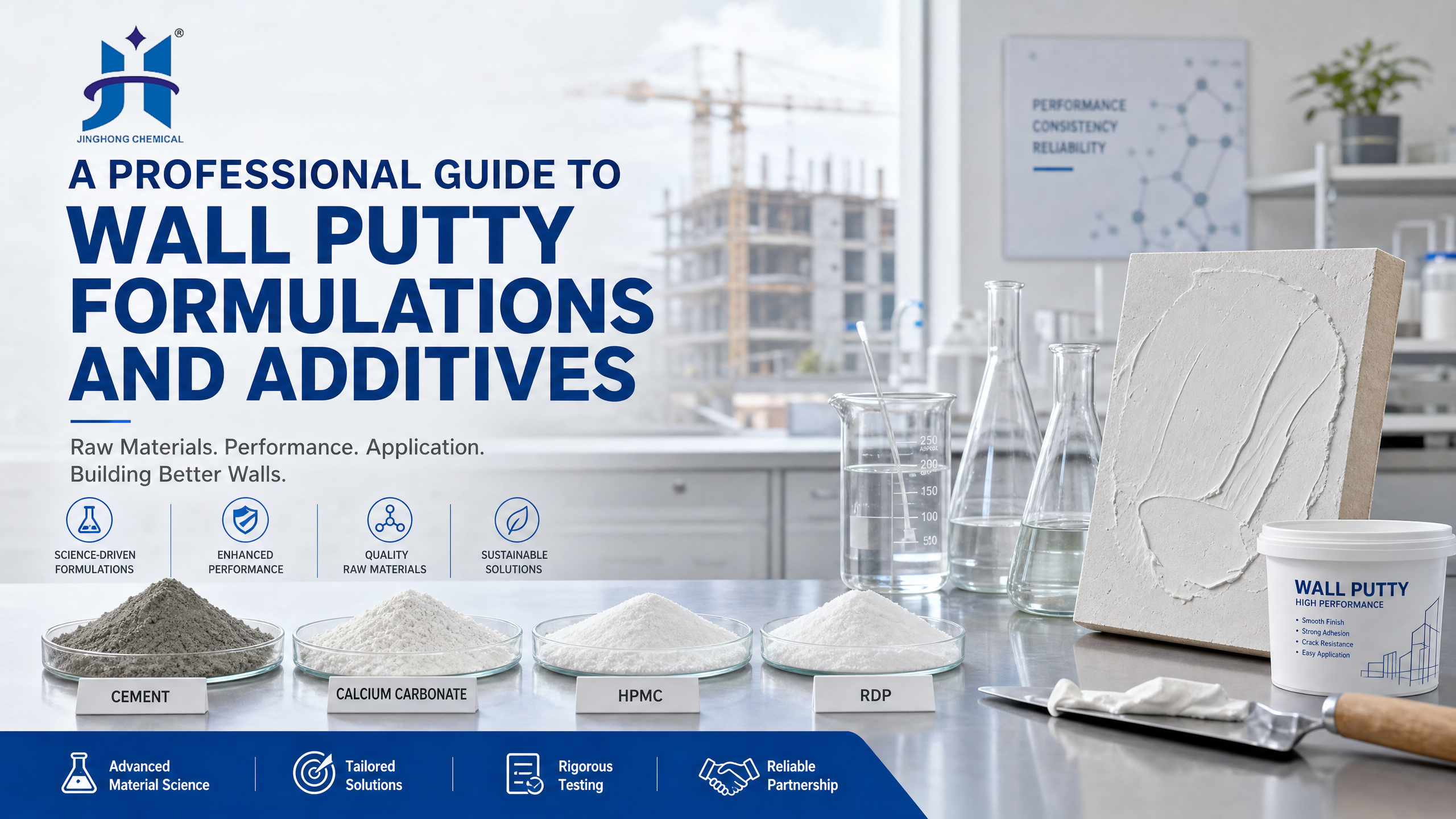
This professional guide from Jinghong Chemical delves into the fundamental science of wall putty formulations, meticulously examining the synergy between core components and the transformative power of critical additives like HPMC and RDP. We will provide best practices for achieving consistent quality and cost-efficiency, empowering you to develop superior wall putty solutions that meet the highest industry standards.
Wall putty formulations are a delicate balance of cementitious binders, inert fillers, and performance-enhancing additives. Understanding their synergistic interaction is key to developing products with superior workability, adhesion, and durability, crucial for achieving flawless and long-lasting wall finishes.
1. The Science of Formulation: Understanding the Synergy of Cement, Fillers, and Polymers
At its core, wall putty is a sophisticated blend designed to create a smooth, level surface. Its performance is fundamentally governed by the synergistic interaction of three primary components: cementitious binders, inert fillers, and polymer additives.
Cementitious Binders: The Strength Providers
The binder is the backbone of any wall putty, providing the necessary strength and adhesion. Common binders include:
- Ordinary Portland Cement (OPC): Provides high compressive strength and rapid setting. Its hydration process forms a rigid matrix that binds the other components.
- White Cement: Similar to OPC but with a lower iron content, resulting in a white color, ideal for light-colored putties and aesthetic finishes.
- Gypsum Plaster: Offers faster setting times and a smoother finish, often used in interior applications. Its hydration forms calcium sulfate dihydrate crystals.
The choice of binder significantly influences the putty’s strength, setting time, and compatibility with other materials. The hydration of these binders is a critical chemical reaction that requires a controlled water environment.
Inert Fillers: The Volume and Workability Enhancers
Fillers constitute the bulk of the wall putty, contributing to volume, workability, and cost-effectiveness. They are typically inert, meaning they do not react chemically with the binder. Common fillers include:
- Calcium Carbonate (Ground Calcium Carbonate – GCC): The most widely used filler, providing bulk, improving workability, and contributing to a smooth finish. Its particle size distribution is crucial for putty density and surface quality.
- Dolomite Powder: A mixture of calcium carbonate and magnesium carbonate, offering similar benefits to GCC but with potentially higher hardness.
- Quartz Sand (Fine): Used in some formulations to enhance hardness and reduce shrinkage, particularly in thicker applications.
Fillers impact the putty’s density, consistency, and how easily it can be applied and sanded. The optimal particle size distribution of fillers is essential for achieving a dense packing and a smooth surface.
Polymers: The Performance Modifiers
Polymers, though used in smaller quantities, are the game-changers in modern wall putty formulations. They modify the fresh and hardened properties of the putty, transforming a basic mix into a high-performance material. The most prominent polymers are:
- Cellulose Ethers (e.g., HPMC): Primarily responsible for water retention, thickening, and improving workability. They prevent premature drying, extend open time, and enhance adhesion.
- Redispersible Polymer Powders (RDP): Enhance flexibility, adhesion to various substrates, impact resistance, and reduce cracking. They form a flexible film within the cementitious matrix upon re-dispersion.
The synergy between these three components is what defines a high-quality wall putty. The binder provides the strength, the fillers provide bulk and workability, and the polymers fine-tune the performance, ensuring the putty meets specific application demands and environmental conditions. Without this delicate balance, the putty would fail to perform optimally, leading to defects and poor durability.
An infographic illustrating the synergistic interaction between cementitious binders, inert fillers, and polymer additives in a typical wall putty formulation.
2. Critical Additives: How HPMC and RDP Transform Basic Mixes into High-Performance Putty
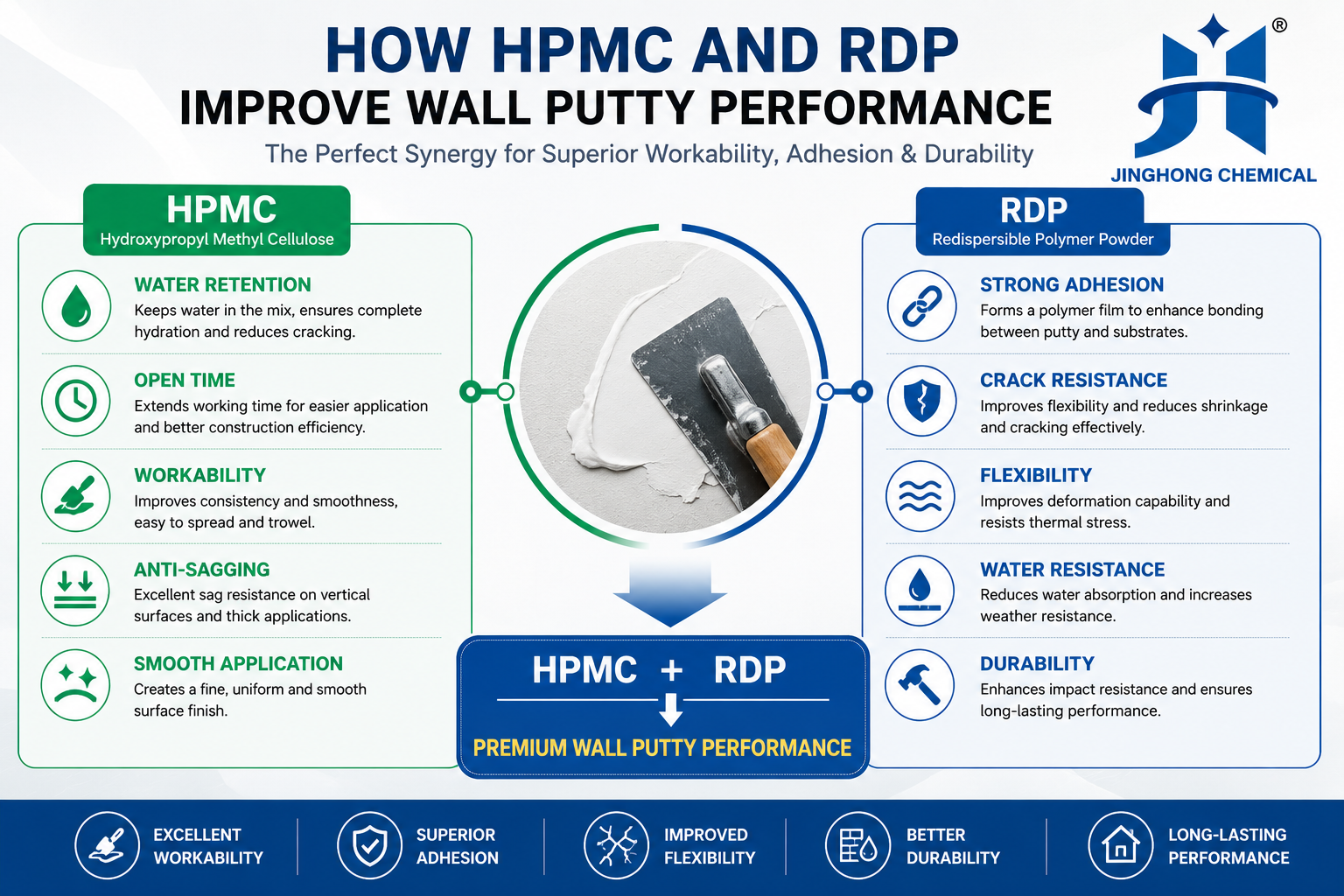
While cementitious binders and inert fillers form the structural and volumetric backbone of wall putty, it is the critical additives that truly elevate its performance from a basic mix to a high-performance material. Among these, Hydroxypropyl Methylcellulose (HPMC) and Redispersible Polymer Powders (RDP) stand out as indispensable components, each playing a unique yet synergistic role in enhancing both fresh and hardened properties.
Hydroxypropyl Methylcellulose (HPMC): The Rheology Master
HPMC is a non-ionic cellulose ether derived from natural cellulose. Its primary functions in wall putty are:
- Exceptional Water Retention: HPMC forms a protective film around cement particles, significantly reducing water evaporation and absorption by porous substrates. This ensures complete hydration of binders, preventing premature drying, cracking, and chalking.
- Thickening and Viscosity Control: HPMC acts as a highly efficient thickener, imparting pseudoplasticity to the putty. This improves sag resistance on vertical surfaces, allowing for thicker application layers without slumping, while maintaining excellent workability during troweling.
- Extended Open Time: By controlling water migration, HPMC prolongs the open time of the putty, giving applicators more time to adjust, level, and achieve a smooth finish, especially in hot or dry conditions.
- Enhanced Workability and Smoothness: The lubricating effect of HPMC improves the plasticity and spreadability of the putty, making it easier to apply and resulting in a smoother, more uniform surface.
Redispersible Polymer Powders (RDP): The Flexibility and Adhesion Enhancer
RDPs are polymer emulsions that have been spray-dried into a powder form. When mixed with water in the putty, they redisperse to form a polymer film that interpenetrates the cementitious matrix. RDPs are crucial for:
- Improved Adhesion: RDPs significantly enhance the bond strength of the putty to various substrates (concrete, masonry, insulation boards) by forming a flexible, adhesive polymer film that bridges pores and irregularities.
- Increased Flexibility and Crack Resistance: Cementitious materials are inherently brittle. RDPs introduce flexibility into the hardened putty, allowing it to accommodate minor substrate movements and thermal stresses, thereby drastically reducing the risk of cracking and delamination.
- Enhanced Impact Resistance: The polymer film absorbs energy, making the putty more resistant to impact and abrasion, which is particularly important for exterior applications or high-traffic areas.
- Reduced Water Permeability: RDPs can form a denser, less permeable matrix, improving the water resistance of the hardened putty.
The Synergy: HPMC and RDP Working Together
The true power of these additives lies in their synergy. HPMC ensures the putty remains workable and retains water during application, creating an optimal environment for RDP to redisperse and form its polymer network. Once hardened, HPMC contributes to the putty’s initial strength and workability, while RDP provides long-term flexibility, adhesion, and durability.
For example, in a high-performance tile adhesive, HPMC ensures the adhesive has sufficient open time and non-sag properties, while RDP provides the necessary flexibility to absorb stresses from tile movement and strong adhesion to various tile types.
An infographic illustrating the distinct yet synergistic roles of HPMC and RDP in transforming basic wall putty mixes into high-performance formulations.
3. Optimizing for Success: Best Practices for Consistent Quality and Cost-Efficiency in Production
Achieving a superior wall putty formulation is only half the battle. To succeed in a competitive market, manufacturers must focus on optimizing production for consistent quality and cost-efficiency. This involves a holistic approach that encompasses raw material selection, precise dosing, and rigorous quality control.
Raw Material Selection and Consistency
The quality of your final product is only as good as the raw materials you use.
- Standardize Your Sources: Establish long-term partnerships with reliable suppliers of cement, fillers, and additives. Inconsistent raw materials lead to unpredictable putty performance.
- Verify Specifications: Regularly test incoming raw materials to ensure they meet your required specifications for particle size, purity, and chemical composition. For fillers, particle size distribution is critical for achieving a smooth finish.
- Storage and Handling: Proper storage is essential to prevent contamination and moisture absorption, especially for cementitious binders and cellulose ethers.
Precise Dosing and Mixing
Precision in dosing is non-negotiable for achieving consistent quality.
- Automated Dosing Systems: Invest in automated dosing systems to minimize human error and ensure every batch follows the exact formulation.
- Optimal Mixing Time: Determine the optimal mixing time and speed for your specific equipment and formulation. Under-mixing leads to poor additive dispersion, while over-mixing can break down polymer structures.
- Sequential Addition: Follow a specific order of addition for raw materials. Typically, dry components are blended first, followed by the gradual addition of additives.
Balancing Performance and Cost
Cost-efficiency is crucial for profitability, but it should never come at the expense of quality.
- Rational Additive Dosage: Avoid over-dosing additives. Use the minimum amount required to achieve the desired performance. Regular testing can help you find the "sweet spot."
- Filler Optimization: Explore different combinations of fillers to achieve the desired bulk and workability at the lowest possible cost. GCC is generally more cost-effective than white cement.
- Climate-Specific Formulations: Adjust your formulation based on the local climate. For instance, in hot and dry regions, you may need to increase the HPMC dosage to ensure sufficient water retention.
Rigorous Quality Control
A robust quality control (QC) program is the final safeguard for your brand reputation.
| Test Parameter | Importance | Testing Method (Typical) |
|---|---|---|
| Water Retention | Ensures complete hydration and prevents cracking. | ASTM C1506 / Internal Lab Test |
| Consistency / Workability | Dictates ease of application and finish quality. | Flow Table Test / Trowel Test |
| Bond Strength | Measures adhesion to various substrates. | Pull-off Adhesion Test (ISO 4624) |
| Setting Time | Affects construction efficiency and scheduling. | Vicat Needle Test (ASTM C191) |
| Surface Smoothness | Determines the aesthetic quality of the finish. | Visual Inspection / Profilometer |
By implementing these best practices, manufacturers can ensure that every bag of wall putty they produce meets the highest standards of quality and performance, while remaining competitive in the market. At Jinghong Chemical, we provide not only high-quality HPMC and RDP but also technical support to help our partners optimize their formulations for success.
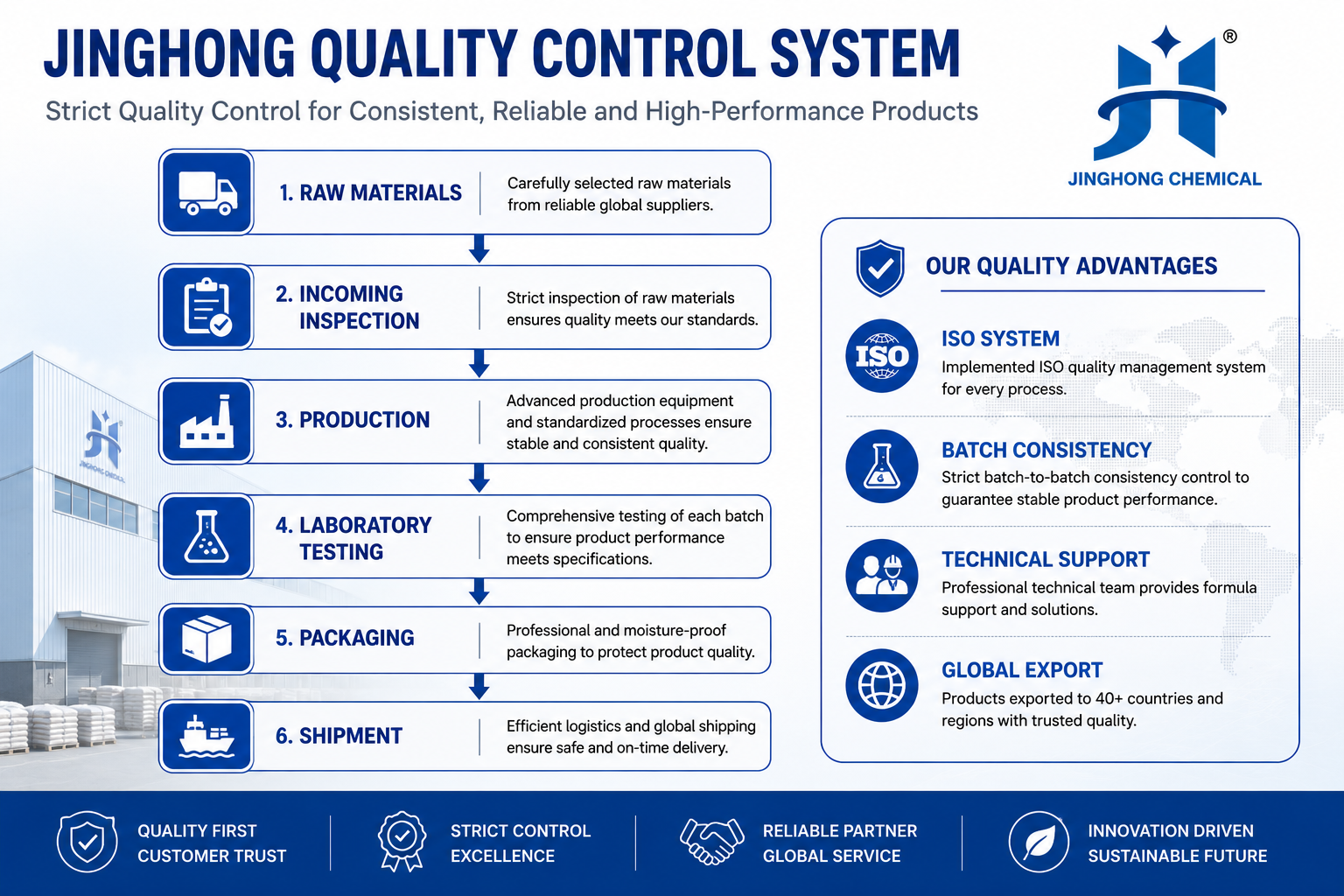
A diagram illustrating the key stages of wall putty production optimization, from raw material selection to rigorous quality control.
Conclusion
Developing a high-performance wall putty is a scientific endeavor that requires a deep understanding of material synergy and the transformative power of additives. By mastering the science of formulation, leveraging the unique properties of HPMC and RDP, and implementing best practices for production optimization, you can deliver superior wall finishes that stand the test of time.
Elevate Your Wall Putty Formulations with Jinghong Chemical
Are you ready to optimize your wall putty products for superior performance and cost-efficiency? Jinghong Chemical is your trusted partner for high-quality Construction Grade HPMC and Redispersible Polymer Powders (RDP). Our technical experts are ready to assist you with formulation optimization and provide tailored solutions for your specific needs.
Email: hpmc@jinghonghpmc.com
WhatsApp: +8615733156958
Website: www.jinghonghpmc.com
References: