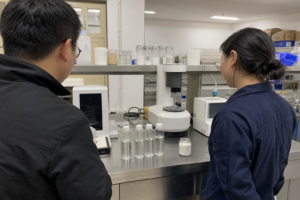
Redispersible polymer powder is used to modify the performance of dry-mix construction products, but buyers often struggle to match a grade with the right formulation. A poor match can waste money or leave the original failure unresolved. I evaluate RDP by the performance target, application, formulation, and test results rather than by the product name alone.
Redispersible polymer powder is mainly used to improve selected properties of cement-based and gypsum-based dry mixes, including adhesion, cohesion, flexibility, abrasion resistance, water resistance, and durability.1 I commonly see it specified for tile adhesive, EIFS mortar, wall putty, repair mortar, gypsum products, and self-leveling compounds. The actual improvement depends on the RDP grade and complete formulation.
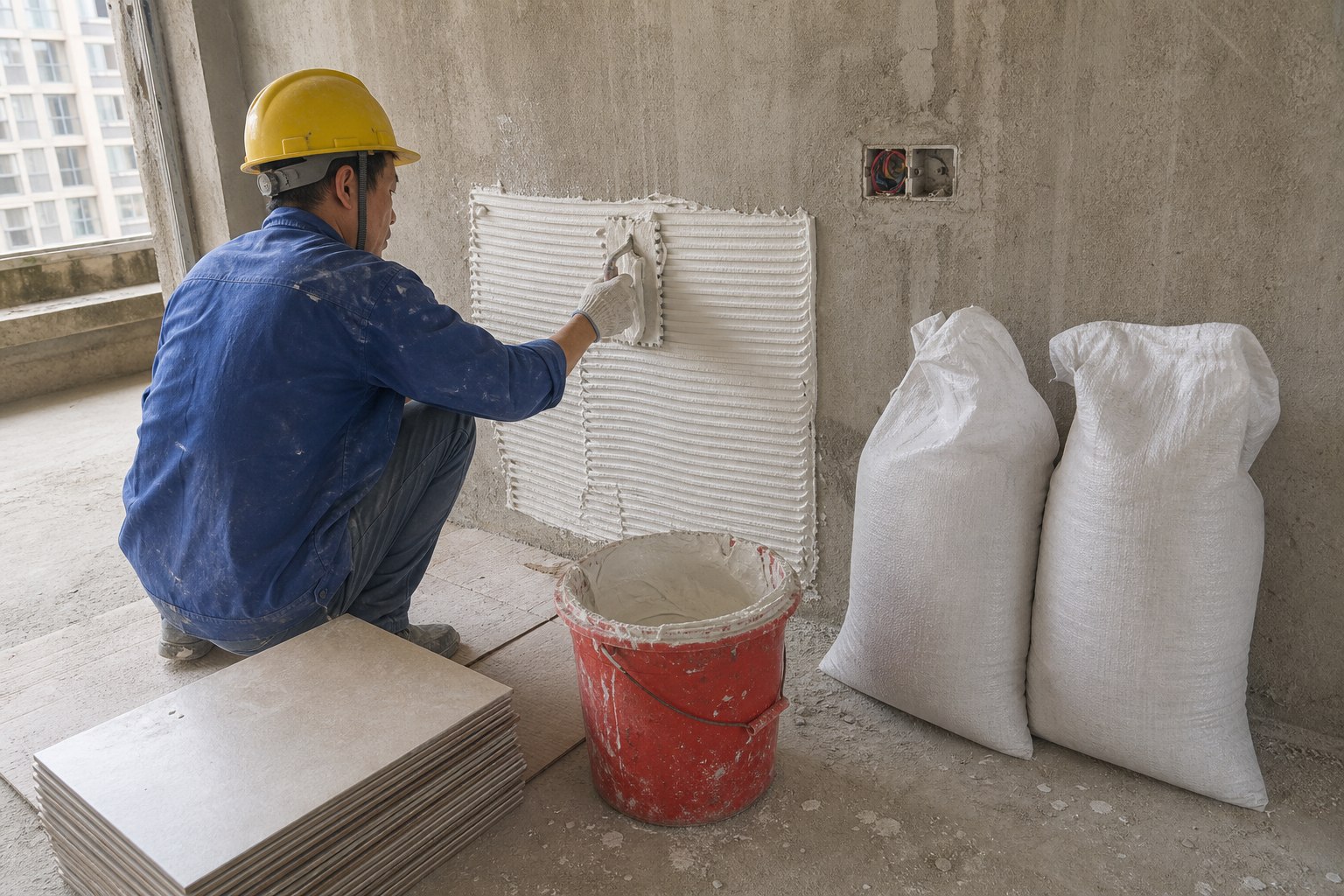
I do not treat RDP as a universal performance booster. I first identify what the finished mortar must do, what is currently failing, and how the customer will measure improvement. This diagnostic approach separates a useful polymer modification from an expensive formulation change that does not address the real problem.
What Does Redispersible Polymer Powder Do in a Mortar Formulation?
Redispersible polymer powder can affect several mortar properties, so reducing its purpose to “better adhesion” creates an incomplete picture. I often receive inquiries that ask only for a high-bonding RDP. That description does not tell me whether the buyer needs flexibility, cohesion, water resistance, impact resistance, or another measurable result. For a closer look at how and why RDP is built into mortar recipes, including the mechanism behind the adhesion, cohesion and flexibility improvements, see why RDP is added to mortar.
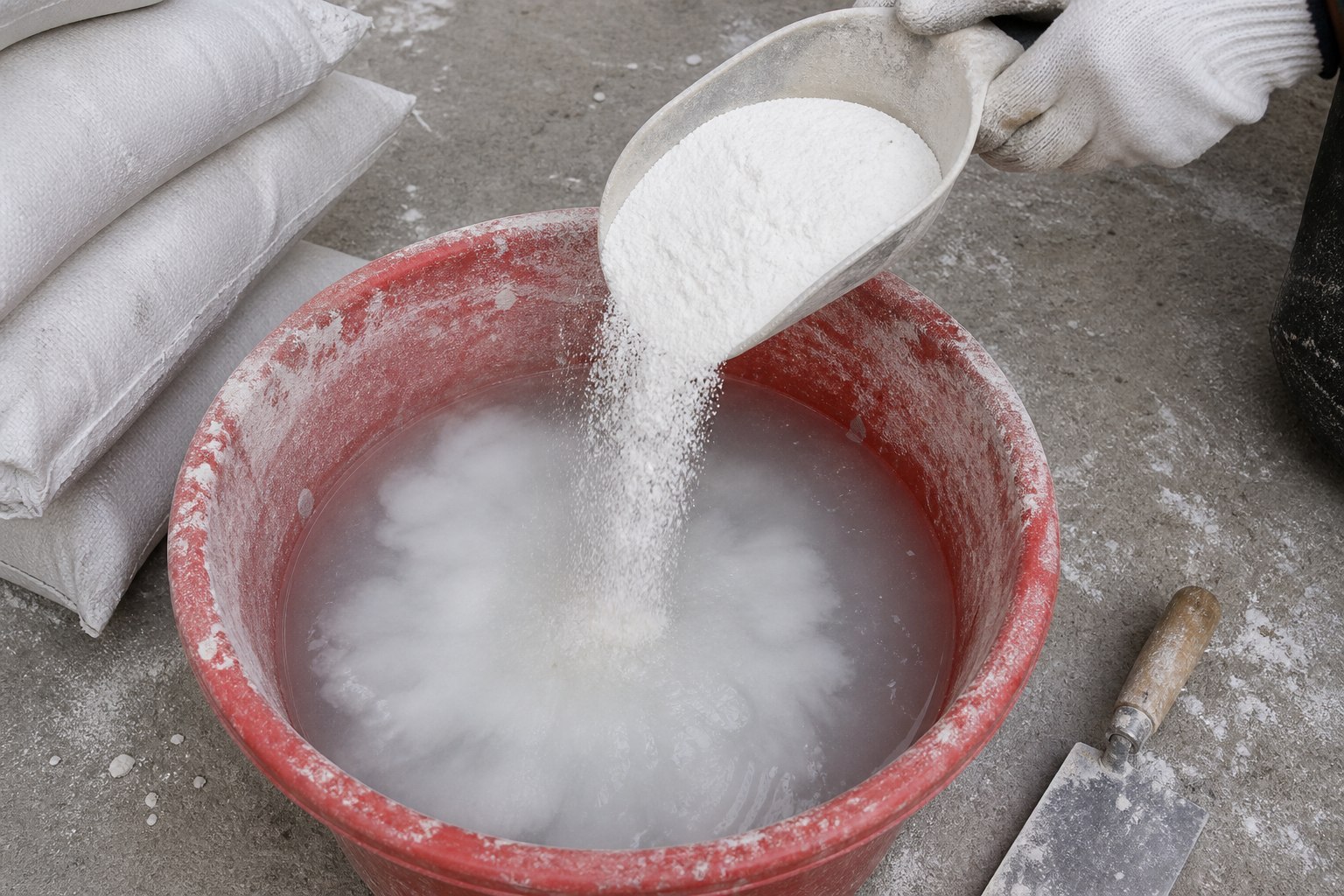
Redispersible polymer powder redistributes as polymer particles when the dry mix contacts water. As the mortar sets and dries, the selected polymer can contribute to a continuous or partly interconnected polymer phase within the mineral matrix. I use this functional model to evaluate potential improvements in bonding, deformation tolerance, cohesion, abrasion resistance, and durability.
I Evaluate RDP by Function
I find that buyers make better grade decisions when they translate a broad application name into a specific performance need. A tile adhesive manufacturer and a putty producer may both purchase VAE-based RDP, but their priorities can differ considerably.
I commonly discuss the following functions:
- Adhesion: I assess whether the mortar needs stronger or more reliable bonding to a specific substrate.
- Cohesion: I examine whether the hardened layer needs improved internal integrity.
- Flexibility: I consider whether the material must tolerate movement, thermal cycling, or deformation.
- Water-related performance: I ask whether the formulation must retain performance after water exposure or wet conditioning.
- Abrasion and impact resistance: I review whether the finished surface will face mechanical wear.
- Workability-related effects: I note that RDP may influence application feel, but I do not treat it as the main thickener or water-retention agent.
- Durability: I connect durability to defined test conditions instead of making a general promise.
| Performance need | Why a formulator may consider RDP | What I recommend verifying |
|---|---|---|
| Stronger substrate bonding | A polymer modifier may support adhesion within the complete mortar system | Substrate type, curing, open time, dry and conditioned bond results |
| Greater deformation tolerance | A suitable polymer may help the mortar accommodate movement | Flexibility or deformability test method and target |
| Better surface integrity | Polymer modification may improve cohesion and abrasion behavior | Surface strength, sanding, cracking, and abrasion tests |
| Improved wet performance | Some grades and formulations can retain properties better after water exposure | Water conditioning method and post-conditioning results |
| Better impact performance | A suitable polymer system may improve toughness | Layer thickness, reinforcement, substrate, and impact method |
I also caution buyers that these effects are grade-dependent and formulation-dependent. The cement type, gypsum source, filler grading, sand-to-binder ratio, cellulose ether, defoamer, starch ether, water demand, curing conditions, and application thickness can all change the outcome.2
In my production and buyer consultations, I have seen customers focus on one powder specification while overlooking the finished-mortar test. I do not regard that approach as sufficient. Powder data helps with incoming quality control, but application performance determines whether a grade is suitable. I therefore recommend controlled laboratory trials and, where necessary, evaluation by a qualified construction-material professional or accredited laboratory.
What Is Redispersible Polymer Powder Used for in Different Construction Products?
A list of applications can look useful, but a bare list does not explain why each system needs polymer modification. I prefer to connect every use with a practical problem. This approach helps a buyer decide whether redispersible polymer powder is necessary and what type of performance the selected grade should support.
Redispersible polymer powder is used in tile adhesives, EIFS base coats and bonding mortars, skim coats, wall putties, repair mortars, gypsum products, waterproofing-related dry mixes, and self-leveling compounds. I select it according to the system’s main requirement, such as adhesion, flexibility, cohesion, surface durability, or resistance after environmental conditioning.
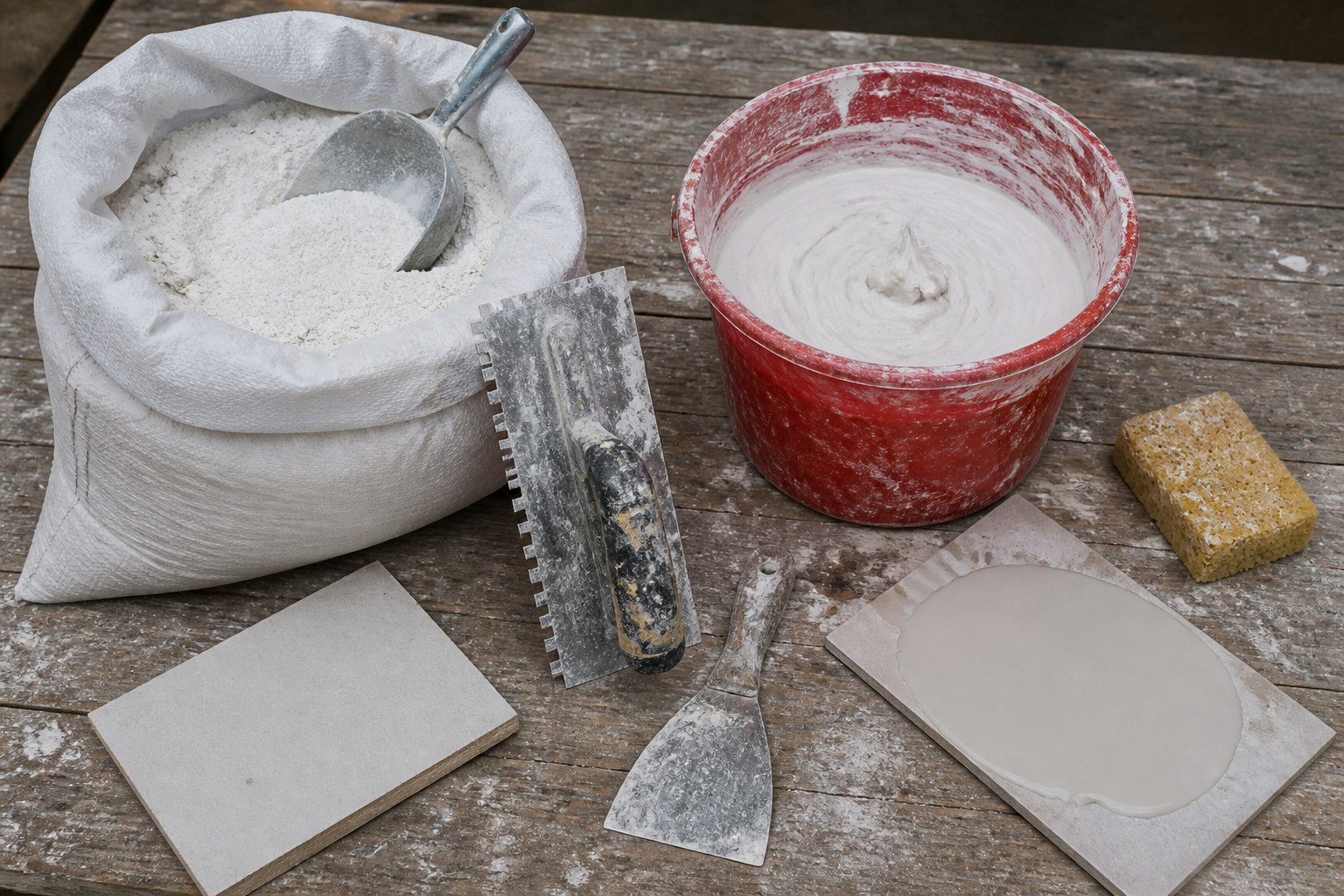
Tile Adhesives
I usually begin a tile adhesive discussion with the tile type, substrate, installation environment, and required standard classification. A basic interior ceramic tile installation presents different demands from a large-format tile, low-absorption tile, exterior façade, heated floor, or deformable substrate.3
A suitable RDP may support:
- Adhesion to the specified tile and substrate
- Bond retention after defined conditioning
- Cohesion within the adhesive layer
- Deformation tolerance
- Open-time performance as part of the overall additive system
- Reduced brittleness in the cured adhesive
I do not promise that any one grade will achieve a particular classification. If a buyer targets a standard such as an EN 12004 classification or a locally applicable equivalent, I ask the buyer to confirm the current test version and arrange formulation-specific testing.
EIFS and External Wall Systems
I see different priorities in EIFS bonding mortars and reinforced base coats. Bonding mortars must interact correctly with both the insulation board and substrate. Base coats must also work with reinforcement mesh and withstand service-related stress.
I may evaluate polymer modification for:
- Bonding to insulation boards or mineral substrates
- Impact and crack resistance
- Flexibility within the reinforced layer
- Water-related durability
- Cohesion in thin applied coats
I always consider the complete tested wall system.4 I do not assume that a good mortar result alone proves the performance of an entire façade assembly.
Wall Putty and Skim Coats
I find that putty buyers often report powdering, weak surface strength, sanding problems, cracking, or poor adhesion. These symptoms do not automatically mean that the formulation needs more RDP. The binder level, filler selection, particle grading, cellulose ether, water addition, substrate condition, and curing can create similar problems.5
A suitable grade may support adhesion, surface integrity, flexibility, and abrasion resistance. However, I recommend that the producer diagnose the failure before changing the polymer level.
Gypsum, Repair, and Self-Leveling Products
I treat gypsum plaster, repair mortar, and self-leveling compounds as separate formulation systems. Gypsum products may require careful control of setting behavior and compatibility. Repair mortars may prioritize adhesion, cohesion, shrinkage management, and mechanical durability. Self-leveling compounds may require a balance among flow, air control, surface quality, adhesion, and dimensional stability.
Customer-reported experience has shown me that a grade performing well in tile adhesive may behave differently in a gypsum-rich or highly fluid system. I describe this evidence as customer feedback, not as independent laboratory proof. I still require sample testing under the buyer’s own raw materials and test conditions.
Is Redispersible Polymer Powder the Same as HPMC?
Buyers sometimes ask me whether they can replace HPMC with redispersible polymer powder or reduce one additive by increasing the other. That substitution can create serious workability or hardened-performance problems. The two products serve different primary roles, even though dry-mix producers often use them together in the same formulation.
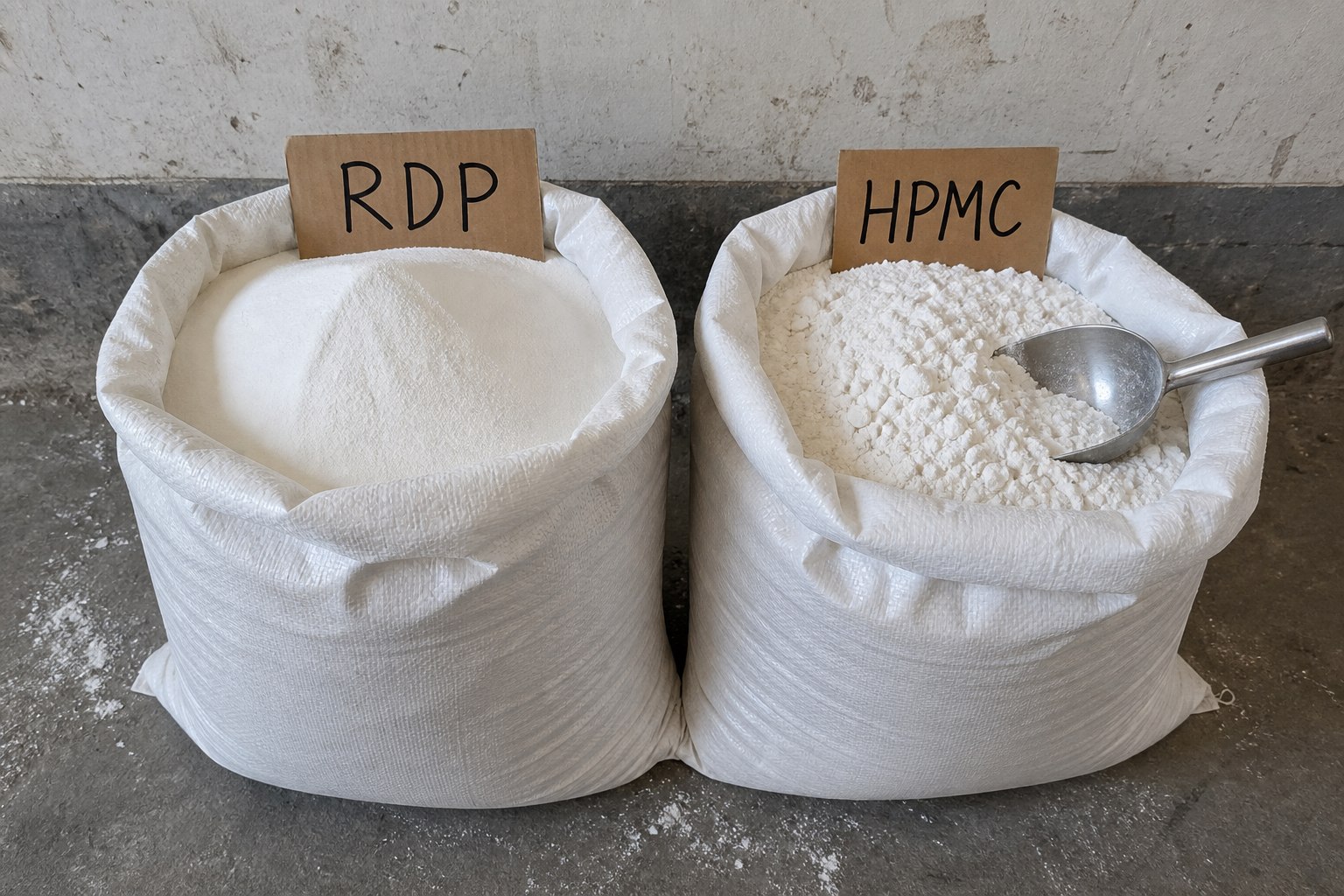
Redispersible polymer powder and HPMC are not interchangeable.6 I use RDP mainly as a polymer modifier for properties such as adhesion, cohesion, flexibility, and durability. I use hydroxypropyl methylcellulose mainly to manage water retention, thickening, consistency, sag resistance, and application workability. A formulation may need both products in a compatible balance.
I Separate Fresh-Mortar and Hardened-Mortar Priorities
I use a simple distinction during initial buyer consultations. HPMC mainly helps the producer manage the behavior of wet mortar during mixing and application. RDP mainly modifies selected properties that develop as the mortar sets and dries. This distinction is simplified, but it prevents the most common purchasing mistake.
| Evaluation point | Redispersible polymer powder | HPMC |
|---|---|---|
| Primary role | Polymer modification | Water retention and rheology control |
| Common fresh-mortar contribution | May influence application behavior depending on the system | Controls consistency, water retention, sag, and workability |
| Common hardened-mortar contribution | May support adhesion, cohesion, flexibility, and durability | Can influence the final result indirectly through hydration and application quality |
| Selection basis | Polymer chemistry, target property, formulation compatibility, testing | Viscosity, modification level, water retention, temperature behavior, compatibility |
| Direct substitute for the other? | No | No |
I often use tile adhesive as an example. HPMC can help retain water so that cement hydration and application remain manageable.7 It can also contribute to consistency and anti-sag behavior. A suitable RDP can modify the hardened adhesive and support bonding or deformation-related targets. Increasing RDP does not automatically correct rapid water loss, and increasing HPMC does not reproduce polymer modification.
I also avoid saying that “more is better.” Excess or poorly balanced additive use may change water demand, setting, air content, consistency, drying, cost, and final performance.8 The direction and size of those changes depend on the grade and formulation.
When a customer reports low bond strength, I ask several questions before blaming either additive:
- What cement, filler, and aggregate system does the customer use?
- What tile and substrate were tested?
- How much water did the operator add?
- What were the mixing, resting, and remixing procedures?
- What were the curing and conditioning conditions?
- Did the failure occur at the tile interface, substrate interface, or inside the mortar?
- Did the customer measure open time, slip, water retention, or air content?
- Did any raw material batch change?
I find that these questions frequently reveal a formulation or process issue that a simple additive substitution would not solve.
How Should I Select a Redispersible Polymer Powder Grade?
Grade selection becomes risky when a buyer provides only an application name and target price. “RDP for tile adhesive” describes a market category, not a complete technical requirement. I need more context before I can recommend a sample because tile adhesive formulations, standards, climates, and raw materials vary by market.
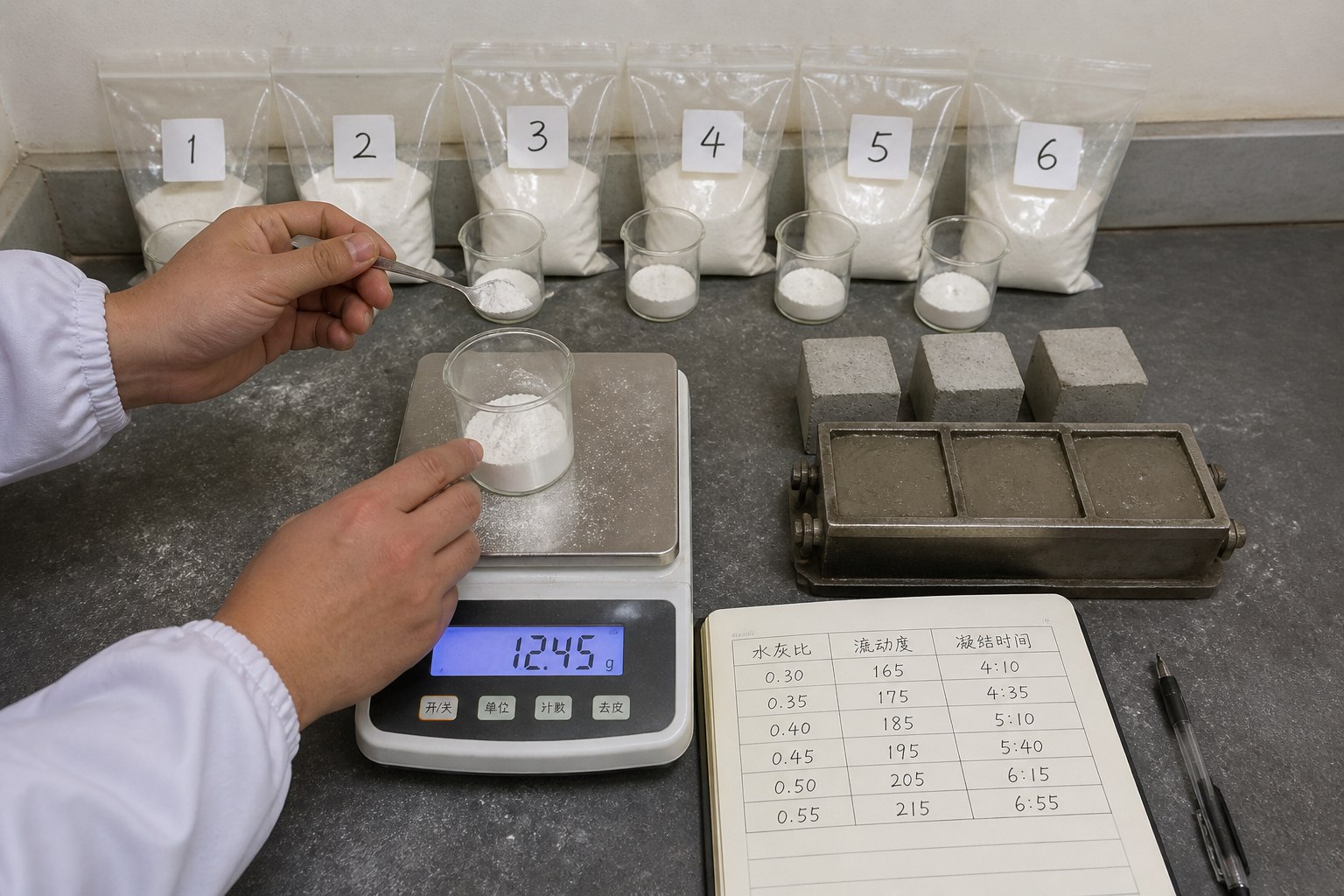
I select redispersible polymer powder through a diagnostic process: I identify the final application, document the present formulation and failure, define the desired improvement, shortlist compatible grades, establish a trial range, and compare samples under controlled conditions. I regard the finished-product test as the deciding evidence rather than the grade name, price, or one powder parameter.
Information I Request Before Recommending a Grade
I normally ask a prospective buyer to provide five categories of information:
-
Final application
I ask whether the product is a tile adhesive, EIFS mortar, putty, gypsum plaster, repair mortar, skim coat, or self-leveling compound. -
Existing formulation type
I request the main binder, aggregate or filler system, other additives, and current polymer type when disclosure is possible. -
Desired improvement
I ask whether the buyer wants better adhesion, flexibility, cohesion, water-conditioned performance, surface strength, or another defined property. -
Current failure
I request a description of cracking, powdering, debonding, brittleness, low wet adhesion, poor abrasion resistance, or processing difficulties. -
Available test data
I ask for the relevant test method, control result, target result, curing conditions, and failure mode.
I then recommend a structured comparison rather than an uncontrolled plant trial. A useful trial plan keeps the cement, sand, filler, cellulose ether, water ratio, mixing procedure, specimen preparation, and curing conditions constant. The formulator changes only the intended variable when possible.
A Practical Sample-Evaluation Sequence
I recommend the following workflow:
- Create a control batch without changing unrelated raw materials.
- Test shortlisted grades at justified trial levels rather than assuming a universal dosage.
- Adjust water carefully because equal consistency can matter when comparing formulations.
- Record fresh properties, including consistency, application feel, sag, flow, open time, and visible air behavior where relevant.
- Record hardened properties that correspond to the target, such as adhesion, deformation, abrasion, impact, or performance after conditioning.
- Repeat promising trials to distinguish a real improvement from normal test variation.
- Run a pilot production batch before adopting the grade commercially.
- Confirm compliance through a qualified laboratory when regulations, contracts, or product classifications require it.
I do not publish a universal RDP dosage because a useful level depends on the formulation, polymer grade, required classification, and test conditions. A number without those details can mislead a buyer and increase either technical risk or unnecessary cost.
I also consider total value. A lower-priced powder may require a different use level or may not meet the target. A higher-priced product does not automatically perform better. I compare cost per compliant tonne of finished mortar, batch consistency, technical support, documentation, and supply reliability.
How Can Buyers Evaluate Redispersible Polymer Powder Quality and Suppliers?
A sample may perform well, but bulk procurement introduces other risks. Buyers can face inconsistent batches, incomplete documentation, unsuitable packaging, or weak technical support. I therefore encourage customers to evaluate both the redispersible polymer powder and the manufacturer’s ability to reproduce and deliver the agreed specification.
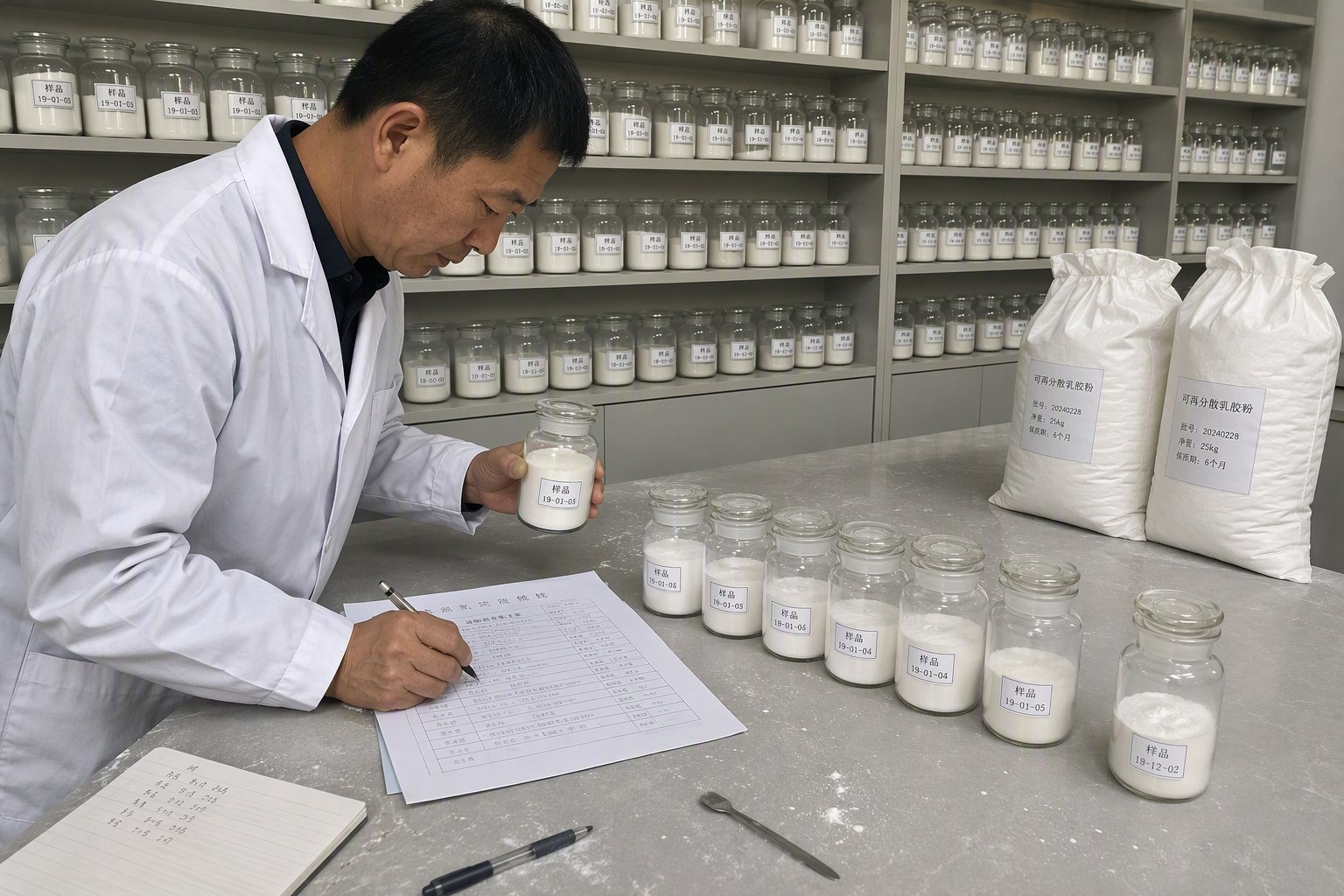
I evaluate a redispersible polymer powder supplier through sample performance, batch consistency, traceable quality-control records, technical communication, production capacity, packaging, and export support. I also review the COA, safety data, agreed specifications, and retained-sample process. I advise buyers to verify certificates and test claims instead of relying only on a logo, price, or sales statement.
I Review More Than One Powder Parameter
I regularly see purchase inquiries that define quality through ash content or one other value. A single result cannot prove application suitability. It can support identification or consistency control, but the finished dry mix remains the relevant performance system.
Depending on the agreed specification and method, a buyer may review:
- Appearance and visible uniformity
- Moisture or volatile content
- Ash-related data
- Bulk density
- Particle-size distribution
- Redispersion behavior
- Polymer or solids-related information
- Film-related characteristics where relevant
- Batch-to-batch variation
- Finished-mortar performance in a reference formulation
I recommend that buyers agree on the test method, not just the parameter name. Two laboratories may report different results if they use different temperatures, preparation methods, instruments, or calculation bases.9
Supplier-Qualification Checklist
| Supplier question | Why I ask it | Evidence a buyer can request |
|---|---|---|
| Can the factory maintain an agreed specification? | Stable production supports repeatable formulations | COAs from multiple batches and incoming inspection results |
| Does the supplier retain samples? | Retained samples help investigate complaints | Written retention procedure and traceable batch codes |
| Can the supplier discuss the application? | Technical context improves grade selection | Technical data sheet, questionnaire, and trial guidance |
| Are documents current and product-specific? | Generic documents can hide important differences | Product-specific COA, SDS/MSDS, and technical data |
| Can the supplier support bulk exports? | Good powder is not useful if delivery is unreliable | Packaging details, lead times, loading plan, and export records |
| Are certifications or audit claims verifiable? | Buyers need valid evidence for qualification | Current certificates, scope, issuing body, and verification route |
At Jinghong Chemical, we manufacture construction additives including RDP, HPMC, HEC, and MHEC, and we support OEM packaging and export documentation. I present that information as our business context, not as independent proof that every grade will suit every buyer. I encourage customers to audit suppliers, verify documents, test samples, and define acceptance criteria in the purchase agreement.
I also recommend pre-shipment or third-party inspection when the purchase risk justifies it. Buyers should involve qualified laboratories or technical professionals for application-specific compliance, façade systems, waterproofing systems, and other uses in which failure may have significant safety or financial consequences.
Frequently Asked Questions
Is redispersible polymer powder used only to improve adhesion?
No. I use redispersible polymer powder to target several possible properties, including adhesion, cohesion, flexibility, abrasion resistance, water-conditioned performance, impact behavior, and durability. The relevant effect depends on the polymer grade, dosage, binder system, other additives, substrate, curing conditions, and test method.
Can I replace HPMC with redispersible polymer powder?
No. I do not treat RDP and HPMC as substitutes. RDP mainly provides polymer modification, while HPMC mainly manages water retention, thickening, consistency, and workability. Many tile adhesives and mortars use both because each additive performs a different role.
Does adding more RDP always improve mortar performance?
No. I do not assume that a higher addition level always produces a better result. Extra polymer can raise cost and may affect water demand, air content, consistency, setting, or other properties. I recommend formulation-specific trials that compare relevant fresh and hardened performance at controlled conditions.
What information should I provide when requesting an RDP sample?
I recommend providing the final application, main formulation type, current RDP or additive system, target performance, present failure, applicable test standard, and available results. I can make a more relevant sample recommendation when I also know the substrate, curing method, climate, packaging needs, and expected order volume.
How should I compare two RDP suppliers?
I compare suppliers through controlled application tests, multiple-batch COAs, specification consistency, document quality, retained-sample procedures, technical support, packaging, production capacity, and delivery reliability. I verify certificates and product claims independently when they affect qualification. I do not select a supplier through price or one powder parameter alone.
Conclusion
Redispersible polymer powder is used to provide targeted polymer modification in tile adhesives, EIFS mortars, putties, gypsum products, repair mortars, and other dry mixes. I select it by diagnosing the application, current failure, desired improvement, and required test result. I never treat RDP as a universal additive or an HPMC substitute. If you need a suitable RDP grade, sample, COA, SDS/MSDS, OEM package, or export quotation, contact Jinghong Chemical with your formulation type and performance target so our team can recommend a structured trial.
<!-- JH_HPMC_APPLICATION_LINKS_START --><p class="jh-related-applications"><strong>Related HPMC applications:</strong> Because RDP works inside a complete dry-mix system, review the HPMC selection guidance for <a href="https://jinghonghpmc.com/hpmc-for-dry-mix-mortar/">HPMC for dry-mix mortar</a> and <a href="https://jinghonghpmc.com/hpmc-for-tile-adhesive/">HPMC for tile adhesive</a> when planning your trials.</p><!-- JH_HPMC_APPLICATION_LINKS_END -->
<!-- JH_RDP_APPLICATION_LINKS_V1_START -->
Explore RDP by Mortar Application
Select an RDP grade according to the mortar application, substrate, binder system and measurable test target:
- RDP/VAE product overview
- RDP for Dry-Mix Mortar
- RDP for Tile Adhesive
- RDP for Wall Putty & Skim Coat
- RDP for Repair Mortar
- RDP for EIFS & External Insulation <!-- JH_RDP_APPLICATION_LINKS_V1_END -->
"Review Preparation and applications of hydrophobic ...", https://www.sciencedirect.com/science/article/abs/pii/S0950061820305845. Studies of polymer-modified cementitious materials report improvements in properties such as adhesion, tensile or flexural behavior, abrasion resistance, and resistance to water exposure, although the magnitude and direction of each effect depend on polymer chemistry, dosage, and mortar composition. Evidence role: general_support; source type: paper. Supports: Independent experimental or review literature should document how redispersible polymer modification can affect adhesion, cohesion, flexibility, abrasion behavior, water resistance, or durability in mineral mortars.. Scope note: The literature supports these effects as formulation-dependent possibilities, not as guaranteed results for every redispersible polymer powder or gypsum-based system. ↩
"Internal Curing of Concrete | NIST", https://www.nist.gov/el/concrete-bibliographic-databases/internal-curing-concrete. Mortar research identifies binder composition, aggregate grading, water-to-binder ratio, admixture interactions, curing history, and specimen geometry as variables that can materially affect fresh and hardened test results. Evidence role: general_support; source type: research. Supports: Research should establish that binder chemistry, aggregate grading, water ratio, admixtures, curing, and specimen dimensions influence mortar properties and the measured effect of polymer modification.. Scope note: A general mortar-science source may support the importance of these variables without quantifying every listed interaction specifically for RDP. ↩
"Sanded Grout - U.S. Embassy in Uganda", https://ug.usembassy.gov/wp-content/uploads/sites/212/2026/05/Technical-Specifications-1-small.pdf. Tile-adhesive standards distinguish products through tested characteristics such as tensile adhesion, open time, slip, and deformability, reflecting the different demands associated with substrates, tile types, and exposure conditions. Evidence role: expert_consensus; source type: institution. Supports: A standards or technical-institution source should show that tile adhesive selection and testing depend on installation conditions and required characteristics such as adhesion, open time, slip, and deformability.. Scope note: A classification standard establishes test categories and thresholds but does not prescribe one RDP grade for every installation. ↩
"Impact of Detailing on the Lateral Performance of Cold- ...", https://tsapps.nist.gov/publication/get_pdf.cfm?pub_id=933727. Technical assessment frameworks for external thermal insulation composite systems evaluate the assembled kit—including insulation, bonding or fixing components, reinforced base coat, and finish—because component-level results alone do not establish whole-system performance. Evidence role: expert_consensus; source type: institution. Supports: An external wall or ETICS assessment document should treat insulation, adhesive, base coat, reinforcement, finishes, and fixings as interacting components of a system.. ↩
"The effect of water-to-binder ratio (W/B) on pore structure of ...", https://pmc.ncbi.nlm.nih.gov/articles/PMC9938476/. Studies of thin cementitious coatings associate cracking, weak surface development, and adhesion loss with interacting factors that include binder content, particle packing, mixing water, substrate absorption, and curing conditions. Evidence role: mechanism; source type: paper. Supports: Research should explain how binder content, particle packing, water addition, substrate suction, and curing influence shrinkage, surface strength, and adhesion in thin mortar layers.. Scope note: Evidence from renders, repair layers, or skim coats may be contextually applicable to wall putty but may not directly test every commercial putty formulation. ↩
"Water Retention Mechanism of HPMC in Cement Mortar - PMC", https://pmc.ncbi.nlm.nih.gov/articles/PMC7372461/. Mortar literature characterizes hydroxypropyl methylcellulose primarily as a cellulose-ether rheology and water-retention modifier, whereas redispersible polymer powder supplies a film-forming polymer phase; these distinct mechanisms do not make the materials direct substitutes. Evidence role: definition; source type: paper. Supports: A source should distinguish cellulose ether's water-retention and rheological functions from the film-forming polymer modification provided by RDP.. Scope note: Both additives can have secondary effects on fresh and hardened properties, so the distinction concerns their primary functions rather than an absolute separation of effects. ↩
"Water Retention Mechanism of HPMC in Cement Mortar - PMC", https://pmc.ncbi.nlm.nih.gov/articles/PMC7372461/. Experimental studies show that hydroxypropyl methylcellulose can increase mortar water retention and alter rheology and cement hydration kinetics, thereby affecting application and early curing behavior. Evidence role: mechanism; source type: paper. Supports: Experimental research should document HPMC's effect on water retention, rheology, and hydration kinetics in cementitious mortar.. Scope note: HPMC may retard or otherwise modify hydration depending on its chemistry and dosage, so retained water does not necessarily translate into uniformly greater hydration at every age. ↩
"Effect of Cellulose Ether and Starch Ether on Hydration ... - PMC", https://pmc.ncbi.nlm.nih.gov/articles/PMC9782582/. Dosage studies of dry-mix mortar additives report non-linear effects on water demand, rheology, entrained air, setting, drying, and mechanical performance, supporting formulation-specific optimization rather than a presumption that higher addition is always beneficial. Evidence role: general_support; source type: paper. Supports: Dosage-response studies should show that polymer powders and cellulose ethers can alter water demand, air content, setting, consistency, and mechanical properties, with higher dosages not always producing a net benefit.. Scope note: The direction and magnitude of each effect depend on the additive chemistry and the reference formulation. ↩
"Interlaboratory "Pilot Run" Study of Small Heat-Flow-Meter ...", https://tsapps.nist.gov/publication/get_pdf.cfm?pub_id=860775. Standards on test-method precision recognize that specimen preparation, environmental conditions, instrumentation, operator procedure, and calculation rules can contribute to differences between laboratories, making an agreed method essential for comparable results. Evidence role: mechanism; source type: institution. Supports: A metrology or standardization source should establish that specimen preparation, environmental conditions, instrumentation, calculations, and operator procedures contribute to reproducibility differences between laboratories.. Scope note: Such guidance establishes the general sources of interlaboratory variability but does not quantify the expected difference for every RDP parameter. ↩