Introduction
For manufacturers of tile adhesives, wall putty, gypsum plaster, EIFS, self-leveling compounds, and other dry mix mortars, Hydroxypropyl Methyl Cellulose (HPMC) is far more than a simple additive. Its quality directly influences water retention, workability, open time, anti-sag performance, and ultimately the consistency of the finished product.
One of the biggest challenges facing mortar manufacturers is batch-to-batch variation. Even minor fluctuations in viscosity or purity can require costly formulation adjustments, increase production waste, and affect product performance in the field.
At Jinghong Chemical, quality control is integrated into every stage of manufacturing rather than being treated as a final inspection step. From carefully selected raw materials and automated production systems to laboratory verification and application performance testing, every batch follows standardized procedures designed to deliver reliable, repeatable quality.
This article provides an inside look at Jinghong’s HPMC quality control process and explains how our laboratory testing, production management, and application verification work together to ensure every shipment meets the expectations of customers around the world.
Standardizing Excellence: Core Laboratory Testing
Every Batch Starts with Scientific Verification
Quality begins long before products are packed for shipment.
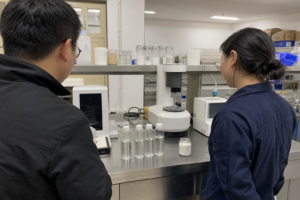
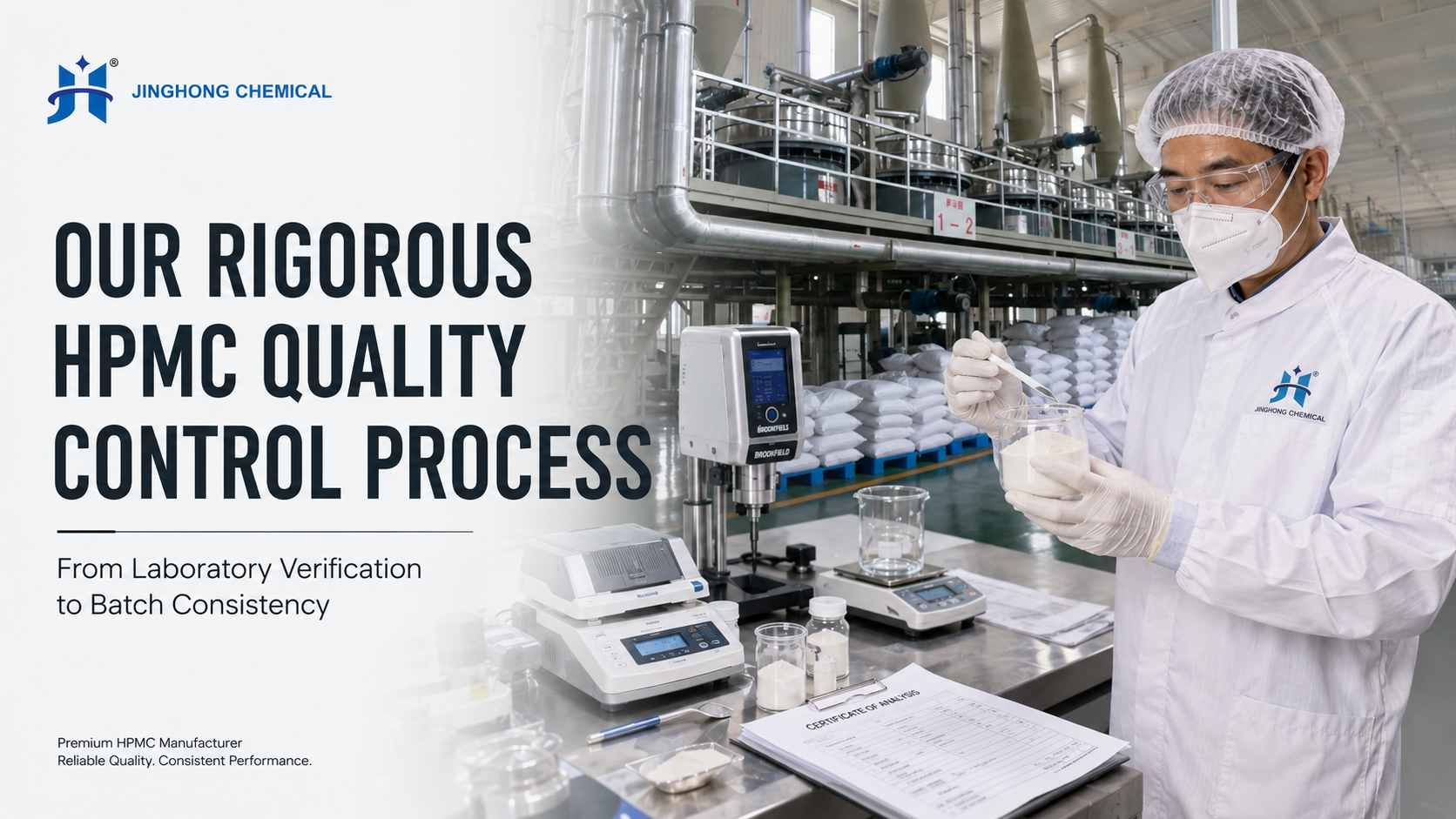
Every production batch entering our laboratory undergoes comprehensive physical and chemical testing. Professional quality engineers verify that each specification meets internal quality standards before the product is released.
Our quality control laboratory is equipped with modern analytical instruments capable of accurately measuring viscosity, moisture, pH value, ash content, whiteness, and other critical performance indicators. Every result is digitally recorded for complete production traceability.
Instead of relying solely on production experience, Jinghong combines standardized testing procedures with modern laboratory equipment to ensure consistent results throughout every manufacturing cycle.
Key Laboratory Tests
Each production batch typically undergoes the following inspections:
- Brookfield Viscosity Testing
- Moisture Content Analysis
- Ash Content Measurement
- pH Value Testing
- Whiteness Inspection
- Particle Size Evaluation
- Bulk Density Testing
- Dissolution Performance Verification
These tests ensure that every batch maintains stable physical properties before moving to packaging and shipment.
Typical Quality Parameters
| Test Item | Purpose |
|---|---|
| Brookfield Viscosity | Confirms viscosity grade consistency |
| Moisture Content | Ensures storage stability |
| Ash Content | Verifies product purity |
| pH Value | Maintains chemical stability |
| Whiteness | Indicates manufacturing consistency |
| Dissolution Test | Evaluates solution performance |
| Bulk Density | Supports formulation consistency |
Consistent laboratory testing allows customers to reduce production variability while improving formulation reliability across different production batches.
# Ensuring Batch Consistency Through Automated Manufacturing

## Intelligent Production Control

Consistent product quality depends not only on laboratory testing but also on stable manufacturing processes.

Jinghong Chemical operates modern production facilities equipped with automated control systems that continuously monitor critical production parameters throughout the manufacturing cycle. From raw material feeding to etherification, purification, drying, and packaging, every production stage follows standardized operating procedures to minimize variation and improve repeatability.

Production engineers monitor reaction temperature, pressure, material ratios, and processing time in real time, ensuring every batch remains within strict operating limits.

This combination of automation and standardized process management significantly reduces human error while improving long-term production stability.

---

## Automated Quality Control Throughout Production

To maintain consistent HPMC quality, multiple production checkpoints are implemented during manufacturing.

Our production management system includes:

- Automated raw material dosing
- Distributed Control System (DCS) monitoring
- Precise temperature and pressure control
- Automated pH adjustment
- Multi-stage purification process
- Controlled drying and milling
- Particle size screening
- Finished product inspection
- Batch identification and traceability

Every production batch receives a unique identification code that records manufacturing data from raw material inspection through final packaging. This traceability system allows every shipment to be tracked quickly and accurately whenever technical support or quality verification is required.

---

## Advantages of Automated Manufacturing

Compared with conventional manual production, automated manufacturing delivers several important benefits:

- Improved viscosity consistency
- Reduced batch-to-batch variation
- Higher product purity
- Better production efficiency
- Stable long-term supply capability
- Complete manufacturing traceability

These advantages help customers reduce formulation adjustments, improve production efficiency, and achieve more reliable product performance.

---

# From Laboratory Verification to Construction Performance

## Testing Under Real Application Conditions

Laboratory data provides valuable technical information, but practical application testing is equally important.

Before shipment, representative HPMC grades are evaluated using actual dry mix mortar formulations. These application tests verify that laboratory specifications translate into dependable construction performance under realistic working conditions.

Testing is performed using formulations commonly found in the construction industry, including:

- Tile Adhesive
- Wall Putty
- Gypsum Plaster
- Cement Mortar
- EIFS
- Self-Leveling Compounds

Fresh mortar samples are prepared using standardized formulas before engineers evaluate key application properties.

---

## Performance Verification

The application laboratory evaluates multiple performance indicators that directly influence construction quality.

### Water Retention

Excellent water retention helps maintain proper cement hydration while reducing premature moisture loss during installation.

### Workability

Stable rheological performance provides smooth mixing, easier trowel application, and improved finishing quality.

### Open Time

Adequate open time allows installers additional working time while maintaining reliable bonding performance.

### Sag Resistance

High anti-sag performance helps prevent tile movement during vertical installation.

### Adhesion Performance

Consistent polymer distribution contributes to reliable bonding strength between mortar and substrate under different construction conditions.

By combining laboratory analysis with application verification, Jinghong ensures that every HPMC grade performs consistently not only on testing equipment but also on real construction projects.

---

# Complete Quality Assurance Process

Every HPMC production batch follows the same standardized quality assurance workflow:

1. **Raw Material Inspection** – Incoming refined cotton and auxiliary materials are inspected before entering production.

2. **Automated Manufacturing** – Production parameters are monitored continuously through standardized operating procedures.

3. **Laboratory Testing** – Finished products undergo comprehensive physical and chemical analysis.

4. **Application Verification** – Representative samples are tested in practical mortar formulations.

5. **Packaging Inspection** – Packaging integrity, labeling, and moisture protection are verified.

6. **Warehouse Storage** – Qualified products are stored in a clean, dry environment before shipment.

7. **Final Export Inspection** – Every shipment undergoes a final quality review before delivery to international customers.

This complete quality assurance system ensures every customer receives HPMC with reliable, repeatable performance regardless of production batch.

---
Every shipment is verified before it reaches your line. To see how these controls translate into working performance, review our HPMC for tile adhesive trials and HPMC for dry-mix mortar trials application pages.