When I speak with dry mortar manufacturers and construction material distributors, I often hear the same concern. They want stable HPMC quality, competitive pricing, and reliable delivery. Unfortunately, many buyers discover these problems only after production delays or inconsistent product performance.
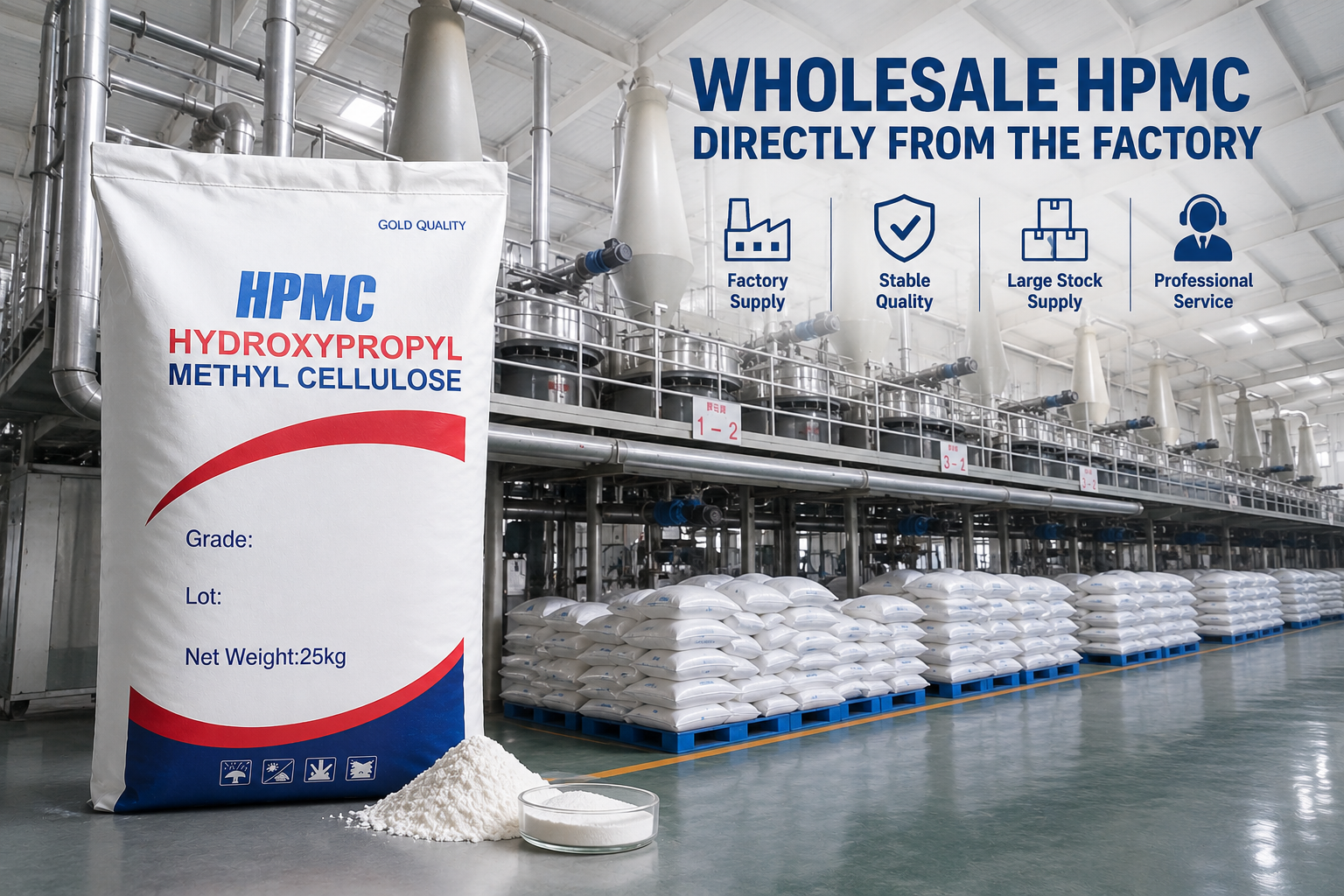
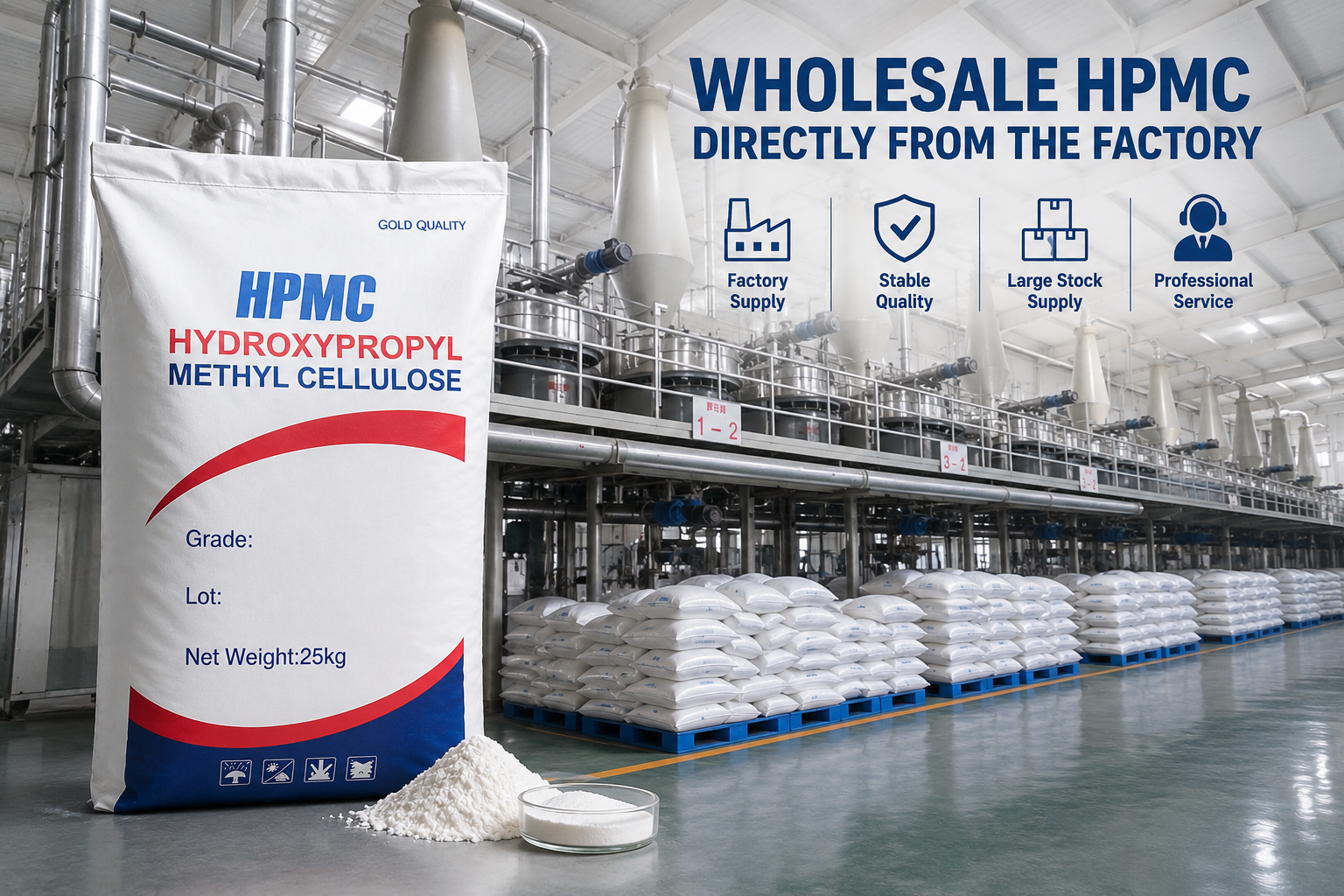
Buying wholesale HPMC directly from the factory offers lower costs, stable product quality, faster technical support, and a more reliable supply chain than purchasing through multiple trading companies. It is one of the most effective ways to improve long-term purchasing efficiency and product consistency.
Wholesale HPMC Factory
Over the past several years, I have worked with customers from Southeast Asia, Africa, and the Middle East. Some were purchasing Hydroxypropyl Methyl Cellulose (HPMC) for the first time. Others had already changed suppliers several times because of unstable viscosity, delayed shipments, or poor technical service. One thing became clear after these conversations. Choosing the right factory is often more important than negotiating the lowest price.
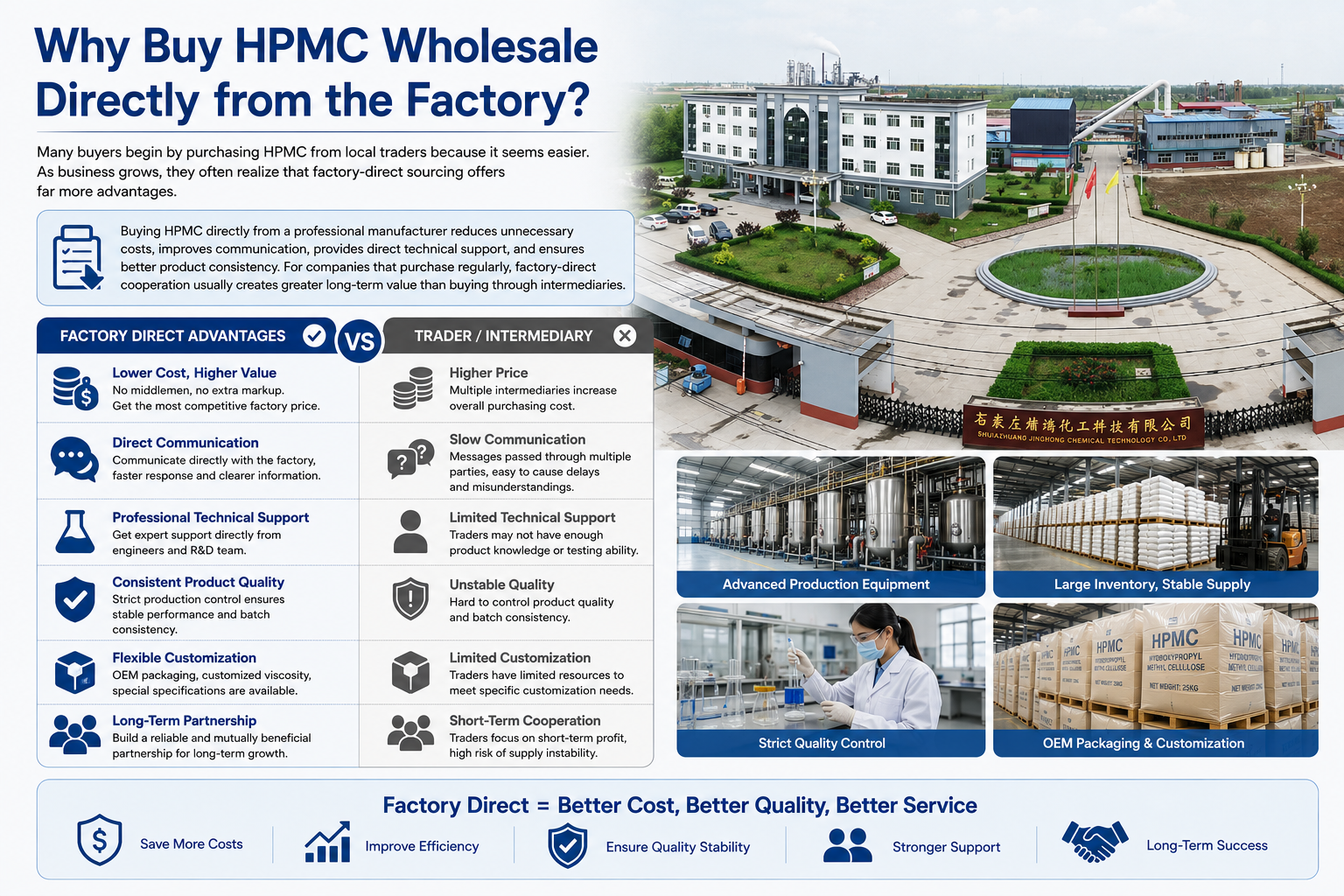
Why Buy HPMC Wholesale Directly from the Factory?
Many buyers begin by purchasing HPMC from local traders because it seems easier. As business grows, they often realize that factory-direct sourcing offers far more advantages.
Buying HPMC directly from a professional manufacturer reduces unnecessary costs, improves communication, provides direct technical support, and ensures better product consistency. For companies that purchase regularly, factory-direct cooperation usually creates greater long-term value than buying through intermediaries.
HPMC Manufacturer
Why More Buyers Are Working Directly with Manufacturers
The construction chemicals market has become much more competitive. Buyers are no longer looking for a supplier that simply offers the lowest quotation. They want stable quality, predictable lead times, and technical support when production problems occur.
When I discuss purchasing plans with customers, I usually encourage them to look beyond the unit price. A slightly cheaper product can become much more expensive if it causes inconsistent mortar performance, customer complaints, or production downtime.
Working directly with an HPMC factory allows buyers to communicate with engineers instead of sales agents who may not fully understand the formulation. If customers need a different viscosity, better water retention, or improved workability, the factory can usually recommend a more suitable grade much faster.
Another important advantage is supply stability. Trading companies often purchase products from several factories depending on price. That means product specifications may change from one shipment to another. A dedicated manufacturer normally follows strict production procedures and quality control systems, making batch consistency much easier to maintain.
Factory Direct vs. Trading Company
| Factory Direct | Trading Company |
|---|---|
| Lower purchasing cost | Additional markup |
| Stable production source | Depends on different factories |
| Direct technical communication | Limited technical knowledge |
| Customized viscosity available | Usually standard products only |
| OEM packaging support | Limited options |
| Better production planning | Supply may change frequently |
Why China Has Become a Leading HPMC Manufacturing Base
China has become one of the world’s largest producers of cellulose ether because it combines mature manufacturing technology, large-scale production capacity, experienced technical teams, and a complete raw material supply chain.
Large manufacturers also invest heavily in automated production lines, laboratory testing, and quality management systems. These investments help improve product consistency while keeping production costs competitive.
For buyers importing HPMC, this creates a strong balance between quality and price. Instead of managing several small suppliers, many distributors now prefer building long-term partnerships with one experienced factory that can support future business growth.
If you would like to learn more about HPMC performance in construction materials, you may also find these articles helpful:
- How Does HPMC Improve Tile Adhesive Performance?
- What Is HPMC and Why Is It Important in Dry Mortar?
For additional technical references, I also recommend reviewing information published by:
- ASTM International — https://www.astm.org
- ISO Standards — https://www.iso.org
-
WACKER Construction Polymers — https://www.wacker.com
These organizations provide valuable technical information about construction materials, testing methods, and quality standards used throughout the industry.
Bulk HPMC Supply
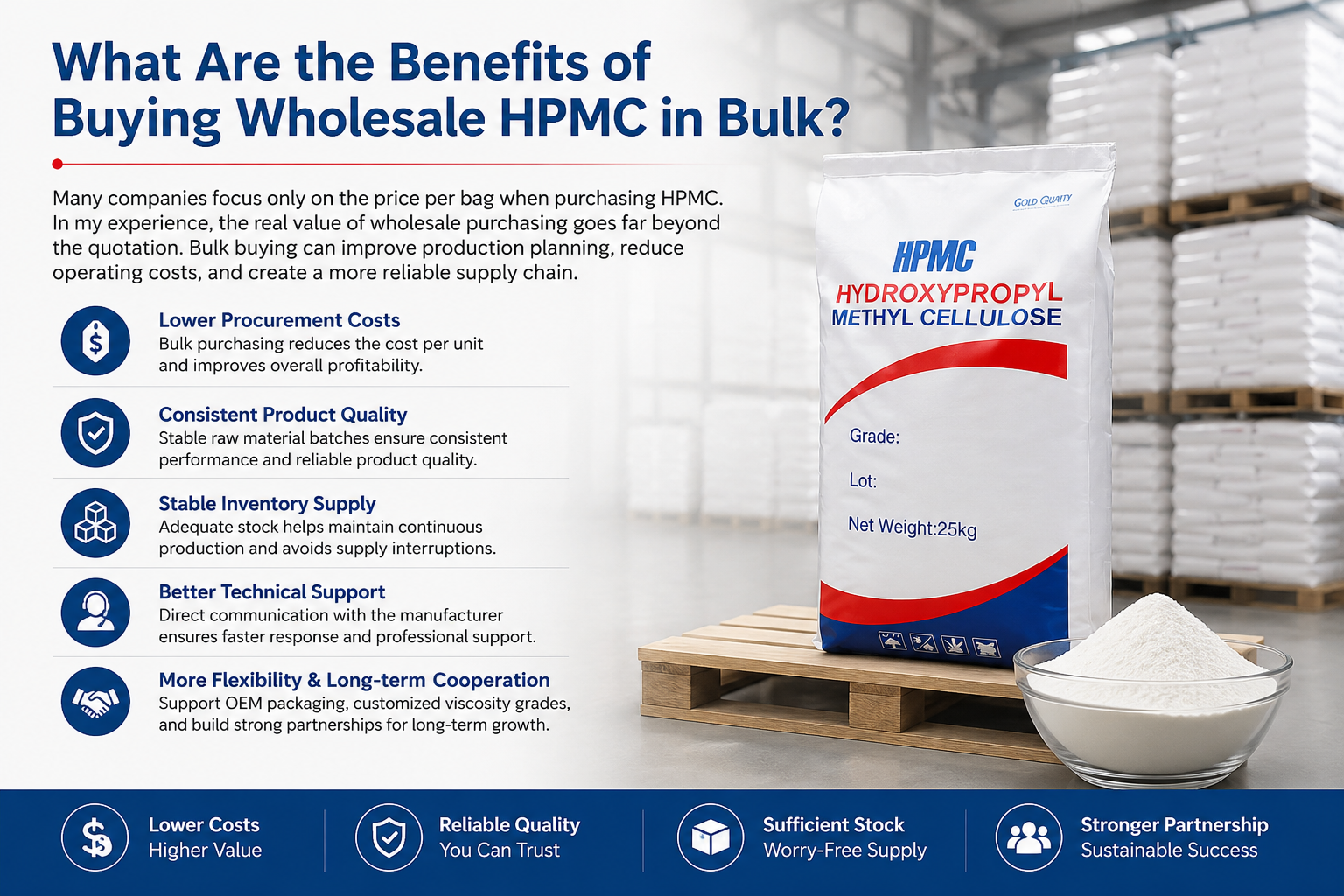
Lower Purchasing Costs Without Sacrificing Quality
Every manufacturer wants to reduce production costs. However, selecting the lowest-priced HPMC is rarely the best long-term decision.
When purchasing directly from a factory, buyers eliminate unnecessary middlemen. Factory pricing is usually more competitive because products move directly from production to export. For companies ordering full containers or establishing annual purchasing agreements, this difference becomes even more significant.
Lower purchasing costs also improve profit margins for distributors and construction material manufacturers. Instead of constantly changing suppliers to chase small price differences, many successful companies prefer building long-term relationships with one reliable factory that offers stable pricing and dependable quality.
Stable Product Quality Means Stable Production
Consistent quality is one of the biggest advantages of wholesale purchasing.
Dry mortar formulations depend heavily on HPMC performance. Even small changes in viscosity, particle size, or water retention can affect tile adhesive, wall putty, skim coat, or gypsum plaster.
A professional manufacturer follows strict production procedures and laboratory testing before every shipment. This helps ensure every batch performs consistently during production.
When product quality remains stable, manufacturers experience:
- Fewer production interruptions
- More consistent mortar performance
- Lower customer complaint rates
- Better product reputation
- Reduced quality inspection costs
For many buyers, these benefits are worth far more than a small difference in purchase price.
Better Supply Planning and Inventory Management
Construction markets can change quickly. Demand often increases before building seasons, creating pressure on raw material inventories.
Wholesale purchasing allows buyers to plan production months in advance instead of placing frequent small orders.
Large manufacturers usually maintain higher production capacity and organized inventory systems, making it easier to guarantee delivery schedules.
This creates several advantages:
- Reduced risk of stock shortages
- Faster shipment scheduling
- Better container utilization
- Lower transportation costs per ton
- Easier annual procurement planning
For distributors serving multiple customers, reliable inventory management can become an important competitive advantage.
More Services Beyond the Product
One reason I recommend working directly with experienced HPMC factories is the additional services they provide.
A professional manufacturer usually offers much more than cellulose ether alone.
These services may include:
- Free product samples
- COA (Certificate of Analysis)
- MSDS documentation
- Technical formulation advice
- OEM packaging
- Customized labeling
- Export documentation
- Loading inspection support
These services save buyers both time and operating costs while making import procedures much easier.
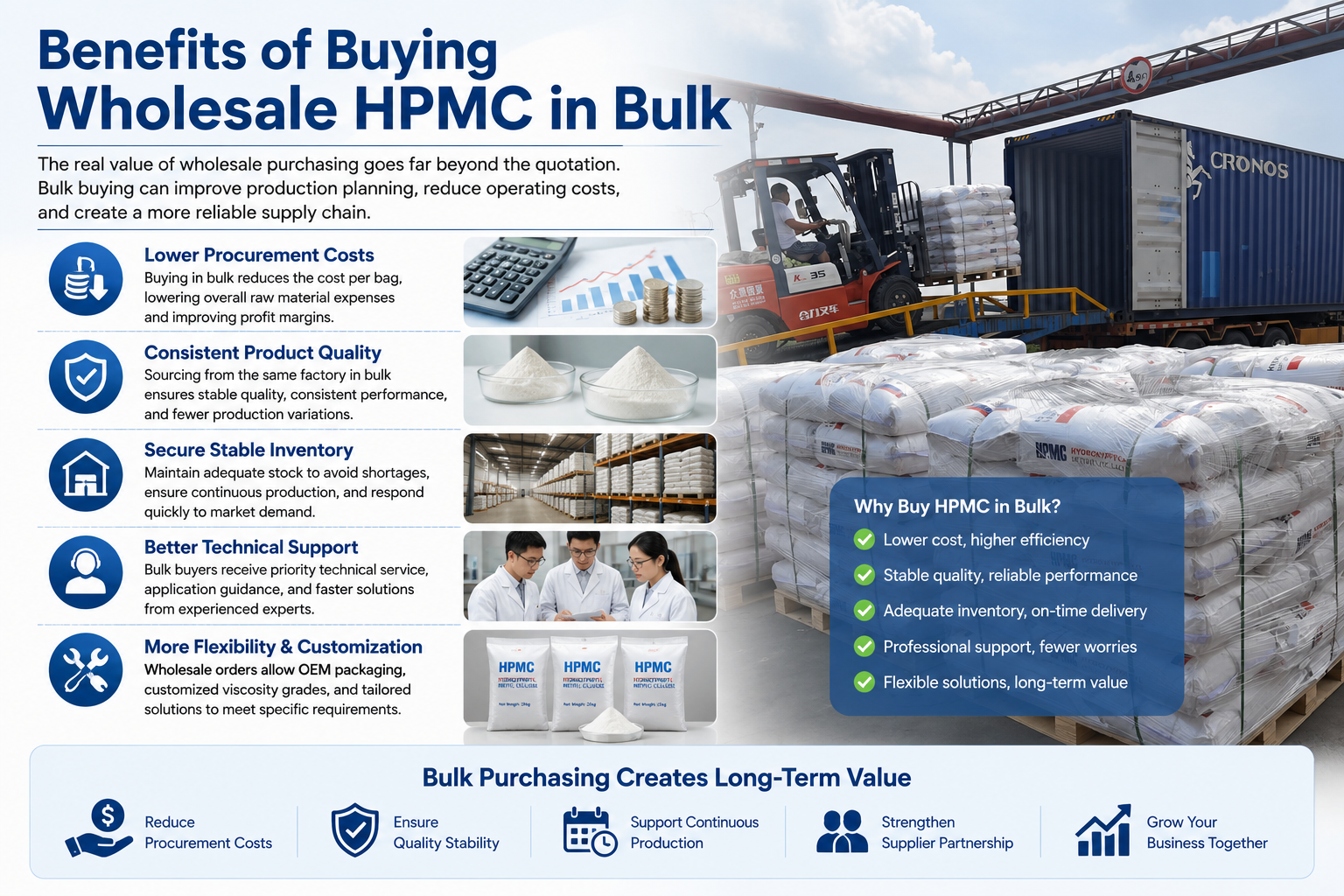
Benefits of Buying HPMC in Bulk
| Benefit | Why It Matters |
|---|---|
| Lower Cost | Higher profit margin and reduced purchasing expenses |
| Stable Quality | Consistent mortar performance and fewer complaints |
| Bulk Inventory | Prevents production delays during peak seasons |
| OEM Packaging | Supports private label business development |
| Technical Support | Faster formulation optimization and troubleshooting |
| Reliable Delivery | Better production scheduling and customer satisfaction |
| Export Experience | Easier customs clearance and documentation |
| Long-Term Partnership | Stable pricing and continuous supply |
Wholesale Purchasing Creates Long-Term Value
Many buyers initially compare suppliers only by price. Later, they discover that communication, product consistency, and after-sales service have a much greater impact on their business.
I have seen customers save far more money by reducing production problems than by purchasing the cheapest HPMC available.
A reliable wholesale supplier helps customers improve production efficiency, reduce waste, and build stronger relationships with their own clients. That creates value for every shipment, not just the first order.
If you are comparing suppliers, you may also find these articles useful:
- Benefits of Polymer Additives in Dry Mortar
- How to Select the Right HPMC Grade for Tile Adhesive
- What Exactly Is Redispersible Polymer Powder and How Is It Made?
For additional industry information, I recommend these resources:
- European Construction Products Regulation — https://single-market-economy.ec.europa.eu
- Dow Construction Chemicals — https://www.dow.com
-
WACKER Polymer Dispersions — https://www.wacker.com
These resources provide useful information about construction material performance, quality management, and polymer technology used throughout the dry mortar industry.
How to Choose a Reliable HPMC Factory Supplier?
Choosing the right HPMC supplier is about much more than comparing quotations. A low price may look attractive at first, but inconsistent quality, delayed deliveries, and poor technical support can quickly increase production costs.
A reliable HPMC factory should provide stable production capacity, strict quality control, experienced technical support, complete export documentation, and consistent product quality. Long-term cooperation with the right manufacturer reduces purchasing risk and improves production efficiency.
HPMC Factory Quality Control
Evaluate the Factory’s Production Capacity
The first thing I recommend checking is whether the supplier is a real manufacturer or simply a trading company.
A professional HPMC factory should be able to clearly explain:
- Annual production capacity
- Number of production lines
- Main export markets
- Available viscosity grades
- Production lead times
- Monthly output
Large production capacity usually means the factory can maintain stable supply during busy construction seasons. It also reduces the risk of shipment delays when demand increases.
Factories with automated production lines generally produce more consistent products than factories relying heavily on manual operations.
Review the Quality Control System
Product consistency is one of the biggest concerns for dry mortar manufacturers.
A professional HPMC supplier should operate a complete quality control process that covers:
- Raw material inspection
- Production monitoring
- Finished product testing
- Batch traceability
- Packaging inspection
- Final shipment verification
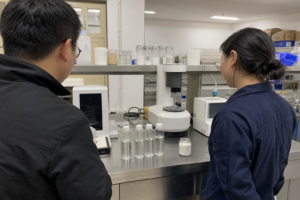
Ask the supplier what laboratory equipment they use and how they test viscosity, moisture content, ash content, particle size, and water retention.
Reliable factories are usually willing to share technical data and explain their testing procedures.
Look Beyond the Product
The best supplier does more than manufacture HPMC.
In my experience, the strongest suppliers become long-term technical partners.
They help customers:
- Select suitable viscosity grades
- Optimize mortar formulations
- Solve production problems
- Recommend dosage adjustments
- Improve construction performance
- Develop new products
This level of technical support becomes especially valuable when producing tile adhesive, skim coat, wall putty, gypsum plaster, or self-leveling mortar.
Check Export Experience
International trade requires more than manufacturing experience.
An experienced exporter should understand:
- Container loading
- Export packaging
- Customs documentation
- COA (Certificate of Analysis)
- MSDS (Material Safety Data Sheet)
- Shipping schedules
- Destination market requirements
Suppliers with extensive export experience usually communicate more efficiently and handle unexpected issues much faster.
For distributors importing regularly, this can save significant time and reduce supply chain risks.
Supplier Evaluation Checklist
Before choosing a long-term HPMC supplier, I recommend reviewing the following points.
| Checklist | Yes / No |
|---|---|
| Own Manufacturing Factory | ✓ |
| Automatic Production Lines | ✓ |
| Stable Batch Quality | ✓ |
| Professional Laboratory | ✓ |
| COA Available | ✓ |
| MSDS Available | ✓ |
| OEM Packaging | ✓ |
| Technical Support Team | ✓ |
| Export Experience | ✓ |
| Free Samples | ✓ |
If several suppliers offer similar prices, this checklist often helps identify which one will provide the greatest long-term value.
Questions I Always Recommend Asking
Before placing a container order, I usually encourage buyers to ask these questions:
- What viscosity grades do you produce?
- Can you recommend the right grade for my formulation?
- How do you control batch consistency?
- What is your monthly production capacity?
- Can you provide COA and MSDS before shipment?
- Do you support OEM packaging?
- How long is the normal production lead time?
- Can I receive samples before placing a bulk order?
The answers often reveal much more than the quotation itself.
For more information about construction chemical standards and cellulose ether applications, you may also find these resources useful:
- ASTM International — https://www.astm.org
- ISO Standards — https://www.iso.org
- European Chemicals Agency (ECHA) — https://echa.europa.eu
- WACKER Construction Chemicals — https://www.wacker.com
You may also like:
- What Is HPMC and Why Is It Essential in Dry Mortar?
- How Does HPMC Improve Tile Adhesive Performance?
- Benefits of Polymer Additives in Dry Mix Mortar
- What Exactly Is Redispersible Polymer Powder and How Is It Made?
Conclusion
Buying wholesale HPMC directly from a professional factory is more than a purchasing decision. It is an investment in product quality, supply chain stability, and long-term business growth. Lower costs, consistent quality, direct technical support, and reliable delivery all contribute to better production efficiency and stronger customer relationships. Instead of choosing suppliers based only on price, I always recommend evaluating their manufacturing capability, quality management system, export experience, and willingness to provide technical support. A trusted factory partner will continue creating value long after the first shipment arrives.