
HPMC for the South African market can create costly problems when buyers select a grade by viscosity or price alone. A poor match may reduce water retention, open time, or workability, while incomplete document checks can delay an order. I recommend a staged process that covers application fit, laboratory trials, supplier consistency, and local compliance verification.
Sourcing HPMC for South Africa requires buyers to define the application, test representative samples, audit batch-control evidence, and verify current import and workplace requirements locally. A viscosity value, COA, SDS, or low quotation cannot prove suitability by itself. Buyers should approve both the product’s formulation performance and the supplier’s ability to reproduce it consistently.

I manufacture cellulose ethers in China, but I do not act as a South African customs or legal adviser. My role is to explain how I would reduce technical and supplier risk before shipment. The final importing, classification, workplace, and application requirements should always be confirmed with qualified local parties.
How Should Buyers Select HPMC for the South African Market?
An HPMC grade can look suitable on paper but fail in the customer’s actual mortar. The risk increases when a buyer starts with a generic request such as “200,000 viscosity construction grade.” I start with the manufacturing task because the application determines which product characteristics deserve the most attention.
Buyers should select HPMC for the South African market by defining the application, binder system, dosage, substrate, climate, mixing process, and required performance. Viscosity remains important, but it should be evaluated with water retention, dissolution, workability, open time, sag resistance, and compatibility1 in the buyer’s complete formulation.

I Start With the Finished Product
I first ask what the buyer manufactures. Tile adhesive, wall putty, gypsum plaster, self-leveling mortar, grout, and repair mortar do not place identical demands on cellulose ether.2
For example, I would ask a tile-adhesive producer about:
- The buyer should identify whether the binder is ordinary Portland cement or a blended system.
- The buyer should state the intended HPMC dosage range.
- The buyer should describe the tile size, porosity, and installation method.
- The buyer should identify whether the adhesive is intended for walls, floors, interiors, or exteriors.
- The buyer should define the target open time, adjustment time, slip resistance, and trowel feel.
- The buyer should provide information about the local sand grading and other additives.
- The buyer should describe expected production and application temperatures.
South Africa includes different coastal, inland, dry, humid, warm, and cooler operating conditions.3 I would not choose one grade based on the country name alone. I would instead use the actual factory location and jobsite conditions as selection inputs.
I Do Not Treat Viscosity as a Complete Specification
Two products can carry the same nominal viscosity and still behave differently.4 The result can change because of:
- The viscosity test method;
- The solution concentration;
- The measurement temperature;
- The viscometer and spindle settings;
- The degree of substitution;
- The particle size and dissolution profile;
- The moisture and ash content;
- The production process and surface treatment;
- The interaction with cement, fillers, starch ether, RDP, or other additives.
A value of 200,000 mPa·s does not mean much unless both parties use comparable test conditions. I ask buyers to compare the method, concentration, temperature, and acceptance tolerance, not only the number printed on a technical data sheet.
I Match Selection Criteria to the Application
| Application | HPMC functions I would examine | Useful trial observations |
|---|---|---|
| Tile adhesive | Water retention, open time, consistency, sag control | Trowel ridges, tile wetting, adjustment time, skin formation |
| Cement wall putty | Water retention, smoothness, thickening, application feel | Spreading, drag, cracking, sanding, surface finish |
| Gypsum plaster | Water retention, workable consistency, setting compatibility | Mixing, lump formation, working time, finishing |
| Self-leveling mortar | Water retention and segregation control without excessive viscosity | Flow diameter, edge quality, bleeding, air release |
| Repair mortar | Water retention, adhesion support, consistency | Vertical stability, finishing, shrinkage, substrate wetting |
| Joint filler | Thickening, smoothness, moisture management | Tooling, slump, drying behavior, crack formation |
Our factory specification for selected construction-grade HPMC products targets water retention above 95% under our defined internal test conditions. I present that figure as a supplier test result, not as a universal guarantee in every South African formulation. A buyer should review the method and repeat a relevant mortar test with local raw materials.
I recommend that buyers treat an HPMC recommendation as a starting hypothesis. The buyer’s controlled formulation trial should provide the approval evidence.
How Should HPMC for the South African Market Be Sample-Tested?
A free sample has little value if the test does not reflect commercial production. Buyers sometimes change several ingredients at once or compare products at unequal dosages. Those approaches make the result difficult to interpret. I recommend a written trial plan with a control formula and measurable acceptance criteria.
A reliable HPMC trial should compare the candidate against an approved control at equal dosage and under controlled mixing, resting, and application conditions.5 Buyers should measure both fresh and practical performance, record the batch number, and repeat promising results before approving HPMC for commercial-scale production.6

I Use a Staged Trial Process
I normally suggest three levels of evaluation.
-
The buyer screens the raw material.
The laboratory checks appearance, moisture, ash, viscosity under an agreed method, and dissolution behavior. -
The buyer tests the complete formulation.
The laboratory compares the candidate HPMC with the current grade in the same cement, gypsum, filler, sand, polymer, and additive system. -
The buyer runs a pilot or production-scale batch.
The factory checks whether the laboratory result survives normal mixing energy, packaging, storage, and application conditions.7
The trial should use a retained control sample. The buyer should also avoid relying on subjective comments such as “the mortar feels better.” Those observations are useful, but a structured scorecard makes supplier comparisons more reliable.
I Recommend Recording Specific Test Conditions
A useful trial sheet can include:
| Trial variable | What I would record |
|---|---|
| HPMC identity | Supplier, grade, sample batch, production date |
| Dosage | Percentage of total dry mix and kilograms per tonne |
| Mixing | Mixer type, speed, dry-mixing time, wet-mixing time |
| Water demand | Water-to-powder ratio and adjustment required |
| Ambient conditions | Temperature and relative humidity |
| Resting procedure | Maturation time and remixing method |
| Fresh properties | Consistency, density, air content, flow, sag |
| Time-related properties | Open time, skinning, adjustment time, setting effect |
| Applied performance | Wetting, workability, finish, adhesion test results |
| Repeatability | Number of repetitions and result variation |
A tile-adhesive trial, for example, should examine more than initial thickness. I would inspect whether the mortar maintains workable consistency, wets the tile, preserves open time, and resists slip at the target water addition.
I Ask Buyers to Challenge Replacement Claims
Our internal team has received enquiries in which a buyer asked for an exact replacement based only on a competitor’s viscosity grade. The team explained that it could suggest a close starting grade, but it could not responsibly claim interchangeability before formulation testing. That was our team’s supplier-side experience, not my personal South African importing experience.
I advise buyers to be cautious when a seller promises a “100% equivalent” without asking for the application or formulation. A credible supplier should request enough information to select a trial grade and should be willing to adjust the recommendation after the first test.
I also recommend obtaining a sample from material that reflects routine production. After initial approval, the buyer can compare the first commercial batch with the approved sample. The buyer should retain both materials and document any observed differences.
How Can Buyers Control HPMC for the South African Market Supply Risk?
The lowest delivered price can become expensive if the next batch changes mortar behavior. Production interruptions, customer complaints, reformulation work, and emergency purchases can outweigh a small saving per kilogram. I therefore evaluate total sourcing risk rather than comparing quotations as if every HPMC grade were interchangeable.
Buyers can control HPMC supply risk by reviewing production traceability, test methods, batch records, change-control practices, capacity, lead times, and complaint handling. They should connect sample approval to a written product specification and confirm that commercial shipments will match the approved performance range across repeat orders.
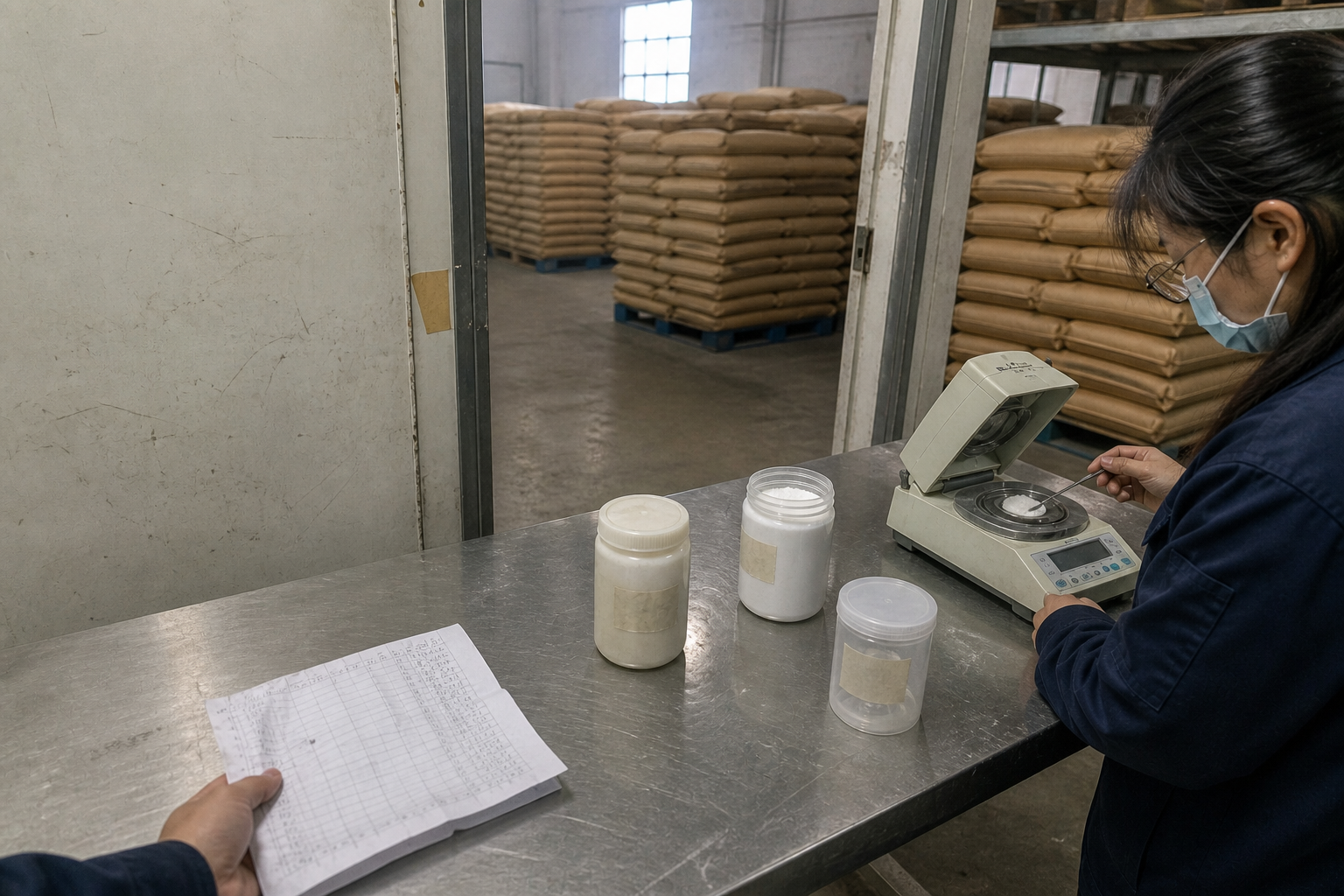
I Look for Buyer-Verifiable Quality Controls
A factory description should not replace evidence. I encourage buyers to request records that help them understand how the supplier controls variation.
Our own factory uses automated production lines and a laboratory that tests each batch for viscosity, water retention, moisture, and ash content. A buyer should still verify those statements through current documents, sample comparisons, an audit, or an independent inspection when the order risk justifies it.
I would request the following information from any potential supplier:
- The supplier should provide a grade-specific technical data sheet.
- The supplier should provide a recent, batch-specific certificate of analysis.
- The supplier should explain the viscosity test method and tolerance.
- The supplier should identify which properties are tested on every batch.
- The supplier should describe its batch-number and retention-sample system.
- The supplier should explain how it handles raw-material or process changes.
- The supplier should state the standard packaging and storage recommendations.
- The supplier should provide realistic capacity, minimum order quantity, and lead time.
- The supplier should describe its process for investigating customer complaints.
- The supplier should confirm whether pre-shipment or third-party inspection is available.
I Build an Approval Specification
I prefer a written approval specification that separates three types of criteria:
- Identity and basic quality criteria can include appearance, viscosity method, moisture, ash content, and packaging.
- Application criteria can include water demand, consistency, open time, sag, flow, or another agreed laboratory result.
- Commercial criteria can include quantity tolerance, delivery schedule, labeling, palletization, shelf-life information, and required documents.
This specification reduces confusion when the purchasing team changes personnel or when the supplier receives a repeat order months later.
I Compare Total Cost, Not Just Unit Price
A practical comparison should include:
| Cost or risk | Questions I ask |
|---|---|
| Product cost | Is the price based on the same grade, quantity, packaging, and Incoterm? |
| Dosage efficiency | Does the formulation require more material to reach the same performance? |
| Production stability | Could variation cause extra water adjustment or rejected batches? |
| Freight exposure | Does the quotation clearly allocate freight, insurance, and destination charges? |
| Inventory | Does the lead time require a larger safety stock? |
| Technical support | Will the supplier help interpret trial failures and recommend another grade? |
| Documentation | Can the supplier prepare consistent commercial and transport documents? |
| Complaint response | Can the supplier trace the batch and investigate a performance change? |
I would normally place a trial order before moving to a larger annual commitment. The buyer can then check packaging integrity, document accuracy, delivery communication, and production performance. A small first order does not eliminate risk, but it reveals issues that a laboratory sample cannot show.
What Compliance Documents Are Needed for HPMC for the South African Market?
Document uncertainty can delay shipment planning even when the product performs well. However, a thick document package can also create false confidence. I separate supplier documents from legal compliance because a COA, SDS, or TDS supports due diligence but does not determine every South African obligation.
A typical HPMC file may include a TDS, SDS, batch COA, commercial invoice, packing list, transport documents, and origin information when requested. The South African importer must still verify tariff classification, importer registration, import controls, chemical classification, labeling, workplace duties, and any application-specific requirements with current official sources or qualified local advisers.

I Separate Technical Documents From Shipment Documents
A supplier can usually prepare or support several document categories.
| Document | Main purpose | What it does not prove by itself |
|---|---|---|
| TDS | Describes typical grade properties and intended uses | It does not prove batch conformity or legal acceptance |
| COA | Reports selected results for a specific batch | It does not prove performance in the buyer’s formulation |
| SDS | Communicates classification, handling, storage, and emergency information | It does not automatically satisfy every local obligation |
| Commercial invoice | States parties, goods, value, currency, and trade details | It does not settle tariff classification |
| Packing list | Describes packages, weights, and marks | It does not confirm product suitability |
| Transport document | Records shipment or carriage details | It does not act as a technical approval |
| Origin document | Supports origin claims when applicable | It does not guarantee preferential treatment |
| Quality certificate | Summarizes supplier quality information | It does not replace buyer testing or regulatory review |
The exact package depends on the product, shipment, Incoterm, carrier, port procedure, importing entity, and customer contract. I ask the importer or customs broker to confirm requirements before production and booking, not after the container is ready.
I Treat Customs Classification as an Importer-Controlled Decision
The South African Revenue Service provides official information on customs registration and the schedules to the Customs and Excise Act. I recommend that the importer or its appointed customs professional confirm the current tariff classification, duty treatment, VAT implications, and registration status directly through SARS.
I do not determine a binding South African tariff code as the foreign manufacturer. Product composition, chemical description, modification, and intended presentation may affect classification.8 A supplier can provide accurate composition and product details, but the local declaration remains a matter for the importer and its qualified representative.
Relevant official sources include:
I referenced these official SARS pages on 8 September 2026. Importers should confirm that the pages, schedules, and procedures remain current when each shipment is planned.
I Confirm Whether Import Controls Apply
The International Trade Administration Commission of South Africa publishes information about goods subject to import and export controls. I would not assume that a product is controlled or uncontrolled based on a supplier’s previous shipment to another country. The importer should check the current product description and controls with ITAC or a qualified local specialist.
The official starting point is:
I referenced this ITAC page on 8 September 2026. A current check remains necessary because product controls and administrative procedures can change.
I Use the SDS as a Compliance Input, Not a Guarantee
South Africa’s Department of Employment and Labour publishes occupational health and safety requirements, including the Hazardous Chemical Agents Regulations, 2021. Whether particular duties apply depends on the product’s classification, workplace exposure, use, and current legal interpretation.
The official government publication is:
I referenced this official government source on 8 September 2026. I recommend that the importer, employer, or local safety professional confirm current SDS, labeling, risk-assessment, training, and workplace requirements for the actual product and use.
HPMC is often supplied as a fine powder, so safe handling should not be ignored even when a product is not classified as hazardous under a particular system.9 The workplace assessment should consider dust generation, ventilation, housekeeping, personal protective equipment, storage, and spill procedures.10
I Do Not Invent Application Standards
I have not identified a sufficiently reliable basis to claim that one specific South African construction-material standard governs every HPMC-containing tile adhesive, putty, plaster, or mortar. I therefore would not publish an unverified standard number.
Buyers can investigate relevant product or industry expectations through current sources such as:
- The South African Bureau of Standards;
- The National Regulator for Compulsory Specifications, where applicable;
- The buyer’s customer or project specification;
- A qualified South African testing laboratory;
- The South African Paint Manufacturing Association for relevant coatings-sector guidance at SAPMA.
SAPMA is an industry association, not a government customs or legal authority. I recommend using association guidance as a starting point and verifying any mandatory requirement with the responsible official body or a qualified South African professional.
Frequently Asked Questions
Is viscosity enough to choose HPMC for a South African tile adhesive?
No. I use viscosity as one selection parameter alongside water retention, open time, workability, sag resistance, dissolution, and compatibility with local cement and fillers. Buyers should also compare viscosity under the same concentration, temperature, and instrument method before treating two grades as equivalent.
What should a South African buyer request before ordering HPMC?
I recommend requesting a grade-specific TDS, representative sample, SDS, recent batch COA, test-method information, packaging details, lead time, and traceability explanation. The buyer should also agree on application tests and confirm required import documents with its customs broker or qualified local adviser.
Does an SDS prove that imported HPMC complies with South African law?
No. An SDS supports hazard communication and due diligence, but it does not independently prove complete compliance. The local importer or employer should verify current classification, language, format, labeling, workplace, transport, and recordkeeping obligations for the specific product and use.
How many HPMC samples should a buyer test?
I recommend testing at least one close candidate against an approved control, followed by repeat testing of the best option. Higher-risk projects may justify several production batches, retained samples, and independent testing. The trial design matters more than collecting many unstructured samples.
Can a Chinese HPMC supplier guarantee the same result in every formulation?
A responsible supplier should not make that universal guarantee. I can control product specifications and provide grade-selection support, but cement, sand, fillers, water, climate, dosage, and mixing conditions influence performance. The buyer should approve the material in its own formulation and production process.
Conclusion
Sourcing HPMC for the South African market requires more than matching viscosity or collecting standard paperwork. I recommend that buyers define the application, run controlled sample and pilot trials, establish an approval specification, and verify the supplier’s batch-control records. The local importer should separately confirm current customs, safety, labeling, and application requirements. For a free HPMC sample, viscosity-grade recommendation, factory-direct quotation, or formulation discussion, contact us at hpmc@jinghonghpmc.com or WhatsApp +86 157 3315 6958.
"Redispersible polymer powder modified cementitious tile ...", https://pmc.ncbi.nlm.nih.gov/articles/PMC8606344/. Tile-adhesive testing frameworks and mortar studies evaluate time-dependent workability, open time, slip resistance, and bonding performance as distinct application properties. Evidence role: general_support; source type: institution. Supports: Standards and technical research identifying open time, slip resistance, workability-related behavior, and adhesion as relevant tile-adhesive performance characteristics.. Scope note: The applicable test suite depends on the finished product category and the governing project or market specification. ↩
"Evaluation of various cellulose ethers performance in ceramic tile ...", https://www.academia.edu/20008732/Evaluation_of_various_cellulose_ethers_performance_in_ceramic_tile_adhesive_mortars. Studies of cellulose ethers in dry-mix mortars report that their effects on water retention, rheology, air entrainment, setting, and adhesion depend on the binder system and intended application. Evidence role: general_support; source type: paper. Supports: Research showing that cellulose ethers affect fresh and hardened properties of cementitious and gypsum-based mortars, with application-specific performance requirements.. Scope note: Individual formulations and commercial grades can respond differently from the systems studied. ↩
"South Africa", https://en.wikipedia.org/wiki/South_Africa. South African climate information documents marked regional variation in temperature and precipitation, including contrasts between coastal and interior areas. Evidence role: general_support; source type: government. Supports: Official climatological information describing regional variation in South African temperature, rainfall, and climate zones.. Scope note: Regional climate descriptions do not establish conditions at a particular factory or jobsite on a specific day. ↩
"Water Retention Mechanism of HPMC in Cement Mortar - PMC", https://pmc.ncbi.nlm.nih.gov/articles/PMC7372461/. Experimental studies indicate that cellulose-ether performance in cementitious materials is influenced by molecular structure and solution behavior in addition to reported viscosity. Evidence role: mechanism; source type: paper. Supports: Research linking cellulose-ether molecular characteristics, including substitution and molecular weight, to mortar rheology and water-retention behavior beyond a single viscosity value.. Scope note: The extent of non-equivalence must still be determined by testing the specific commercial grades in the intended formulation. ↩
"Statistical Engineering Division", https://www.nist.gov/system/files/sed2004.pdf. Experimental-design guidance supports holding relevant process variables constant and comparing treatments with a reference condition so that observed differences can be interpreted more reliably. Evidence role: mechanism; source type: government. Supports: Experimental-design guidance explaining that controlling relevant variables and using reference comparisons enables attribution of observed differences to the tested factor.. Scope note: Such design principles improve inference but do not by themselves validate commercial-scale product performance. ↩
"NIST TN 1297: Appendix D1. Terminology", https://www.nist.gov/pml/nist-technical-note-1297/nist-tn-1297-appendix-d1-terminology. Metrology guidance distinguishes repeatability from reproducibility and treats repeated measurements as necessary for assessing the reliability of a reported test result. Evidence role: expert_consensus; source type: government. Supports: Metrology guidance defining repeatability and reproducibility as essential considerations when evaluating measurement results.. Scope note: Repeatability of individual laboratory measurements does not ensure reproducibility across different plants, operators, or raw-material lots. ↩
"Scale Up Methodology for the Fine Chemical Industry-The Influence ...", https://www.academia.edu/120034072/Scale_Up_Methodology_for_the_Fine_Chemical_Industry_The_Influence_of_the_Mixing_in_the_Process. Scale-up research recognizes that differences in equipment, mixing conditions, handling, and storage can alter performance observed in laboratory formulations. Evidence role: general_support; source type: research. Supports: Process-scale-up literature explaining that mixing energy, equipment, handling, and storage can affect material behavior relative to laboratory tests.. Scope note: The magnitude and direction of scale-up effects depend on the formulation and production process. ↩
"Harmonized System (HS) Codes", https://www.trade.gov/harmonized-system-hs-codes. Customs classification under the Harmonized System is determined by the legal tariff text and the objective characteristics of the goods as presented for importation. Evidence role: definition; source type: institution. Supports: The Harmonized System's interpretive framework under which classification follows the terms of headings, legal notes, and the characteristics of imported goods.. Scope note: Only the competent customs authority or an authorized ruling process can determine the classification applicable to a specific import. ↩
"A Guide to Respirators Used for Dust in Construction", https://www.cdc.gov/niosh/bulletin/2020/respirators-construction.html. Occupational-safety guidance identifies airborne and accumulated dust as workplace-control concerns and describes measures such as ventilation, housekeeping, and suitable protective practices. Evidence role: general_support; source type: government. Supports: Occupational-safety guidance on controlling airborne and accumulated dust through ventilation, housekeeping, and appropriate work practices.. Scope note: This general dust-control guidance does not establish that a specific HPMC product presents a particular toxicity or combustible-dust hazard. ↩
"Chemical Safety Guide, 6th Ed. - ORS", https://ors.od.nih.gov/sr/dohs/Documents/Chemical-Safety-Guide.pdf. Occupational-health risk-management frameworks require assessment of exposure and the use of appropriate control measures, which can include engineering controls, work practices, personal protection, storage controls, and emergency procedures. Evidence role: mechanism; source type: government. Supports: Official occupational-health requirements or guidance describing risk assessment and control measures for hazardous chemical agents and workplace exposures.. Scope note: The controls required for a specific workplace must be selected from the actual product information, exposure assessment, and applicable legal requirements. ↩