

An HPMC certificate of analysis can look reassuring: product name, batch number, viscosity, moisture, ash, pH, and a final “pass.” Yet those numbers do not automatically tell me whether the material will behave correctly in a customer’s tile adhesive, dry-mix mortar, or another formulated product.
The purchasing risk starts when a buyer treats every line as equally important—or compares numbers that were produced by different methods. A viscosity value without concentration, temperature, instrument, spindle, speed, and sample-preparation details may be impossible to interpret. A compliant COA also cannot replace application validation.
My practical approach is to use the HPMC COA as one layer of evidence. I first verify identity and test context, then compare like with like, review batch patterns, test a representative sample in the intended formula, and define receiving checks before shipment. This guide explains that workflow without inventing a universal specification or any Jinghong-specific tolerance. The right acceptance limits should come from the agreed product grade, test method, contract, and application.
1. Are the Product Identity, Moisture, Ash, and pH Lines Actually Useful?
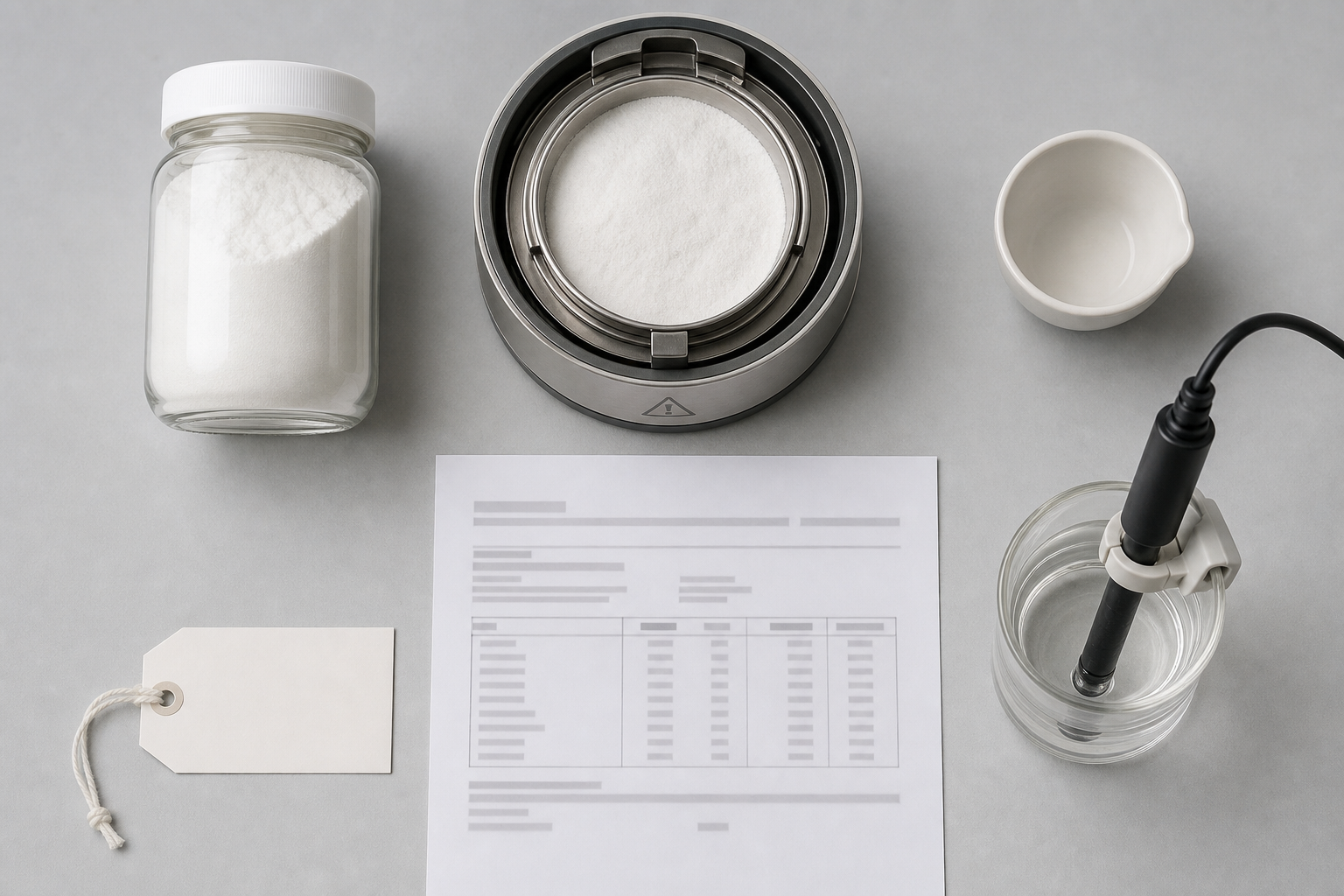
Problem. Buyers often scan the numerical results but overlook whether the certificate belongs to the offered grade and batch. They may also assume that moisture, ash, or pH alone predicts field performance. That can create a false sense of control before a bulk order.
A useful HPMC COA starts with traceable product and batch identity, then reports moisture, ash, and pH under defined methods. These values help screen storage condition, inorganic residue, and solution behavior, but no single result proves that the HPMC will deliver the required performance in your formulation.
Solution. I begin with document identity before interpreting chemistry. The COA should clearly connect the tested material to the quotation, sample label, production batch, and intended grade. HPMC itself should be described as a white or off-white fine powder, not with unsupported promises about performance based on appearance alone. The ECHA substance identity page is a useful external reference for hydroxypropyl methylcellulose identity.[1]
Use the basic lines as screening signals:
| COA item | What it can help indicate | What it cannot prove |
|---|---|---|
| Product/grade and batch | Traceability to the supplied material | Suitability for your recipe |
| Appearance | Obvious visual conformity or contamination | Viscosity, workability, or adhesion |
| Moisture/loss on drying | Water exposure, drying, or storage concerns | Application stability by itself |
| Ash/residue | Inorganic residue under the stated method | Purity across every possible method |
| pH | Behavior of a prepared solution under stated conditions | Compatibility with the complete formulation |
I also ask for the method or a referenced procedure, because “moisture,” “ash,” and “pH” are not self-defining. Sample mass, drying or ignition conditions, solution concentration, water quality, and equilibration can affect results.
For a broader view of product roles, I use the HPMC overview to identify the relevant grade family. Then I place agreed test methods and acceptance criteria in the purchase specification rather than assuming that a generic limit applies to every application.
2. Can I Compare the Viscosity Number With Another Supplier’s COA?

Problem. Viscosity is often the first number a buyer compares, but it is also the easiest to misuse. Two certificates may show different values even when both materials are reasonable, simply because the laboratories used different solution concentrations, temperatures, instruments, spindle systems, speeds, or preparation procedures.
Never compare HPMC viscosity values directly unless concentration, temperature, instrument or method, spindle or geometry, rotational speed, sample preparation, and reporting basis match. A larger number measured under different conditions is not evidence of a “stronger” grade, and an apparently similar number may still hide different application behavior.
Solution. I treat viscosity as a method-dependent result, not a free-standing product label. ASTM D2196 describes rotational viscosity measurement using rotational viscometers, reinforcing why instrument configuration and operating conditions matter.[2] It does not create one universal HPMC buying specification.
Before comparing two values, use this checklist:
- Same HPMC solution concentration and concentration basis
- Same test temperature and equilibration time
- Same instrument type or explicitly correlated method
- Same spindle, rotor, or measuring geometry
- Same rotational speed and reading procedure
- Same hydration, mixing, deaeration, and resting process
- Same units and reporting basis
| Comparison situation | Buyer action |
|---|---|
| All critical conditions match | Compare against the mutually agreed range |
| One condition differs | Treat the values as non-equivalent until correlation is demonstrated |
| Conditions are missing | Request the test method and raw context |
| Supplier uses another method | Ask for side-by-side correlation on the same samples |
This rule matters because HPMC solutions can be shear-dependent, and preparation history can change the reading. I would not convert or “normalize” results using an improvised multiplier.
The better commercial question is: does the reported viscosity, measured by the agreed method, track consistently with application performance? Jinghong’s article on its HPMC quality-control process explains how laboratory checks can be linked with production and application verification. For critical sourcing, I also ask whether the relevant laboratory operates under a suitable quality system; ISO/IEC 17025 addresses testing and calibration laboratory competence.[3]
3. Does a Passing COA Demonstrate Batch Consistency—and Is It the Same as a TDS?

Problem. A single passing batch can satisfy a written limit while still sitting far from the supplier’s usual production pattern. Buyers also confuse the certificate of analysis with the technical data sheet, even though the two documents answer different questions and serve different levels of evidence.
A COA reports results for an identified batch, while a TDS describes a grade’s typical properties, use, or general specification framework. Neither document alone proves long-term batch consistency. Buyers should review several comparable batches, the agreed methods, trend position, and relevant application records before approving repeat supply.
Solution. I use the TDS to understand the offered grade and the COA to check the specific shipment or batch. I do not substitute one for the other.
| Document | Best use | Main limitation |
|---|---|---|
| TDS | Grade positioning, typical data, handling, intended uses | Usually not batch-specific |
| COA | Recorded results tied to a named batch | Limited to listed tests and methods |
| Specification/contract | Agreed acceptance criteria and methods | Must be established before disputes arise |
| Application test record | Performance in a defined formula and procedure | Relevant only to the tested system |
For batch consistency, I request a small set of recent, comparable COAs for the same grade. I check whether the same methods and units were used, then look for unexplained shifts rather than inventing a statistical tolerance. If data are available, a simple trend table can capture batch ID, production date, viscosity under the agreed conditions, moisture, ash, pH, and disposition.
Consistency also includes the manufacturing and release process. Useful questions include:
- How are batches identified and retained samples controlled?
- What happens when a result trends away from the normal production pattern?
- Are key tests repeated before release or shipment?
- How are method changes communicated to buyers?
- Can an application check be linked to the same batch?
When qualifying a source, I combine this document review with the checkpoints in the reliable HPMC manufacturer guide. A “pass” matters, but a stable, traceable system tells me much more about repeat-order risk.
4. Why Must I Validate a Pre-Shipment Sample in the Actual Application?
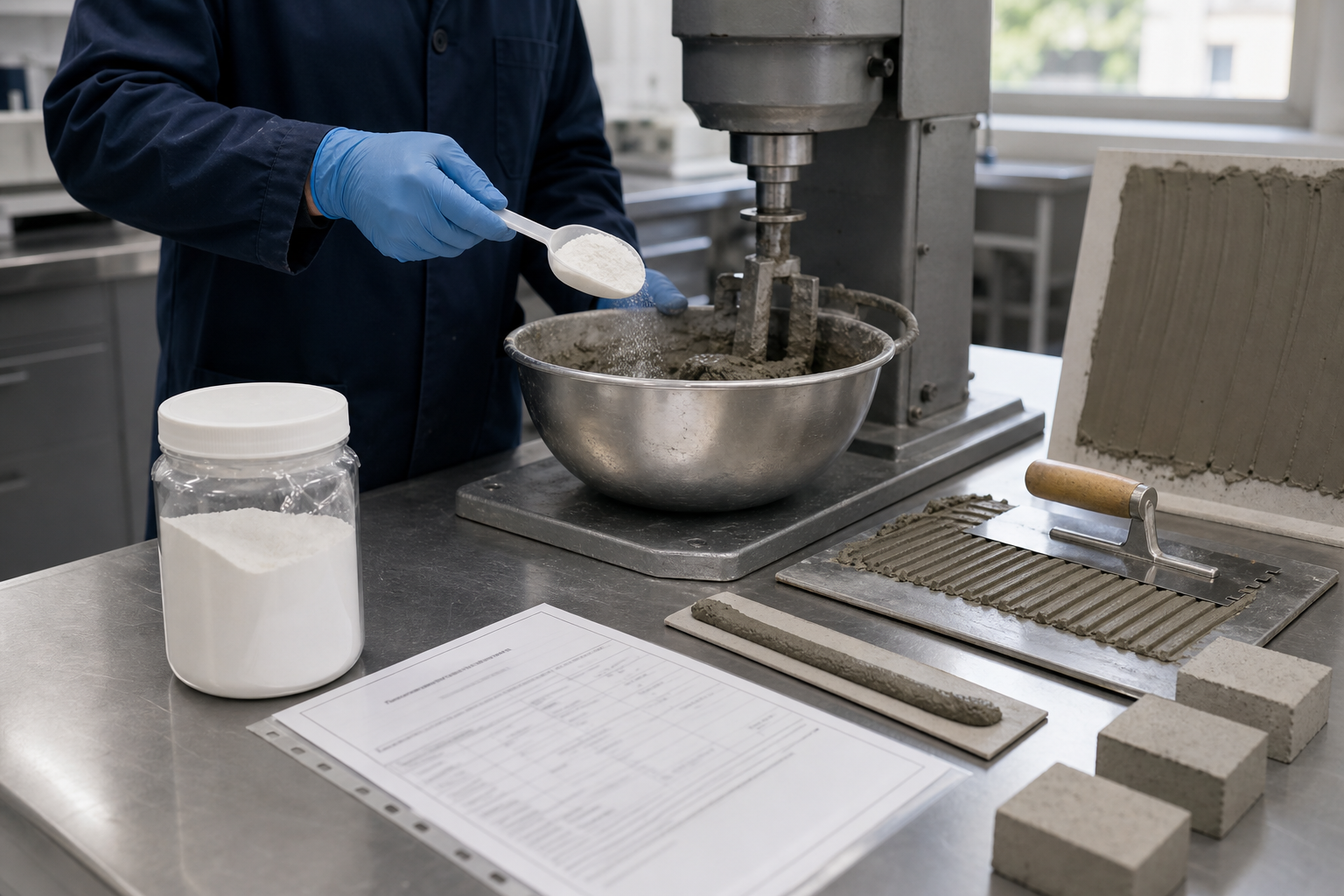
Problem. A COA compresses a complex material into a short list of laboratory results. It may not show water demand, open time, sag resistance, workability, thickening development, air entrainment, or compatibility with cement, fillers, polymers, and additives in the buyer’s exact formulation.
An HPMC COA cannot replace application validation. Before a bulk order, test a traceable pre-shipment sample in the intended formula, dosage, raw materials, mixing sequence, conditioning, and performance protocol. Approval should connect the sample, batch or production lot, COA, and acceptance record so purchasing receives the material actually evaluated.
Solution. I define the application test before requesting the sample. For tile adhesive, that may include mixing behavior, consistency, sag, open time, wetting, and relevant adhesion testing. For dry-mix mortar, workability, water retention, consistency development, and finished-system requirements may take priority. The HPMC for tile adhesive and HPMC for dry-mix mortar pages help frame application-specific questions, but the buyer’s validated formula remains decisive.
Representative buyer scenario (anonymous; not a claim about an actual customer): A buyer receives two HPMC samples with COAs that appear acceptable. The viscosity figures cannot be compared directly because one certificate omits rotational speed and uses a different concentration. Instead of selecting the higher number, the buyer requests complete methods, obtains traceable pre-shipment samples, and runs both through the same internal mortar protocol. The purchase decision is then based on matched laboratory evidence plus application validation—not on the headline viscosity value.
A practical approval pack should include:
- Sample ID, grade, batch or lot link, and date
- COA and current TDS revision
- Test method details, especially for viscosity
- Formula version, dosage, and raw-material lots
- Mixing, conditioning, and evaluation procedure
- Results, deviations, approval owner, and retained sample
- Written rule for substitutions or production-lot changes
If shipment planning is part of qualification, I also review the guide to importing HPMC from China. The key control is simple: the approved sample must remain traceably connected to what will be produced and shipped.
5. What Should Receiving Inspection Check After the Bulk HPMC Arrives?

Problem. Qualification work can be lost at receiving if the warehouse checks only bag count and visible damage. Without a predefined inspection plan, teams may discover a document mismatch or application deviation after material has entered production, making investigation, segregation, and supplier communication much harder.
Receiving inspection should verify supplier, grade, batch, packaging, quantity, COA linkage, and agreed document revisions before release. Inspect HPMC as a white or off-white fine powder, sample under a defined plan, repeat critical agreed tests where justified, and retain material for investigation. Final acceptance should still reflect application risk.
Solution. I write the receiving plan before the purchase order is released. The depth should match risk, history, and contractual requirements; it should not be improvised after arrival.
| Receiving stage | Recommended check | Record |
|---|---|---|
| Document review | PO, grade, batch, COA, TDS revision, shipment papers | Document checklist |
| Packaging inspection | Seal condition, labels, damage, moisture exposure | Photos and exception log |
| Identity/appearance | Correct label; white or off-white fine powder; no obvious foreign matter | Inspection result |
| Sampling/testing | Defined sampling plan and selected agreed tests | Sample ID and lab report |
| Application confirmation | Risk-based comparison with approved reference | Release or hold decision |
| Retention | Sealed, labeled retained sample under stated storage | Retention register |
Do not assume an incoming viscosity result is comparable with the supplier’s COA unless your laboratory reproduces the agreed test conditions. If results conflict, place the batch on hold, preserve samples, document methods, and compare laboratories before deciding that the material is nonconforming.
Frequently Asked Questions
Which HPMC COA value matters most?
There is no universal “most important” value. Start with identity and traceability, then evaluate viscosity under matching conditions, moisture, ash, pH, and any agreed grade-specific tests. Application-critical evidence should drive priority.
Can I compare two suppliers by viscosity alone?
No. Compare only when concentration, temperature, instrument, geometry or spindle, speed, preparation, units, and reporting basis match. Even then, validate the material in your formulation.
Is a COA more important than a TDS?
They perform different jobs. A TDS describes the grade; a COA reports an identified batch. The purchase specification and validated application protocol connect both to acceptance.
Should every incoming batch be application-tested?
The frequency should reflect risk, supplier history, process capability, and your quality agreement. Define reduced or full testing rules in advance rather than deciding informally.
What should I request before placing the bulk order?
Request the current TDS, a batch-linked COA with methods, comparable historical COAs where appropriate, a traceable pre-shipment sample, application-test support, and clear shipment and change-control terms.
For a grade discussion or a document-and-sample plan tailored to your application, use the Jinghong HPMC contact page. That is the single next step: share your formula type, target performance, test method, and purchasing stage so the technical review starts with comparable evidence.
References
- European Chemicals Agency (ECHA), hydroxypropyl methylcellulose substance identity: https://chem.echa.europa.eu/100.115.379/identity
- ASTM D2196-20(2026), Standard Test Methods for Rheological Properties of Non-Newtonian Materials by Rotational Viscometer: https://store.astm.org/d2196-20r26.html
- ISO, ISO/IEC 17025—testing and calibration laboratories: https://www.iso.org/ISO-IEC-17025-testing-and-calibration-laboratories.html