In the competitive landscape of modern construction materials, achieving a flawless, durable finish is no longer just an aesthetic preference; it is a strict technical requirement. Whether you are formulating interior wall coatings or producing high-performance joint compounds, the base material—gypsum—presents inherent challenges. Construction gypsum sets rapidly and loses moisture quickly to porous substrates, which can lead to disastrous consequences such as cracking, hollowing, and poor workability. The solution to these industry-wide challenges lies in a highly specialized additive: Hydroxypropyl Methylcellulose (HPMC).
Are you a dry-mix mortar manufacturer struggling with gypsum plaster that dries too fast, or a contractor dealing with joint fillers that sag on vertical applications? The difference between a failed application and a premium, long-lasting finish often comes down to the precise selection and dosage of cellulose ethers. Understanding how HPMC interacts with gypsum at a molecular level is crucial for optimizing your product formulations and reducing on-site failures.
This comprehensive guide from Jinghong Chemical explores the critical role of HPMC in gypsum-based products. We will delve into how it revolutionizes water retention and workability, provide a detailed framework for selecting the correct viscosity grade, and outline the rigorous testing standards required for premium formulations. By mastering the application of HPMC, you can elevate the quality of your gypsum plaster and joint fillers, ensuring superior performance and enhanced customer satisfaction.
Construction-grade HPMC is a critical functional additive for gypsum plaster and joint fillers, primarily responsible for maximizing water retention (≥96%), extending open time, preventing drying shrinkage cracks, and providing essential sag resistance. Selecting the optimal viscosity grade is paramount for achieving professional, defect-free construction finishes.
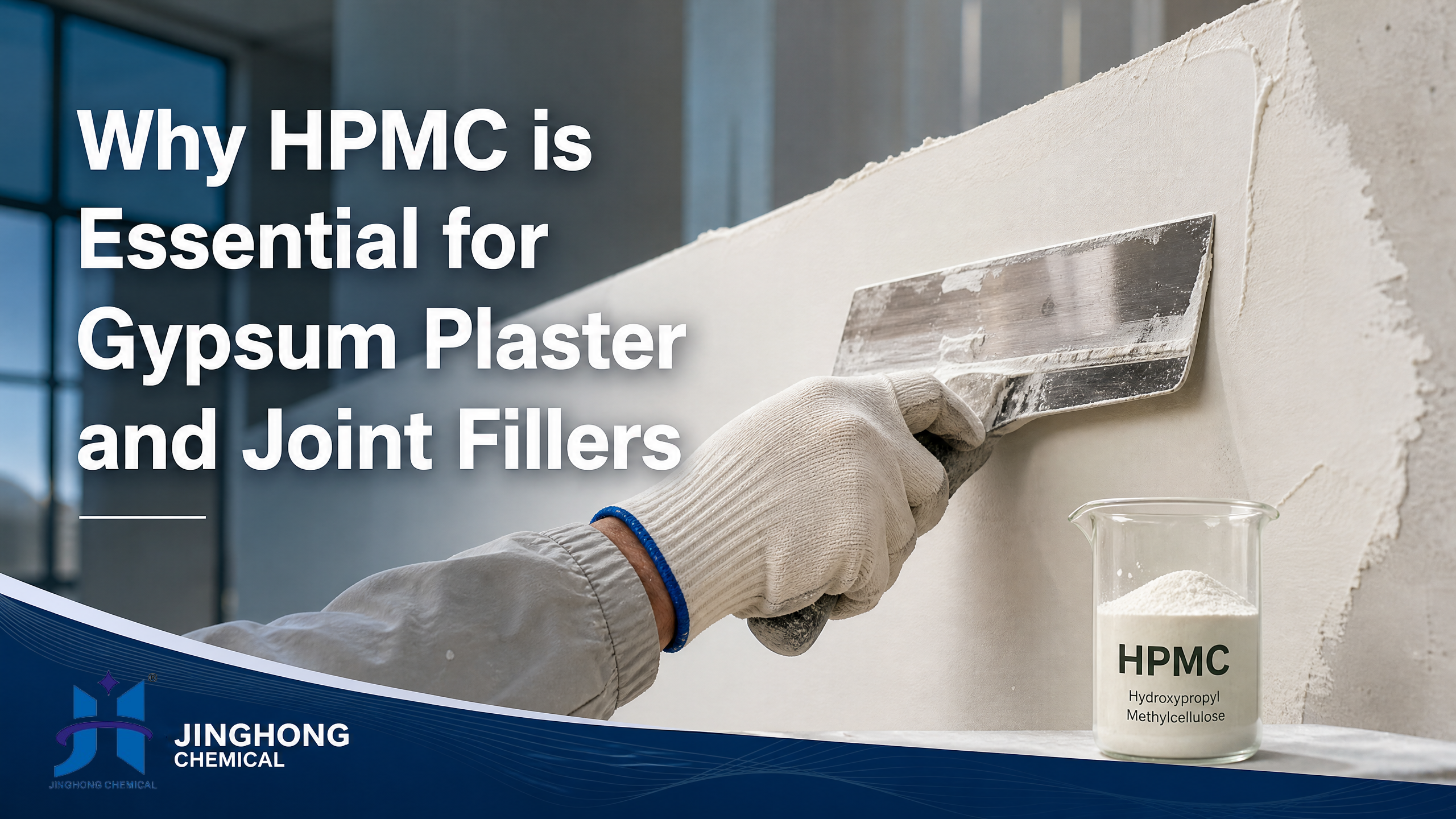
A professional application of gypsum plaster enhanced with construction-grade HPMC, ensuring a smooth, defect-free finish.
1. Understanding HPMC’s Role in Gypsum Plaster: Water Retention, Workability, and Crack Prevention
The fundamental challenge with gypsum-based materials, particularly hemihydrate gypsum ($CaSO_4 \cdot \frac{1}{2}H_2O$), is its rapid hydration process. When mixed with water, it quickly crystallizes into dihydrate gypsum ($CaSO_4 \cdot 2H_2O$). Without intervention, this rapid reaction, combined with water absorption by porous substrates like concrete or brick, leads to a weak, powdery surface and severe structural defects. HPMC gypsum plaster formulations are specifically designed to counteract these natural limitations through three primary mechanisms.
The Science of Superior Water Retention
Water retention is the most critical function of HPMC in any gypsum formulation. When HPMC powder is mixed with water, its hydroxyl groups form strong hydrogen bonds with water molecules. This creates a viscous, colloidal solution that effectively "locks in" the moisture within the mortar matrix [1].
For high-quality gypsum plaster, a water retention rate of $\ge 96\%$ is required. This controlled moisture environment is essential for two reasons. First, it ensures that the gypsum binder has sufficient water to complete its hydration reaction, preventing the formation of a weak, chalky surface (often referred to as "sanding"). Second, it dramatically extends the HPMC open time gypsum applications require. While unmodified gypsum plaster may become unworkable in just 30 minutes, the addition of premium HPMC extends this open time to 60–90 minutes, providing workers ample time for mixing, transporting, and applying the material over large areas.
Enhancing Workability and Sag Resistance
Beyond moisture control, hydroxypropyl methylcellulose gypsum formulations benefit from significantly improved rheological properties. HPMC acts as a powerful thickening agent, increasing the yield value of the wet mortar. This translates to exceptional workability on the construction site.
When applied, the plaster adheres smoothly to the trowel, reducing the physical effort required by workers to spread and level the material. More importantly, HPMC provides crucial HPMC sag resistance plaster applications demand. During vertical applications on walls or overhead applications on ceilings, the thixotropic nature imparted by HPMC ensures that the wet plaster remains firmly in place without slumping under its own weight. This is particularly vital for thick-layer gypsum plasters, which are often applied at thicknesses of 20-30mm in a single pass.
Preventing Cracks and Improving Adhesion
Drying shrinkage is a primary cause of failure in gypsum installations. As water evaporates from the curing plaster, the material shrinks, creating internal stresses that manifest as fine surface cracks. HPMC crack prevention gypsum strategies rely on the polymer’s ability to regulate this drying process. By slowing down water evaporation, HPMC ensures a uniform drying rate, minimizing internal stress.
Furthermore, the long molecular chains of the cellulose ether form a flexible, microscopic polymer network within the hardened gypsum matrix. This network distributes shrinkage stresses and significantly improves the flexural strength of the plaster. Simultaneously, this polymer film enhances the adhesion of the plaster to various challenging substrates, effectively preventing delamination and hollowing, ensuring a durable, long-lasting bond.
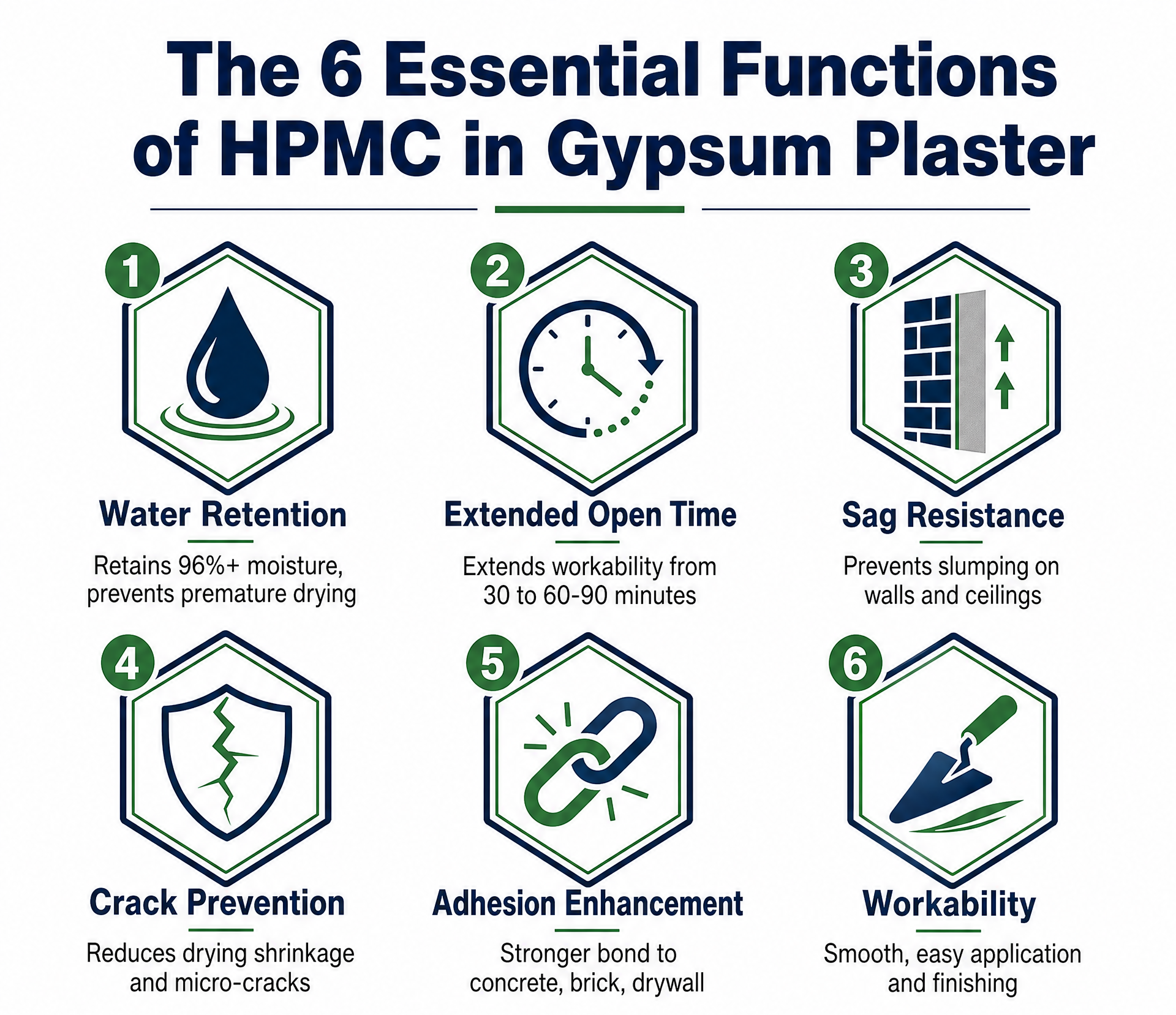
The core functional benefits of incorporating HPMC into gypsum plaster formulations.
Looking to upgrade your dry-mix formulations? Discover how our premium Construction Grade HPMC can eliminate cracking and improve the workability of your gypsum products. Contact Jinghong Chemical today for a free technical consultation.
2. Optimizing Gypsum Plaster and Joint Filler Performance: HPMC Grade Selection and Dosage
Understanding the benefits of HPMC is only the first step; achieving optimal performance requires precise formulation. The effectiveness of the additive depends entirely on selecting the correct HPMC viscosity grade gypsum applications demand and applying the exact dosage. Blindly adding cellulose ether without considering the specific application will inevitably lead to performance failures or unnecessary cost increases.
Navigating Viscosity Grades for Specific Applications
The viscosity of HPMC directly dictates its thickening power and, to a lesser extent, its water retention capabilities. Different gypsum products require vastly different rheological profiles.
For standard interior wall HPMC gypsum plaster, a medium viscosity grade ranging from 40,000 to 60,000 mPa·s is generally recommended. This range provides the perfect balance between adequate water retention and smooth workability, ensuring the mortar is neither too runny nor excessively sticky.
Conversely, thick-layer applications require a much stronger internal structure to prevent sagging. In these cases, a higher viscosity HPMC (60,000–100,000 mPa·s) is necessary to provide the required yield stress to hold a 30mm layer of wet plaster on a vertical wall.
When formulating HPMC joint filler or gypsum joint compound HPMC, the requirements shift. Joint fillers are typically applied in very thin layers and require exceptional spreadability to achieve a seamless finish between drywall panels. Therefore, a lower viscosity grade (20,000–40,000 mPa·s) is optimal. This ensures the compound is smooth, easy to feather, and does not drag on the trowel [2].
| Application Type | Recommended Viscosity (mPa·s) | Minimum Water Retention | Typical Dosage | Primary Function |
|---|---|---|---|---|
| Standard Gypsum Plaster | 40,000 – 60,000 | $\ge 96\%$ | 0.15% – 0.30% | Balanced workability & hydration |
| Thick-Layer Plaster (20-30mm) | 60,000 – 100,000 | $\ge 97\%$ | 0.20% – 0.40% | High sag resistance |
| Gypsum Joint Filler | 20,000 – 40,000 | $\ge 95\%$ | 0.10% – 0.25% | Smooth spreadability & finishing |
| Mechanical Spray Plaster | 50,000 – 200,000 | $\ge 97\%$ | 0.15% – 0.25% | Pump stability & anti-sag |
Mastering the Dosage: Finding the Sweet Spot
The HPMC dosage gypsum plaster formulations require is remarkably small—typically between 0.15% and 0.3% of the total dry powder weight—yet its impact is profound. Precision is non-negotiable.
If the dosage falls below 0.15%, the formulation will suffer from insufficient water retention. The plaster will dry too quickly, leading to incomplete hydration, low compressive strength, and a high likelihood of cracking and hollowing.
However, exceeding 0.3% (or 0.4% for highly absorbent substrates) is equally detrimental. Excessive HPMC will cause the mortar to become overly viscous and sticky, making it exhausting for workers to apply. Furthermore, high concentrations of cellulose ether tend to entrain excessive air bubbles during mixing. When the plaster cures, these bubbles burst, leaving microscopic pores that severely compromise the surface smoothness and structural integrity of the finish.
Synergy with Other Additives
Gypsum formulations rarely rely on HPMC alone. To achieve commercial-grade performance, HPMC must work synergistically with other chemical additives. For instance, retarders (such as citric acid or protein-based compounds) are essential to delay the initial setting time of the gypsum. HPMC is generally compatible with these retarders, but formulators must carefully balance the ratios to prevent excessive retardation that could delay construction schedules [3].
Additionally, to further enhance bond strength and flexibility, formulators often incorporate Redispersible Polymer Powder (RDP/VAE). The combination of HPMC’s water retention and RDP’s film-forming capabilities creates a highly durable, flexible matrix that is highly resistant to impact and thermal stress. To learn more about this powerful combination, read our detailed guide on the Synergy of HPMC and RDP in High-Performance Mortars.
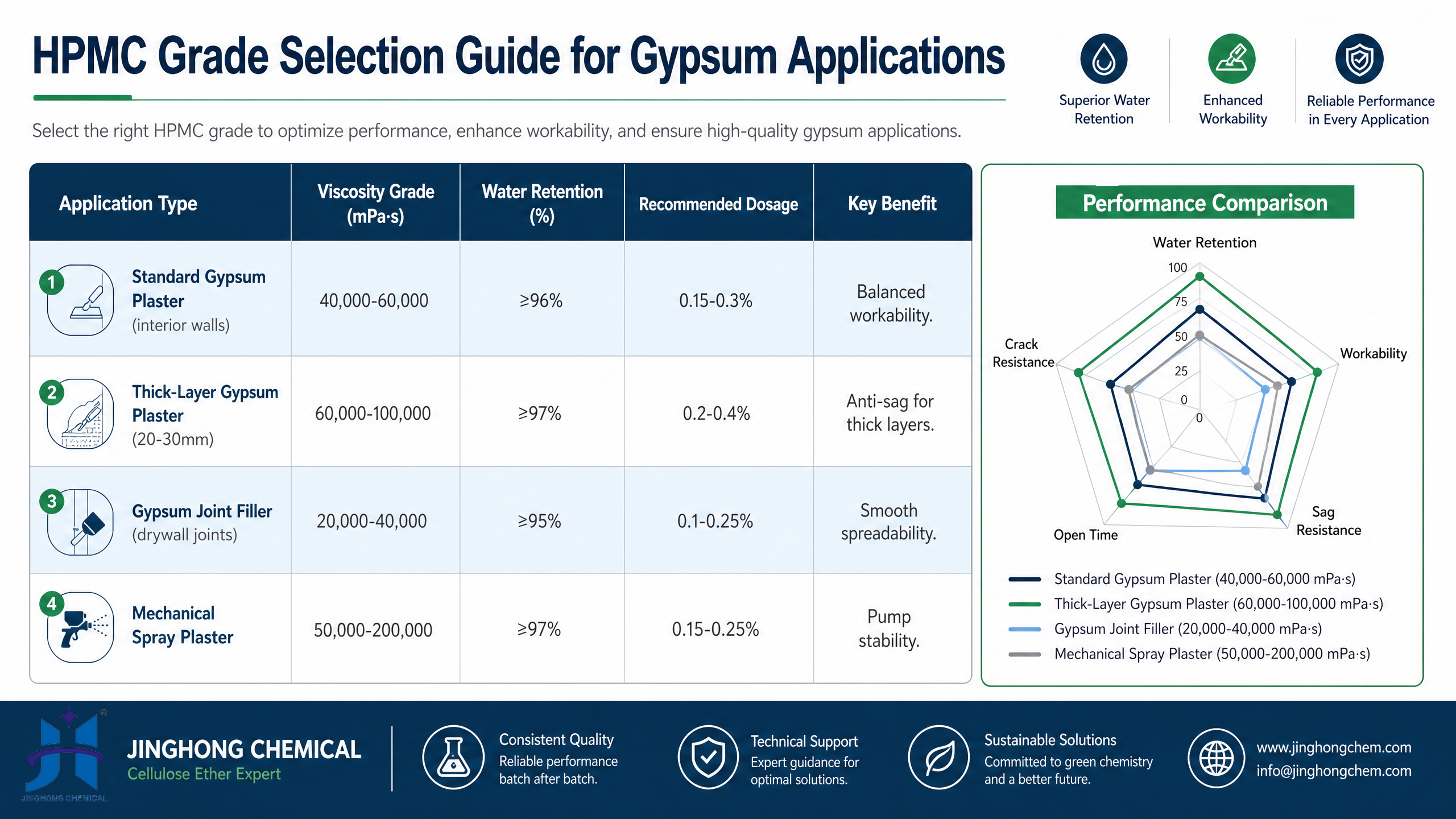
A comprehensive guide to selecting the correct HPMC viscosity and dosage for various gypsum applications.
Need help optimizing your joint filler formulation? Our technical experts can help you select the perfect low-viscosity HPMC to achieve seamless, crack-free drywall finishes. Request a Free Sample of our Joint Filler HPMC today.
3. Quality Standards and Testing: How to Evaluate HPMC for Gypsum Applications
When you decide to buy HPMC for gypsum plaster, you are investing in the core stability of your building materials. Inconsistent additive quality can lead to catastrophic batch failures, resulting in costly product recalls and damaged brand reputation. Therefore, partnering with a reliable HPMC supplier gypsum construction professionals trust requires a strict adherence to international quality standards and rigorous laboratory testing.
International Compliance Standards
High-quality gypsum products must comply with stringent international standards to guarantee safety and performance in residential and commercial buildings. Two of the most critical standards are:
- EN 13279-1: This European standard defines the specifications for gypsum binders and gypsum plasters for interior use. It dictates the requirements for setting times, mechanical strength, and fire safety. High-quality HPMC ensures that the formulated plaster consistently meets or exceeds the workability and strength parameters outlined in this standard [4].
- ASTM C475 / C475M: This American standard specifies the requirements for joint compounds and joint tapes used for finishing gypsum board. It mandates strict tolerances for shrinkage, cracking, and putrefaction. The precise water retention provided by specific HPMC grades is essential for passing the rigorous shrinkage and cracking tests defined by ASTM C475 [5].
Essential Quality Control Parameters for HPMC
Before incorporating HPMC into your production line, the raw material itself must be evaluated against strict quality control parameters. A reputable manufacturer like Jinghong Chemical provides detailed Certificates of Analysis (CoA) verifying the following specifications:
- Viscosity: Measured typically as a 2% aqueous solution at 20°C using a Brookfield viscometer. Consistency here is vital for maintaining predictable thickening behavior in your mortar.
- Water Retention: Must be tested in a standardized mortar mix. For gypsum applications, a retention rate of $\ge 95\%$ is the absolute minimum acceptable standard.
- Moisture Content: Should be $\le 5\%$. High moisture content in the raw HPMC powder can lead to clumping during storage and uneven dispersion during mixing.
- Ash Content: Should be $\le 5\%$. High ash content indicates impurities that could interfere with the hydration of the gypsum binder.
- pH Value: A 1% solution should typically fall between 5.0 and 8.0, ensuring chemical compatibility with the slightly acidic to neutral nature of gypsum.
Troubleshooting Common Formulation Failures
Even with high-quality HPMC, improper formulation can lead to application failures. Recognizing the indicators of these failures is crucial for rapid troubleshooting:
- Issue: Severe Cracking and Powdery Surface.
- Cause: Insufficient water retention due to either a dosage that is too low ($<0.15\%$) or using an HPMC grade with poor retention properties.
- Solution: Increase the HPMC dosage incrementally or switch to a higher-retention grade.
- Issue: Plaster Slumping on Walls.
- Cause: Inadequate yield stress. The viscosity of the chosen HPMC is too low for the applied thickness.
- Solution: Upgrade to a higher viscosity HPMC (e.g., shifting from 40,000 mPa·s to 80,000 mPa·s) or incorporate a small amount of starch ether to boost thixotropy.
- Issue: Mortar is Too Sticky and Difficult to Trowel.
- Cause: The HPMC dosage is too high ($>0.4\%$), or the viscosity grade is excessive for a thin-layer application.
- Solution: Reduce the HPMC dosage or select a lower viscosity grade to improve spreadability.
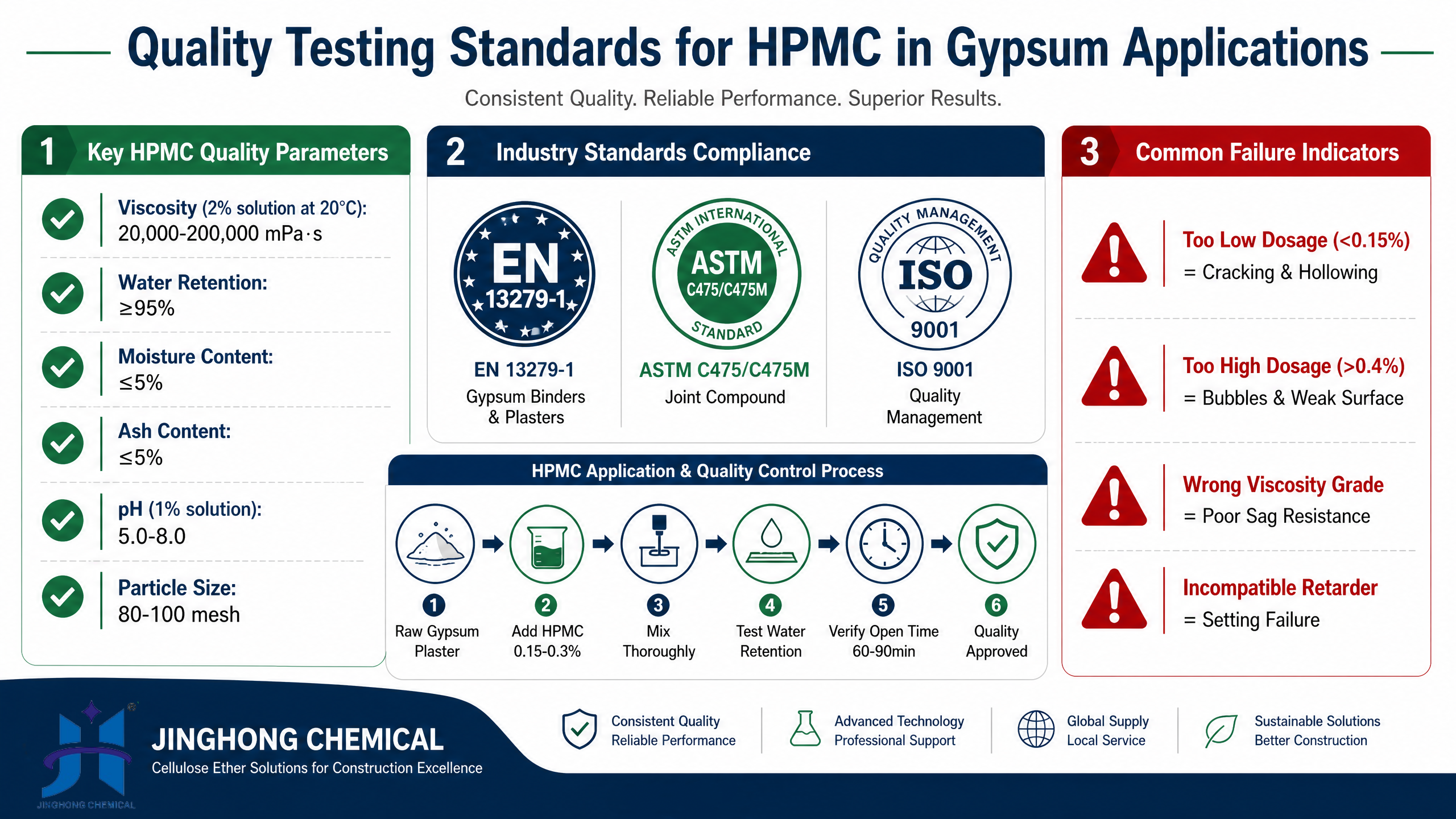
Key quality parameters, industry standards, and common failure indicators for HPMC in gypsum products.
Don’t compromise on quality. Jinghong Chemical is a leading source factory providing high-purity, consistent HPMC for the global construction industry. Learn more about our manufacturing standards in our B2B Buyer’s Guide to Choosing a Reliable HPMC Manufacturer.
Conclusion
The formulation of premium gypsum plaster and joint fillers is a precise science, heavily reliant on the advanced properties of Hydroxypropyl Methylcellulose (HPMC). By acting as a superior water retention agent, a powerful rheology modifier, and a flexible polymer binder, HPMC effectively eliminates the traditional weaknesses of gypsum—preventing rapid drying, cracking, and sagging.
However, success requires more than simply adding the chemical. It demands a deep understanding of viscosity grades, precise dosage control, and strict adherence to quality testing standards like EN 13279 and ASTM C475. By selecting the optimal HPMC profile for your specific application—whether it be a high-viscosity grade for thick-layer plasters or a low-viscosity grade for smooth joint compounds—you can dramatically improve the workability, durability, and overall quality of your construction materials.
Partner with Jinghong Chemical for Construction Excellence
As a source factory with over 15 years of expertise, Jinghong Chemical is dedicated to advancing the construction industry through high-performance cellulose ethers. We provide direct supply and unbeatable prices on premium HPMC, RDP, HEMC, and HEC products, ensuring batch-to-batch consistency for your critical formulations.
Ready to optimize your gypsum products?
Contact our technical team today to discuss your specific formulation challenges, request detailed technical data sheets, or secure free samples for laboratory testing.
- Email: hpmc@jinghonghpmc.com
- WhatsApp: +86 157 3315 6958
- Website: www.jinghonghpmc.com
References
[1] National Center for Biotechnology Information. (n.d.). Water Retention Mechanism of HPMC in Cement Mortar. PMC. Retrieved from https://pmc.ncbi.nlm.nih.gov/articles/PMC7372461/
[2] Tenessy. (2025). Analysis of the Application of Cellulose Ether in Gypsum Plaster Mortar. Retrieved from https://tenessy.com/analysis-of-the-application-of-cellulose-ether-in-gypsum-plaster-mortar/
[3] Landercoll. (n.d.). HPMC in Gypsum/Plaster Applications: Enhancing Strength, Workability & Durability. Retrieved from https://landercoll.com/en/hpmc-in-gypsum-plaster-applications-enhancing-strength-workability-durability/
[4] iTeh Standards. (2008). EN 13279-1:2008 – Gypsum binders and gypsum plasters – Part 1: Definitions and requirements. Retrieved from https://standards.iteh.ai/catalog/standards/cen/3330e92c-2203-4118-934c-da6b441a6cb3/en-13279-1-2008
[5] ASTM International. (2017). ASTM C475 / C475M-17 Standard Specification for Joint Compound and Joint Tape for Finishing Gypsum Board. Retrieved from https://standards.iteh.ai/catalog/standards/astm/3601a4aa-d0c8-424d-8311-86d0f8b7d9f5/astm-c475-c475m-17