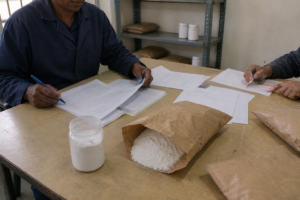
Tile adhesive sag can remain severe even when an HPMC grade carries a high viscosity value. That mismatch creates costly trial-and-error, encourages unnecessary dosage increases, and often leads buyers to blame a single raw material. I use a structured diagnosis instead: verify the viscosity data, evaluate the complete mortar system, and reproduce the actual application load.
Tile adhesive can sag despite high HPMC viscosity because solution viscosity does not directly represent the wet mortar’s yield behavior, structural recovery, or load-bearing capacity1. Water dosage, particle grading, binders, other additives, mixing, temperature, adhesive-bed thickness, and tile weight all affect vertical slip. I therefore recommend controlled application trials rather than selecting HPMC by viscosity alone.
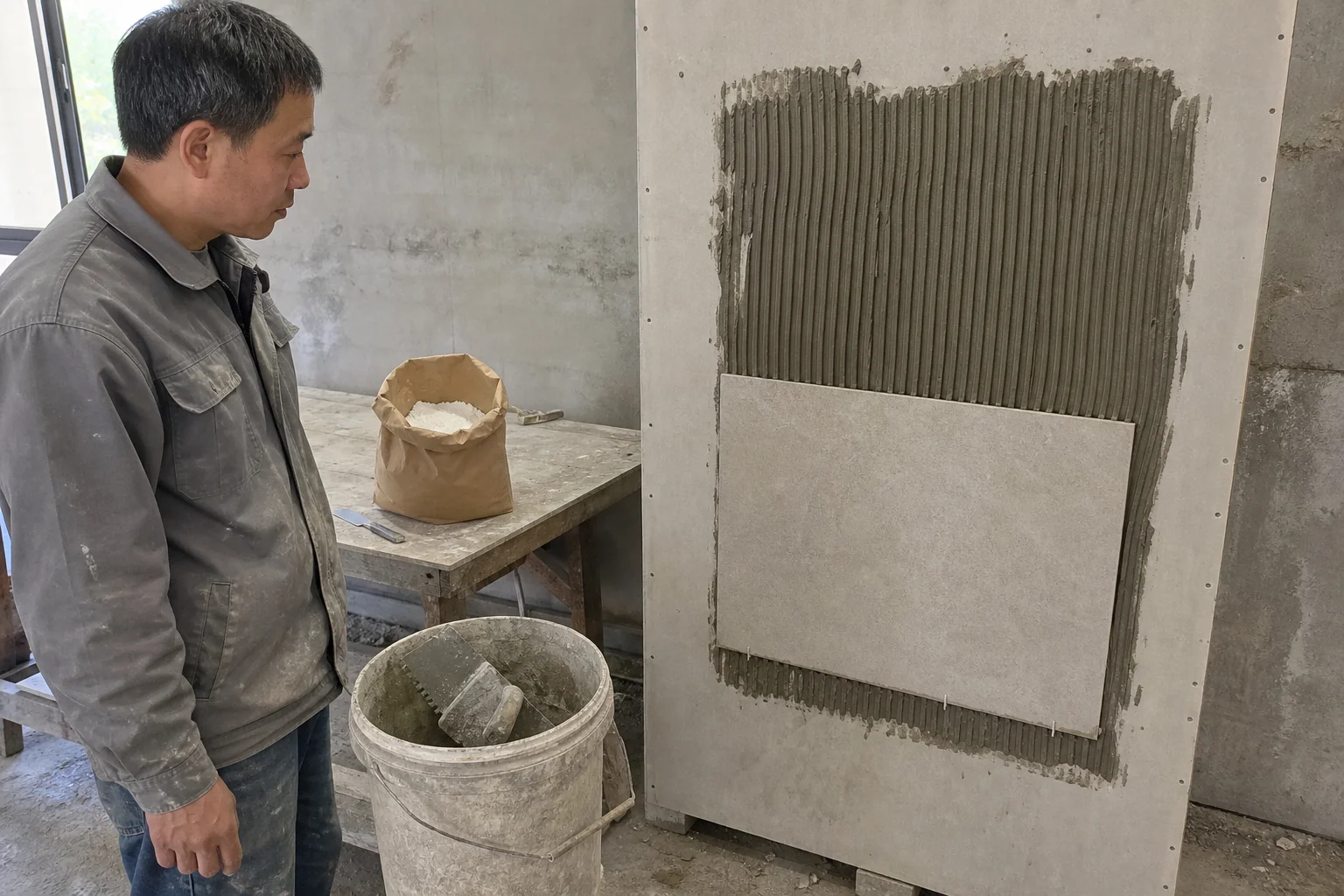
In sample-selection discussions, I often hear, “The viscosity is already high, so why does the tile still move?” I cannot prove the cause without the complete formulation and controlled results. However, I can turn that question into a practical investigation that separates specification problems from formulation, processing, and application variables.
What Does Tile Adhesive Sag Actually Mean?
Tile adhesive sag is easy to confuse with several other application problems. That confusion can send a development team in the wrong direction. Before I recommend another cellulose ether grade, I first establish what moved, when it moved, and under which tile load and environmental conditions.
Tile adhesive sag is the downward movement of a tile or wet adhesive layer after the tile has been placed on a vertical surface.2 It differs from skinning, open-time loss, poor wetting, and low final adhesion.3 A meaningful assessment must record displacement, tile dimensions and weight, bed thickness, waiting time, temperature, and application method.
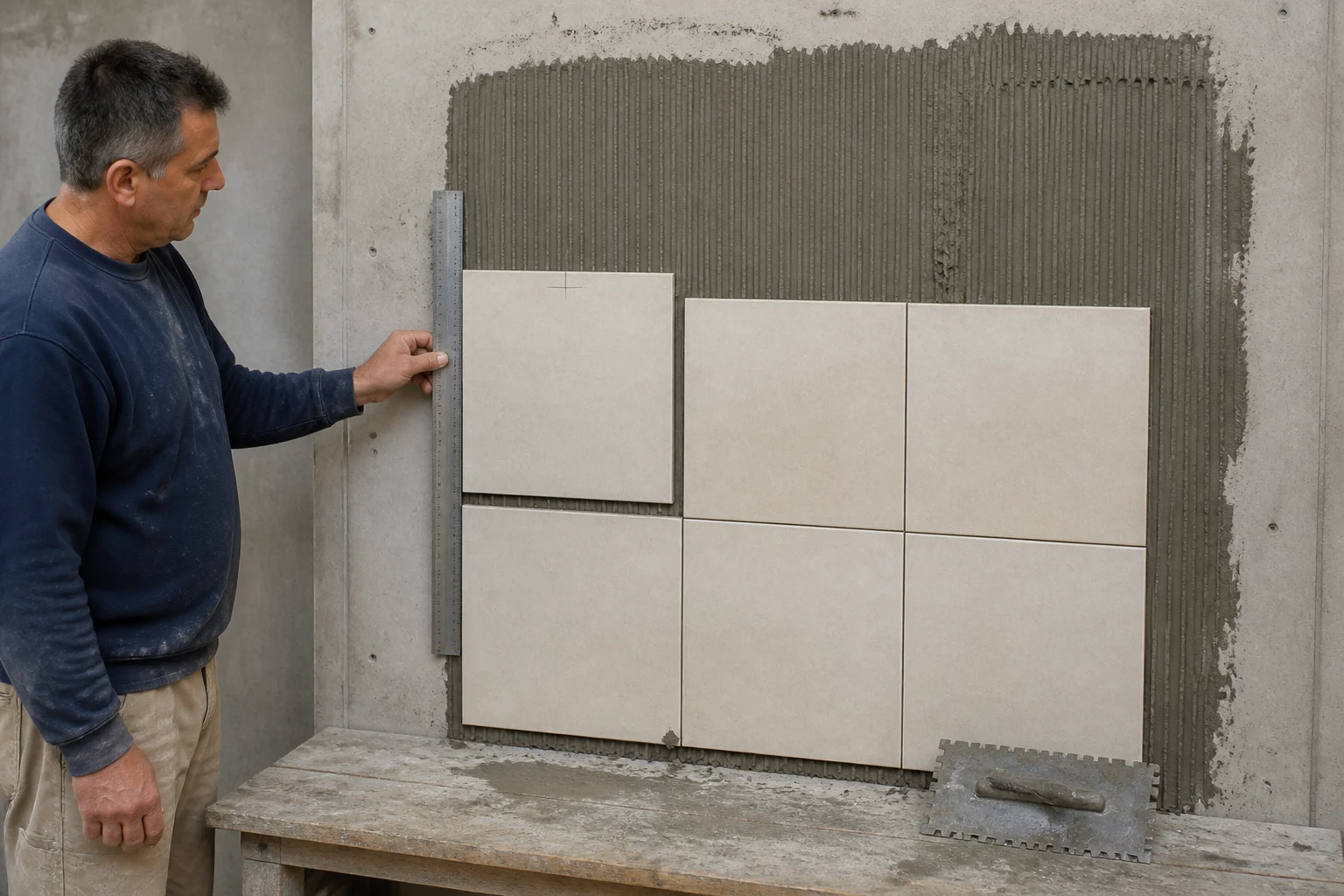
Sag, skinning, and open time describe different behaviors
I separate these terms because they point toward different tests:
- Sag or vertical slip: The tile moves downward after placement.
- Skinning: A dry or partially dry film forms on the exposed adhesive surface.
- Open time: The usable period during which the applied adhesive can still develop the required bond after tile placement.
- Poor wetting: The adhesive does not transfer adequately to the tile back.
- Slump: The mortar body deforms or spreads under its own weight.
- Low adhesion: The cured system fails to develop the required bond strength.
A mortar can show good sag resistance but skin quickly. Another mortar can have a long workable period but allow a heavy tile to slide. I do not treat these properties as interchangeable, and I do not attribute all of them to HPMC.
Skin formation, for example, can reflect the combined effects of temperature, wind speed, substrate absorption, spread area, water dosage, cementitious materials, and cellulose ether behavior. Simply increasing the additive dosage may thicken the mortar without solving the actual open-time problem.
I define the test task before judging performance
I ask buyers to document the actual task in measurable terms:
- What are the tile’s dimensions and weight?
- Is the tile ceramic, porcelain, stone, or another material?
- What adhesive-bed thickness is being tested?
- Is the substrate absorbent, sealed, smooth, or rough?
- How long passes between spreading and tile placement?
- Is the tile pressed, twisted, tapped, or simply positioned?
- How far does the tile move, and over what period?
- What are the room, powder, water, and substrate temperatures?
These details matter because a light laboratory test piece and a large-format tile create very different loads. A thin adhesive bed and a thick bed also develop different deformation patterns.
Where a market or product class refers to a standard vertical-slip test, I recommend following the current prescribed method. For example, buyers working with EN-classified cementitious tile adhesives commonly encounter vertical-slip evaluation under EN 1308, while classification requirements are addressed through the applicable EN 12004 framework4. Buyers should verify the current edition, test conditions, and target limit with a qualified laboratory rather than relying on a supplier’s informal demonstration.
I treat “the tile moved” as an observation, not a complete diagnosis.
Why Can Tile Adhesive Sag Despite High HPMC Viscosity?
A high number on a technical data sheet feels reassuring, but that number may describe a cellulose ether solution under specific conditions rather than a complete tile adhesive under load. If two suppliers use different test protocols, their reported values may not even be directly comparable.
High HPMC viscosity may fail to prevent tile adhesive sag because solution viscosity is only one material measurement. Vertical stability depends more directly on the wet mortar’s yield behavior, internal structure, and recovery after mixing or troweling. Those properties emerge from the whole formulation, not from one cellulose ether specification.
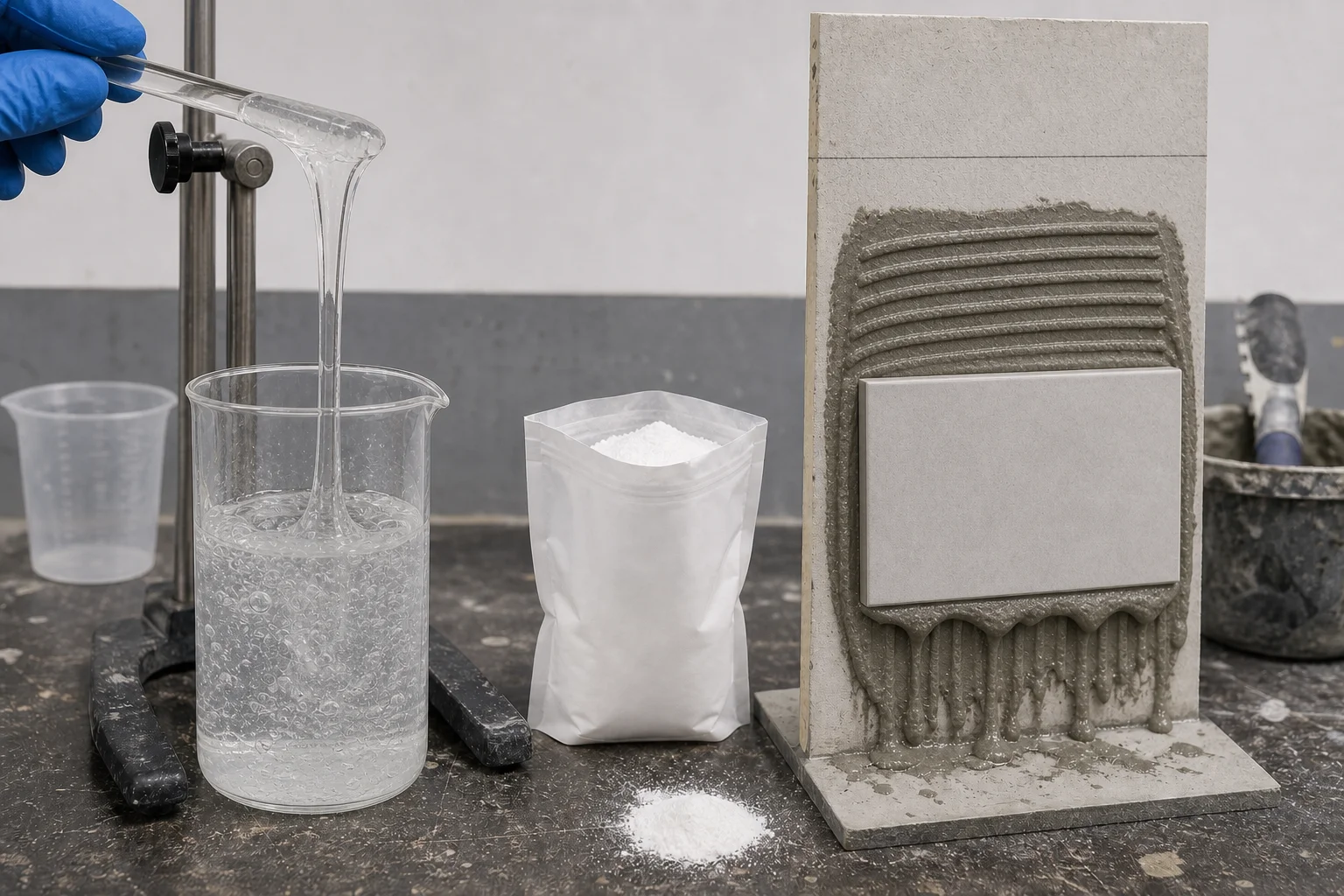
I verify what the viscosity number means
Before comparing products, I request the full viscosity test conditions. At minimum, I want to know:
| Comparison item | Why I check it |
|---|---|
| Solution concentration | A 1% solution and a 2% solution can produce very different results |
| Test temperature | Cellulose ether solution viscosity changes with temperature5 |
| Instrument type | Different viscometer systems may not produce interchangeable values6 |
| Spindle or geometry | The selected setup affects the reported reading |
| Rotational speed | Shear conditions influence an apparent viscosity result |
| Hydration procedure | Incomplete wetting or dissolution can distort the result |
| Conditioning time | The solution may need a defined period before measurement |
| Moisture correction | As-supplied and dry-basis calculations may differ |
A certificate that states only “viscosity: 200,000 mPa·s,” for example, gives me too little information for a serious comparison. I need the method behind the number.
I have received anonymized inquiries in which buyers compared two grades carrying similar labels but reporting different application behavior. In those situations, I could not conclude that one cellulose ether caused the difference. The suppliers’ test methods, formulations, water demand, and mixing procedures had not been aligned. The feedback was useful for forming a test plan, but it was not a controlled case study.
Wet mortar needs enough structure to resist movement
At a conceptual level, yield stress describes the stress that a structured material must overcome before it begins to flow. A vertical adhesive bed needs enough internal resistance to support the applied tile under the test conditions.
Thixotropic recovery describes how structure rebuilds after shear is reduced. Mixing and troweling break down some structure so the mortar can be spread. After troweling stops, the material should recover enough structure to hold the ridges and resist movement.
I do not reduce either property to a single HPMC viscosity grade. The following formulation variables can change the result:
- Water-to-dry-mix ratio
- Cement type and content
- Limestone or other filler grading
- Fine-to-coarse particle balance
- Redispersible polymer powder type and dosage
- Starch ether or rheology modifier selection
- Cellulose ether chemistry and modification
- Air content
- Setting regulators
- Mineral additions
- Soluble salts and other interactions
A higher solution-viscosity HPMC may increase consistency in one formula, but it may also change water demand, mixing response, or trowel feel. Another formula may need better structural recovery rather than simply higher apparent thickness. I therefore avoid promising that any specific viscosity grade will eliminate sag.
Which Variables Should I Check When Tile Adhesive Sag Appears?
When a vertical application fails, teams sometimes change several ingredients at once. That approach creates new uncertainty because nobody knows which change mattered. I prefer to divide possible causes into layers and hold the remaining variables constant during each comparison.
I investigate tile adhesive sag in four layers: environment, substrate, formulation, and application process. I also check mixing and maturation as a separate control point. This layered method helps buyers distinguish heat or water-related effects from raw-material variation, particle grading, additive interaction, and installation conditions.
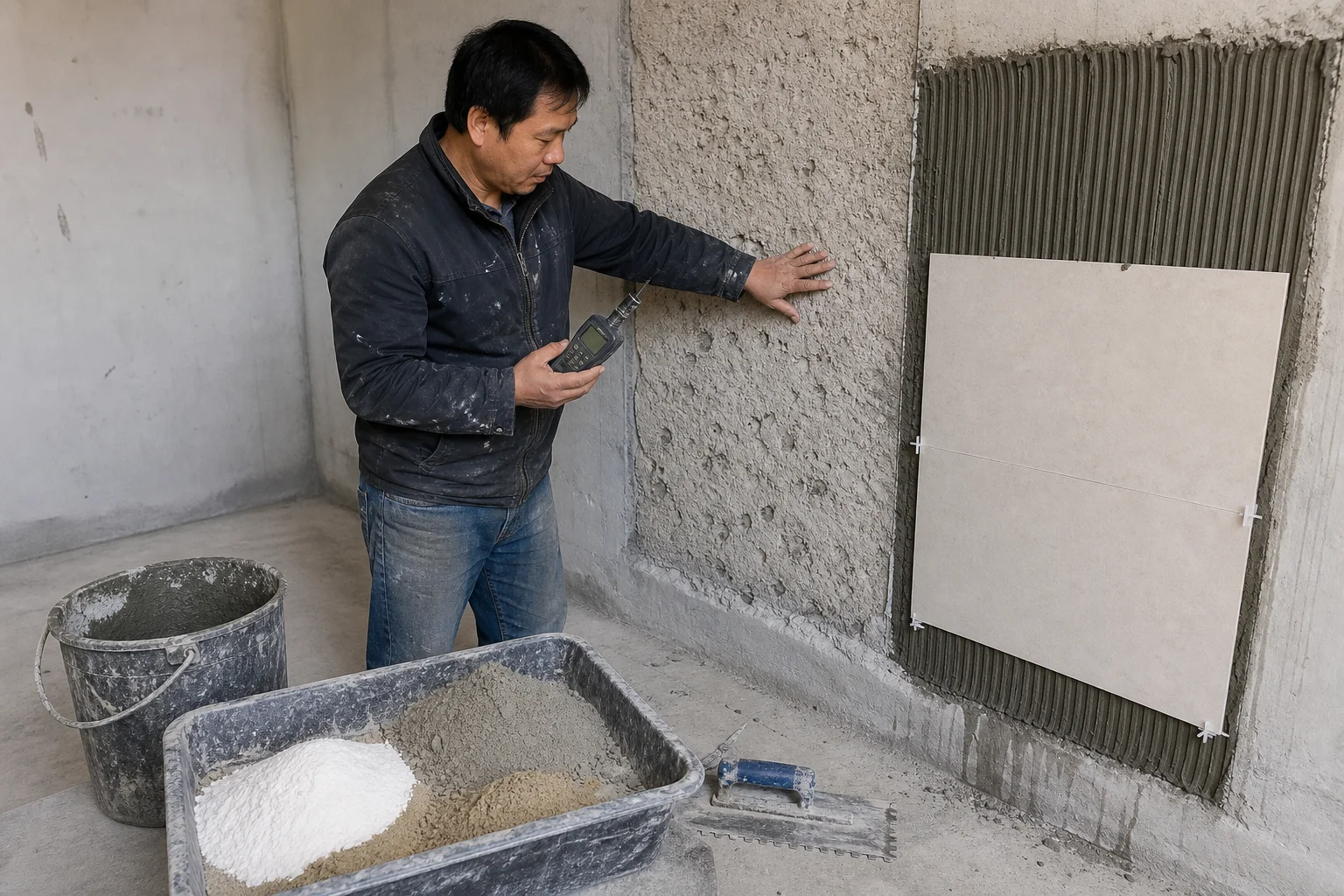
1. Environment
Temperature influences water loss, hydration, consistency, and working behavior.7 Air movement can accelerate surface drying, especially when the installer spreads a large area before placing tiles.
I record:
- Air temperature
- Relative humidity
- Wind or fan exposure
- Substrate temperature
- Mixing-water temperature
- Powder temperature
- Direct sunlight
- Time between spreading and placement
High-temperature markets deserve particular attention. A mortar evaluated in a mild laboratory may behave differently on a hot wall or with warm mixing water. However, I still avoid assuming that climate is the only cause.
2. Substrate
An absorbent wall can pull water from the adhesive.8 A very smooth or contaminated surface can create another type of application problem. Substrate effects may also appear unevenly, which explains why one wall performs differently from another despite using the same bag.
I check whether the substrate is:
- Highly absorbent
- Damp or dry
- Dusty
- Painted or sealed
- Smooth or mechanically keyed
- Hot from sun exposure
- Consistent across the test area
Rapid water loss may affect troweling, wetting, and surface skin formation. It does not automatically prove a cellulose ether failure. I first compare the same mortar on controlled, representative substrates.
3. Formulation
Water dosage is one of my first checks. A small uncontrolled increase can make mixing easier while weakening vertical hold.9 The mortar may still feel “viscous” in the bucket, yet it may deform under sustained tile load.
I also examine:
- Binder-to-filler balance
- Particle-size distribution
- Cellulose ether grade and actual dosage
- Polymer powder selection
- Rheology modifiers
- Retarders or accelerators
- Powder moisture and storage history
- Batch weighing accuracy
At Jinghong, we manufacture cellulose ethers and test our batches for viscosity, water retention, moisture, and ash content. I regard those controls as supplier-quality evidence, not proof that a customer’s finished adhesive will pass a particular sag requirement. The target formulation still needs application testing.
4. Application process
The same mortar can produce different results when operators use different methods. I record trowel size, angle, pressure, bed thickness, tile placement technique, and delay time.
Large, heavy tiles place greater demand on the system. Excessive bed thickness can also increase movement. If one operator presses and twists the tile while another lightly places it, the results may not be comparable.
5. Mixing, maturation, and remixing
I frequently ask buyers to standardize preparation before changing grades. They should control:
- Powder and water mass
- Mixer type and speed
- Initial mixing time
- Maturation or standing period
- Remixing time
- Time of testing after remixing
- Any later water addition
A team should never “correct” consistency with unrecorded extra water during a controlled trial. That single action can invalidate a supplier comparison.
How Should I Test Tile Adhesive Sag With Controlled Comparisons?
An uncontrolled site trial can identify a problem, but it rarely isolates the cause. If the operator changes the water, tile, substrate, and HPMC grade together, the final result cannot support a sound purchasing decision. I design comparisons so that each test answers one clear question.
A controlled tile adhesive sag trial should keep the base formulation, water ratio, mixing procedure, substrate, tile load, bed thickness, temperature, and observation time constant. The evaluator should change only one variable per comparison, measure vertical movement, and record troweling, wetting, skinning, open time, and consistency separately.
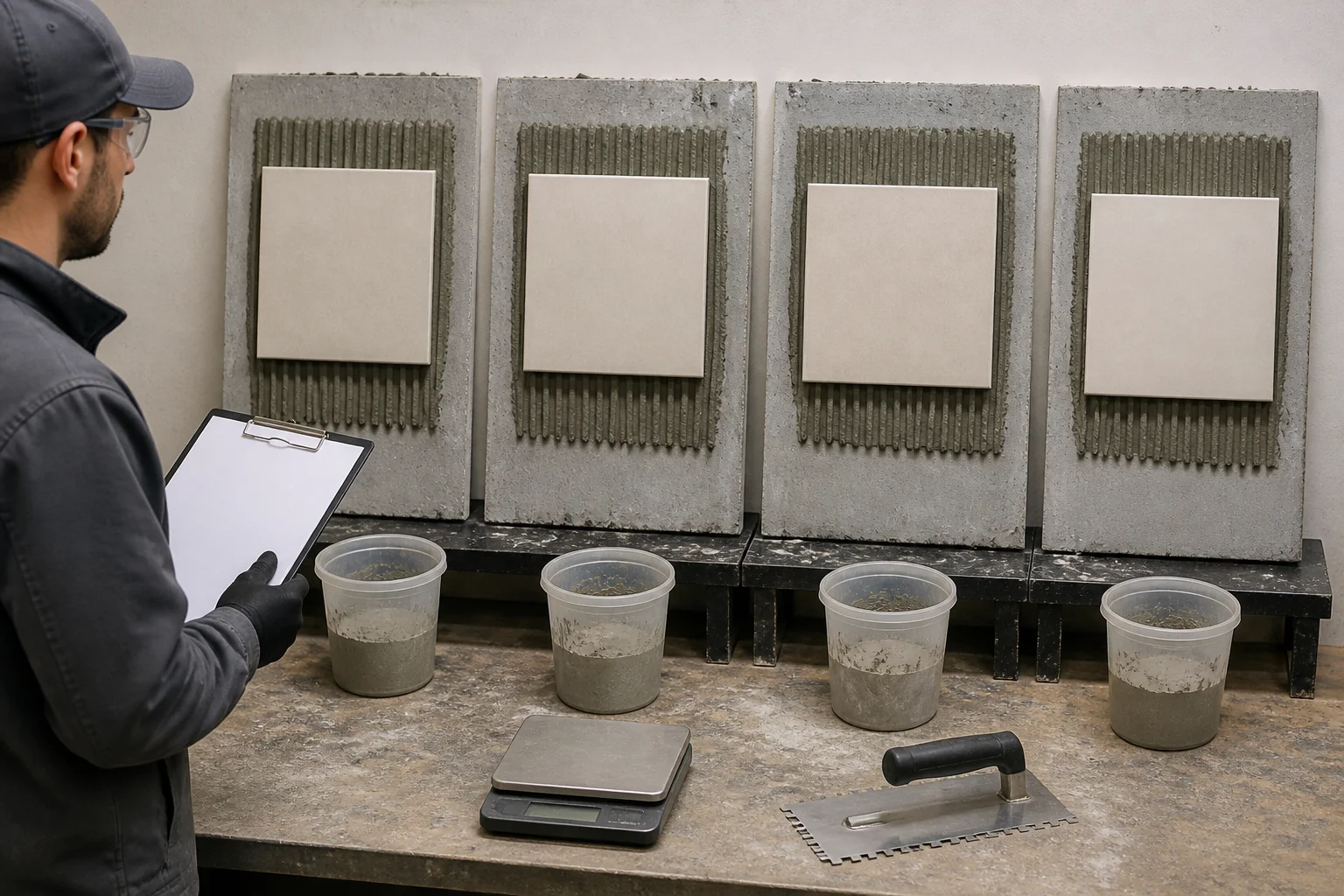
I start with a repeatable baseline
I recommend preparing at least one baseline batch before evaluating a replacement grade. If practical, the evaluator should repeat the baseline to estimate normal preparation and measurement variation.
A simple trial matrix might look like this:
| Trial | HPMC variable | Water dosage | Mixing method | Tile and bed | Main question |
|---|---|---|---|---|---|
| A | Current grade | Fixed | Fixed | Fixed | What is the baseline? |
| B | Candidate grade | Fixed | Fixed | Fixed | Does the grade change vertical movement? |
| C | Current grade | One controlled adjustment | Fixed | Fixed | How sensitive is the formula to water? |
| D | Candidate grade | Same controlled adjustment | Fixed | Fixed | Does the response remain consistent? |
I would not use Trial C or D to search randomly for a favorable result. I would use them only when the development team needs to understand water sensitivity within a technically reasonable range.
I measure more than bucket consistency
A complete observation sheet can include:
- Initial mixing appearance
- Lump formation or delayed dissolution
- Consistency after maturation
- Ease of remixing
- Trowel drag
- Ridge definition
- Ridge collapse
- Tile displacement after defined intervals
- Adhesive transfer to the tile back
- Surface skin formation
- Open-time observations
- Pot-life behavior
- Air entrainment, if measured
- Final adhesion results under the relevant standard
These observations prevent a common mistake: selecting a material that improves one visible characteristic while damaging another. Very strong ridge holding, for example, does not by itself prove good wetting, open time, or final bond performance.
I use visible signals to guide the next test
Certain field signals can help narrow the investigation, although none proves causation alone:
| Visible signal | Possible area to investigate |
|---|---|
| Mortar becomes much softer after standing | Water dosage, additive hydration, mixing sequence |
| Ridges stand initially but collapse under tile load | Yield behavior, tile load, bed thickness, formulation structure |
| Tile holds at first but moves after tapping | Structural recovery and application method |
| Fast film formation before placement | Heat, wind, substrate absorption, spread area, water retention |
| Weak transfer to tile back | Skinning, placement delay, wetting, troweling method |
| Large variation between operators | Water control and application procedure |
| Lumps or inconsistent thickening | Cellulose ether dispersion, dissolution, mixing |
| Different behavior between bags | Sampling, storage, batch records, production consistency |
When skinning is the main complaint, I do not automatically treat it as a sag issue. I run separate controls for temperature, airflow, substrate absorption, spread area, placement delay, and water dosage. I then check cellulose ether water retention and dissolution behavior as part of the full system.
For application-specific validation or standard compliance, I recommend testing through a qualified tile-adhesive laboratory or experienced formulation professional.
How Should Buyers Select HPMC When Tile Adhesive Sag Is the Problem?
Procurement teams need comparable documents, but documents alone cannot recreate a mortar formulation. A viscosity certificate may help with incoming quality control, yet it cannot guarantee sag resistance under a buyer’s tile size, climate, substrate, and application method. I combine document review with staged sample testing.
Buyers addressing tile adhesive sag should select HPMC through method-aligned specifications, supplier documentation, formulation disclosure under appropriate confidentiality, and controlled sample trials. They should compare viscosity test conditions, water retention, moisture, ash, dissolution, and batch consistency, then validate shortlisted grades in the target adhesive rather than purchasing solely by viscosity label.
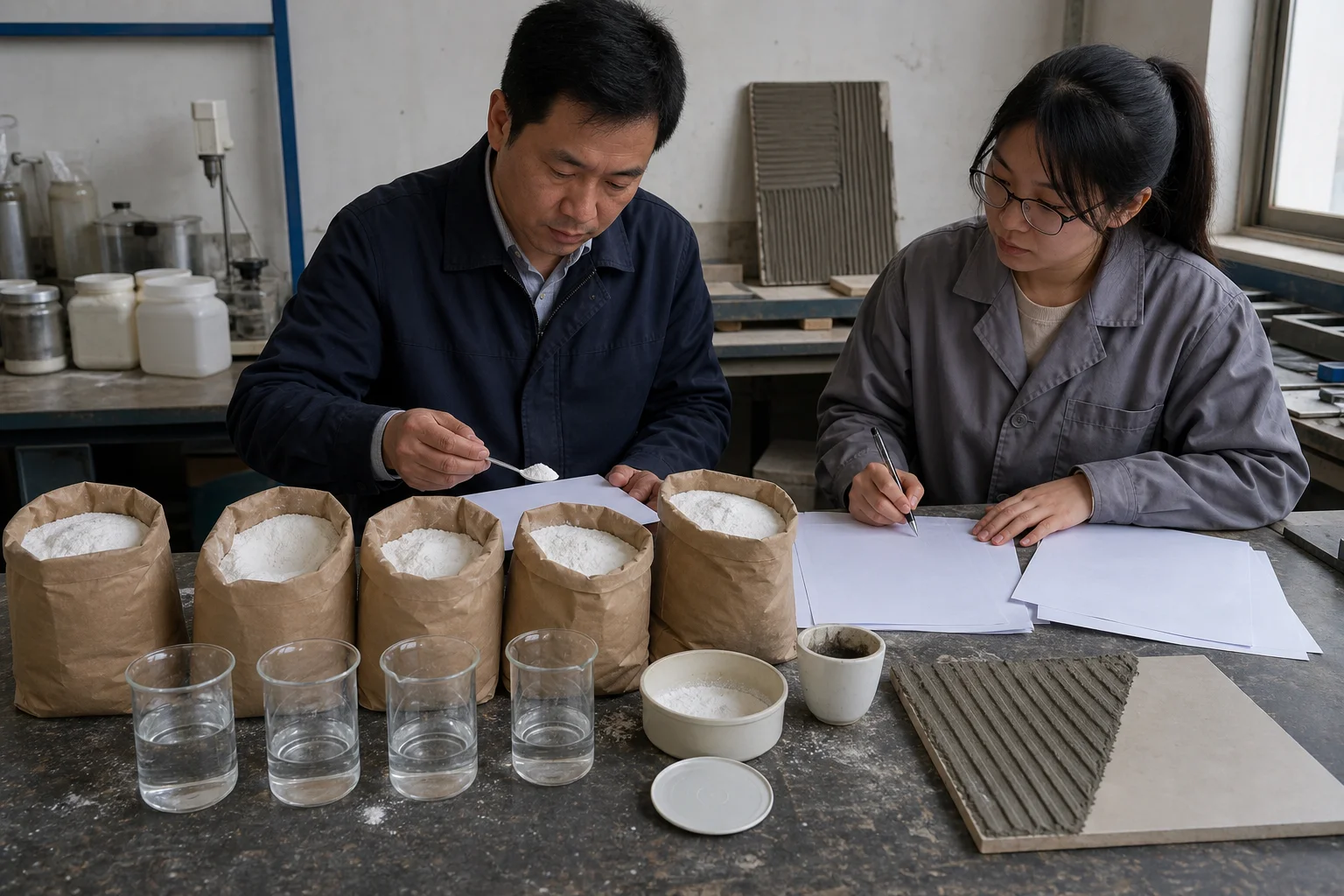
I use a procurement checklist
I suggest asking each prospective supplier for:
- Product technical data sheet
- Representative certificate of analysis
- Exact viscosity test method
- Solution concentration and temperature
- Instrument conditions
- Moisture and ash specifications
- Water-retention test method and result
- Recommended dispersion and mixing procedure
- Sample batch identification
- Manufacturing and quality-control information
- Safety data sheet
- Relevant regulatory or compliance documents
- Change-notification policy
- Technical support process
Buyers should verify certifications and compliance documents independently when those documents affect import, tender, safety, or market access. A logo on a brochure should not replace verification.
I separate qualification into three stages
Stage 1: Document comparison
I align test methods before comparing numbers. If methods differ, I ask for retesting under a shared protocol or treat the values as non-equivalent.
Stage 2: Laboratory formulation screening
I compare the current and candidate products in the same base formula. I keep preparation conditions fixed and evaluate several properties, not only sag.
Stage 3: Representative application validation
I use the intended tile load, substrate, bed thickness, climate range, and work sequence. If the product serves several markets, I test the demanding use conditions rather than assuming one laboratory result covers every region.
I do not let price per kilogram decide the result
A lower-priced HPMC can become expensive if it creates unstable water demand, rejected batches, formulation rework, or customer complaints. A higher-priced grade can also waste money if its extra solution viscosity does not improve the target application.
I compare cost in the validated formula, not only raw-material price. I also consider:
- Required dosage after optimization
- Batch-to-batch consistency
- Production efficiency
- Customer complaint risk
- Technical response time
- Lead time and minimum order quantity
- Availability of pre-shipment samples
- OEM and packaging requirements
In our own supplier role, I can recommend candidate viscosity ranges based on the buyer’s substrate, climate, and performance target. I can also provide samples and formulation troubleshooting. However, I still ask the buyer to validate the recommendation in the target dry mix. Incomplete formulation information and informal feedback do not justify a performance guarantee.
Frequently Asked Questions
Does a higher HPMC viscosity always reduce tile adhesive sag?
No. A higher solution-viscosity value may change mortar consistency, but it does not automatically provide the yield behavior and structural recovery needed for vertical stability. I evaluate water dosage, filler grading, binders, other additives, mixing, tile weight, and bed thickness before recommending a higher grade.
Can I solve tile adhesive sag by adding more HPMC?
I do not recommend increasing HPMC automatically. A dosage increase can affect water demand, troweling, wetting, air content, open time, and cost. I prefer a controlled dosage comparison in the target formulation, followed by checks of sag, transfer, workability, and final adhesion.
What is the difference between sag and skinning?
Sag is downward movement after a tile is placed on a vertical adhesive bed. Skinning is film formation on the exposed adhesive surface before placement. Temperature, airflow, substrate absorption, spread area, water dosage, binders, and cellulose ether can influence skinning, so I test it separately from vertical slip.
When should I investigate HPMC dissolution or water retention?
I investigate dissolution when I observe lumps, delayed thickening, inconsistent maturation, or variation caused by mixing sequence. I review water retention when rapid moisture loss, hot conditions, absorbent substrates, poor transfer, or early skin formation appears. Neither result should be interpreted outside the complete formulation.
What information should I send an HPMC supplier?
I recommend sending the binder system, filler grading, additive package, current water ratio, mixing method, climate, substrate, tile size and weight, bed thickness, current HPMC test method, and observed failure. If the complete formula is confidential, ranges and controlled trial data can still support better grade selection.
Conclusion
Tile adhesive sag is not solved by chasing the highest viscosity number. I first verify how viscosity was measured, then examine wet-mortar structure, water dosage, particle grading, additive interactions, preparation, climate, substrate, and actual tile load. Controlled trials provide stronger evidence than supplier labels or uncontrolled site feedback.
If you need help comparing construction-grade HPMC samples for a tile adhesive formulation, contact Shijiazhuang Jinghong Chemical Technology Co., Ltd. at hpmc@jinghonghpmc.com or WhatsApp +86 157 3315 6958 for sample support, grade-selection discussion, and a factory-direct quotation.
"(PDF) Rheological properties of cellulose ethers and their ...", https://www.academia.edu/77185505/Rheological_properties_of_cellulose_ethers_and_their_application_in_cementitious_tile_adhesives_formulation. Fresh cementitious mortars exhibit yield stress and time-dependent structural rebuilding determined by particle interactions, water content, and admixtures; a cellulose-ether solution-viscosity value is therefore not, by itself, a direct measure of mortar load-bearing rheology. Evidence role: mechanism; source type: paper. Supports: Research explaining that fresh cement-based mortar rheology, including yield stress and thixotropy, arises from the full particulate and admixture system rather than from solution viscosity alone.. Scope note: The cited rheology literature may concern cementitious mortars generally rather than every proprietary tile-adhesive formulation. ↩
"Understanding tile adhesives and its related standards", https://www.mapei.com/sg/en/blog/detail/tech-talk/2020/09/11/understanding-tile-adhesives-and-its-related-standards. Tile-adhesive standards use vertical slip as the displacement of a tile after application to a vertical test assembly, distinguishing it from bond-strength and open-time evaluations. Evidence role: definition; source type: institution. Supports: A recognized tile-adhesive standard defines and evaluates slip or vertical displacement of a tile applied to a vertical surface.. ↩
"ISO 13007-2:2013 Test Methods for Ceramic Tile Adhesives", https://standards.iteh.ai/catalog/standards/iso/609300cf-03d9-434e-b460-f339f9a0f52e/iso-13007-2-2013?srsltid=AU7gw4X2LfSKWvkgCOWIzDw1rxFIuvBCFfxWtA85GhDW30lXg2qMKFQp. Standard test frameworks assess vertical slip, open time, and adhesive strength through separate procedures, indicating that these properties should not be treated as interchangeable. Evidence role: definition; source type: institution. Supports: Tile-adhesive standards specify separate procedures for vertical slip, open time, and tensile adhesion, supporting their treatment as distinct performance characteristics.. Scope note: Skinned-surface formation and wetting may be described operationally in application guidance rather than defined identically in every standard. ↩
"SIST-EN-1308-2007.pdf", https://cdn.standards.iteh.ai/samples/26611/2960e33da3c34932ba03456d12155078/SIST-EN-1308-2007.pdf. EN 1308 specifies a method for determining slip of ceramic tile adhesives, while EN 12004 sets terminology, requirements, and classification provisions for ceramic tile adhesives. Evidence role: historical_context; source type: institution. Supports: The official titles and scopes of EN 1308 and EN 12004, including their relationship to slip testing and adhesive classification.. Scope note: Users must consult the edition adopted in their jurisdiction because standards may be revised, replaced, or nationally implemented. ↩
"A Study on the Impact of Hydroxypropyl Methylcellulose ... - PMC", https://pmc.ncbi.nlm.nih.gov/articles/PMC4370968/. The apparent viscosity of aqueous hydroxypropyl methylcellulose solutions is temperature-dependent, so viscosity comparisons require controlled and reported measurement temperatures. Evidence role: mechanism; source type: paper. Supports: Experimental evidence that aqueous HPMC or related cellulose-ether solution viscosity depends on measurement temperature.. Scope note: The magnitude and direction of the change depend on polymer concentration, substitution pattern, shear conditions, and temperature range. ↩
"Fluid Suspensions and Emulsions", https://www.nist.gov/programs-projects/fluid-suspensions-and-emulsions. For non-Newtonian fluids, reported apparent viscosity depends on the applied shear conditions and measurement geometry; values obtained under different protocols are not necessarily interchangeable. Evidence role: mechanism; source type: government. Supports: Metrology guidance explaining that apparent viscosity of non-Newtonian materials depends on shear conditions and measurement geometry, limiting cross-method comparability.. Scope note: A specific HPMC solution can be compared across methods only after its concentration, temperature, instrument settings, and shear conditions are established. ↩
"The Influence of Ambient Temperature on High Performance ...", https://pmc.ncbi.nlm.nih.gov/articles/PMC7603087/. Temperature changes evaporation rates and cement hydration kinetics, and consequently can alter the consistency and workable time of fresh cement-based materials. Evidence role: mechanism; source type: research. Supports: Cement-materials research showing that temperature affects evaporation, hydration kinetics, and fresh-state workability.. Scope note: Tile adhesives contain fillers and chemical admixtures that can modify the magnitude of temperature effects relative to conventional concrete or mortar. ↩
"Water Retention Mechanism of HPMC in Cement Mortar - PMC", https://pmc.ncbi.nlm.nih.gov/articles/PMC7372461/. Porous substrates can absorb water from fresh cementitious mortars, changing the adhesive’s local moisture condition and potentially affecting workability and early interfacial behavior. Evidence role: mechanism; source type: paper. Supports: Evidence that porous, absorbent substrates draw water from fresh cementitious materials and thereby alter near-interface moisture conditions.. Scope note: The effect varies with substrate porosity and moisture state, adhesive formulation, contact pressure, and exposure conditions. ↩
"Influences of Additives on the Rheological Properties of ... - PMC", https://pmc.ncbi.nlm.nih.gov/articles/PMC12028820/. Increasing the water content of cementitious mortar commonly increases flowability and reduces yield stress or related resistance to deformation, which can reduce vertical stability under load. Evidence role: mechanism; source type: paper. Supports: Experimental evidence that increased water content generally lowers fresh cementitious mortar yield stress or consistency while increasing flowability.. Scope note: The response is formulation-specific and may be moderated by particle packing, cellulose ethers, polymers, and other rheology modifiers. ↩