In the dynamic world of construction, the pursuit of high-performance building materials is relentless. Dry-mix mortars, in particular, have undergone significant advancements, largely due to the intelligent combination of various additives. Among these, Hydroxypropyl Methylcellulose (HPMC) and Redispersible Polymer Powder (RDP) stand out as two indispensable components. However, simply adding them to a formulation is not enough; understanding their synergistic relationship is the key to unlocking superior mortar properties.
Are you struggling with mortar formulations that lack consistent workability, insufficient bond strength, or poor flexibility? The challenge often lies in optimizing the interaction between these crucial additives. Without a clear understanding of how HPMC and RDP work together, formulators risk compromising performance, increasing material costs, and failing to meet stringent project demands.
This comprehensive guide will delve into the intricate synergy between HPMC and RDP, revealing how their combined action elevates mortar performance beyond what either can achieve alone. We will explore the mechanisms behind their interaction, their impact on critical properties like flexibility and impact resistance, and strategies for optimizing their ratio for both performance and cost-efficiency. By the end, you will have a clearer roadmap to formulating high-performance mortars that meet the toughest challenges.
HPMC (Hydroxypropyl Methylcellulose) provides essential water retention and thickening, while RDP (Redispersible Polymer Powder) enhances adhesion, flexibility, and cohesion. Their combined use creates a powerful synergistic effect, leading to mortars with superior workability, bond strength, and durability, crucial for demanding construction applications.
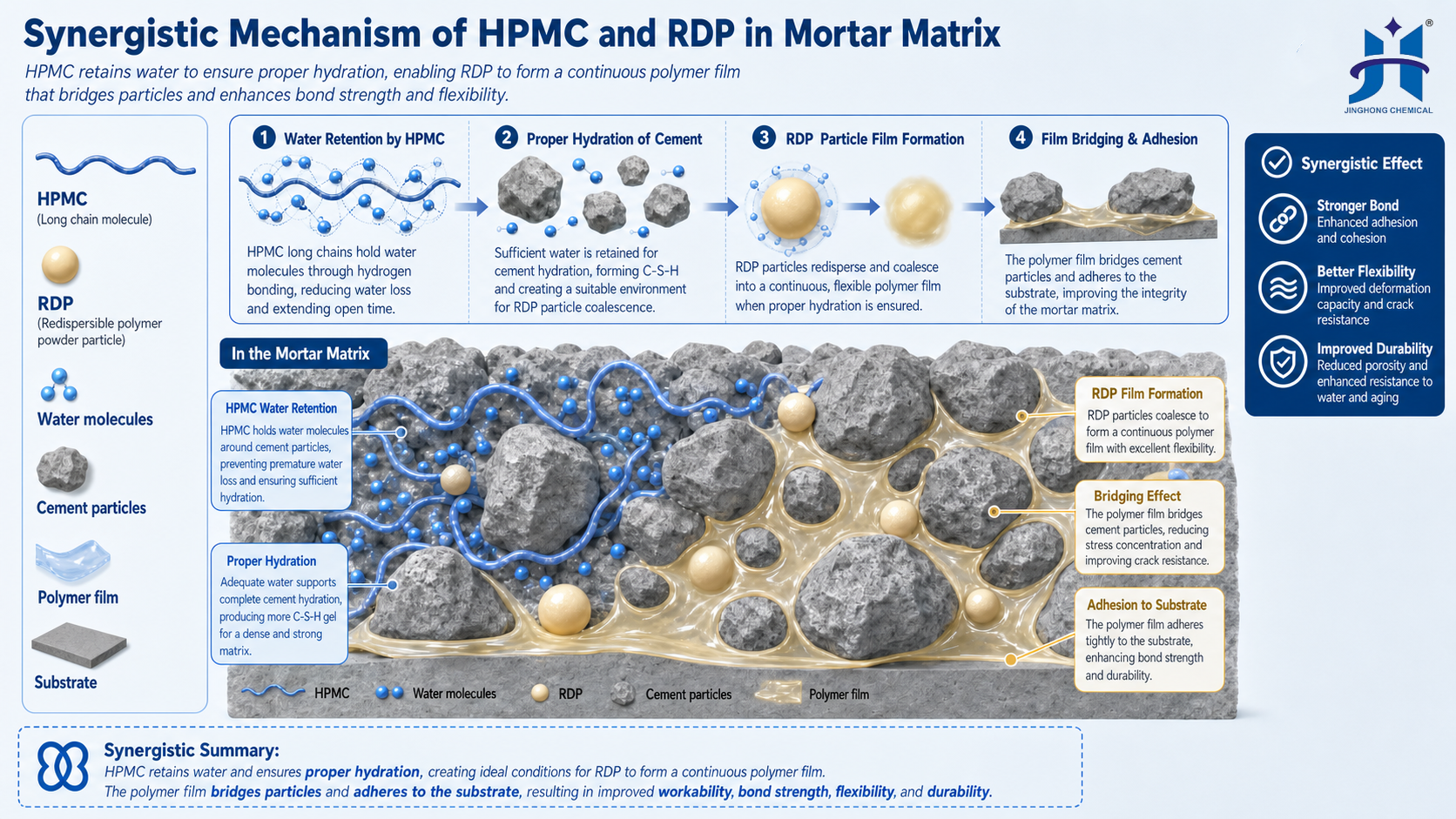
A detailed scientific diagram illustrating the synergistic mechanism of HPMC and RDP in a mortar matrix.
1. The Mechanism of Synergy: How HPMC and RDP Enhance Bond Strength
The magic of HPMC and RDP in high-performance mortars lies not just in their individual contributions but in their profound synergistic interaction. Understanding this mechanism is fundamental to optimizing mortar formulations, particularly concerning bond strength.
HPMC: The Water Manager
HPMC primarily functions as a water retention agent and thickener. Upon mixing with water, HPMC polymers hydrate rapidly, forming a viscous solution that effectively traps water within the mortar matrix. This controlled release of water is critical for several reasons:
- Extended Open Time: It prolongs the time during which the mortar remains workable, allowing for proper application and adjustment of building elements.
- Efficient Cement Hydration: By preventing rapid water loss to porous substrates, HPMC ensures that the cement has sufficient water to fully hydrate, which is essential for developing its inherent strength and microstructure.
- Improved Workability: The thickening effect of HPMC enhances the rheology of the fresh mortar, making it easier to spread, trowel, and adjust.
RDP: The Polymer Enhancer
RDP, on the other hand, consists of polymer particles that redisperse in water to form a stable polymer emulsion. As the mortar dries and cures, these polymer particles coalesce and form a continuous, flexible polymer film within the cement matrix. This film acts as a secondary binder, significantly enhancing several key properties:
- Enhanced Adhesion: The polymer film adheres strongly to both the cement matrix and the substrate, creating a robust bond that can withstand various stresses. This is particularly important for bonding to challenging surfaces or in applications requiring high tensile adhesion strength.
- Increased Flexibility: The inherent flexibility of the polymer film helps to bridge micro-cracks that may form due to drying shrinkage or thermal expansion/contraction, thereby improving the mortar’s crack resistance and overall durability.
- Improved Cohesion: RDP enhances the internal cohesion of the mortar, making it more resistant to deformation and improving its overall mechanical properties.
The Synergistic Interaction
The true power emerges when HPMC and RDP work together. HPMC ensures that the RDP particles have enough water to fully redisperse and form their continuous film. Without adequate water retention from HPMC, RDP might not fully hydrate or coalesce, leading to a compromised polymer network and reduced performance. Conversely, RDP’s film-forming capabilities protect the HPMC, allowing it to maintain its water retention properties for longer, especially in challenging conditions.
This combined action leads to:
- Superior Bond Strength: HPMC ensures optimal cement hydration, while RDP forms a strong, flexible polymer bridge between the mortar and the substrate, resulting in significantly improved adhesion to various materials like concrete, masonry, and insulation boards.
- Enhanced Cohesion and Reduced Segregation: The combined thickening and binding effects lead to a more homogeneous and stable mortar mix, reducing segregation and bleeding.
- Improved Stress Distribution: The flexible polymer film from RDP, supported by the consistent hydration provided by HPMC, helps to distribute stresses more evenly within the mortar, preventing localized failures and improving overall durability.
This intricate dance between HPMC and RDP is what transforms a basic mortar into a high-performance material capable of meeting the rigorous demands of modern construction. For further scientific insights into polymer-modified cementitious materials, you can refer to research published by organizations like the American Concrete Institute (ACI).

Infographic illustrating the enhanced flexibility and impact resistance of mortar in EIFS due to the synergy of HPMC and RDP.
2. Performance Impact: Improving Flexibility and Impact Resistance in EIFS
The synergistic action of HPMC and RDP is particularly evident in their profound impact on the mechanical properties of mortars, especially in applications demanding high flexibility and impact resistance, such as External Insulation and Finish Systems (EIFS).
Enhancing Flexibility and Reducing Cracking
Traditional cementitious mortars are inherently brittle. This brittleness makes them susceptible to cracking under thermal expansion/contraction, substrate movement, or mechanical stress. RDP plays a crucial role in mitigating this issue:
- Polymer Film Formation: As discussed, RDP forms a continuous polymer film that interpenetrates the cement hydration products. This film acts as a flexible bridge, absorbing stresses and preventing the propagation of micro-cracks. The result is a more ductile and flexible mortar.
- Improved Adhesion to Insulation Boards: In EIFS, the mortar needs to bond effectively to rigid insulation boards (e.g., EPS, XPS). RDP significantly enhances this adhesion, creating a strong yet flexible interface that can accommodate differential movements between the insulation and the substrate, thereby preventing delamination and cracking.
HPMC, while not directly contributing to flexibility, ensures that the RDP can fully perform its role by providing optimal water conditions for polymer film formation. Without HPMC’s water retention, RDP’s film formation could be compromised, leading to a less flexible and more brittle mortar.
Boosting Impact Resistance
Impact resistance is another critical property, especially for exterior applications like EIFS, where mortars are exposed to hail, accidental impacts, or other mechanical forces. The polymer film formed by RDP significantly improves the mortar’s ability to absorb energy and resist penetration.
- Energy Dissipation: The flexible polymer network within the mortar matrix can dissipate impact energy more effectively than a purely inorganic cement matrix. This means that instead of cracking, the mortar can deform slightly, distributing the stress over a larger area.
- Increased Cohesion: RDP enhances the internal cohesion of the mortar, making it tougher and more resistant to fragmentation upon impact. This is vital for maintaining the integrity of the EIFS layer and protecting the underlying insulation.
Why it matters for EIFS: In EIFS, a flexible and impact-resistant base coat mortar is essential for the long-term durability and performance of the system. It protects the insulation from damage, prevents moisture ingress through cracks, and ensures the aesthetic integrity of the facade. The combined power of HPMC and RDP allows formulators to achieve these demanding performance criteria, leading to more robust and reliable EIFS solutions. For industry guidelines on EIFS, refer to organizations like the EIFS Industry Members Association (EIMA).
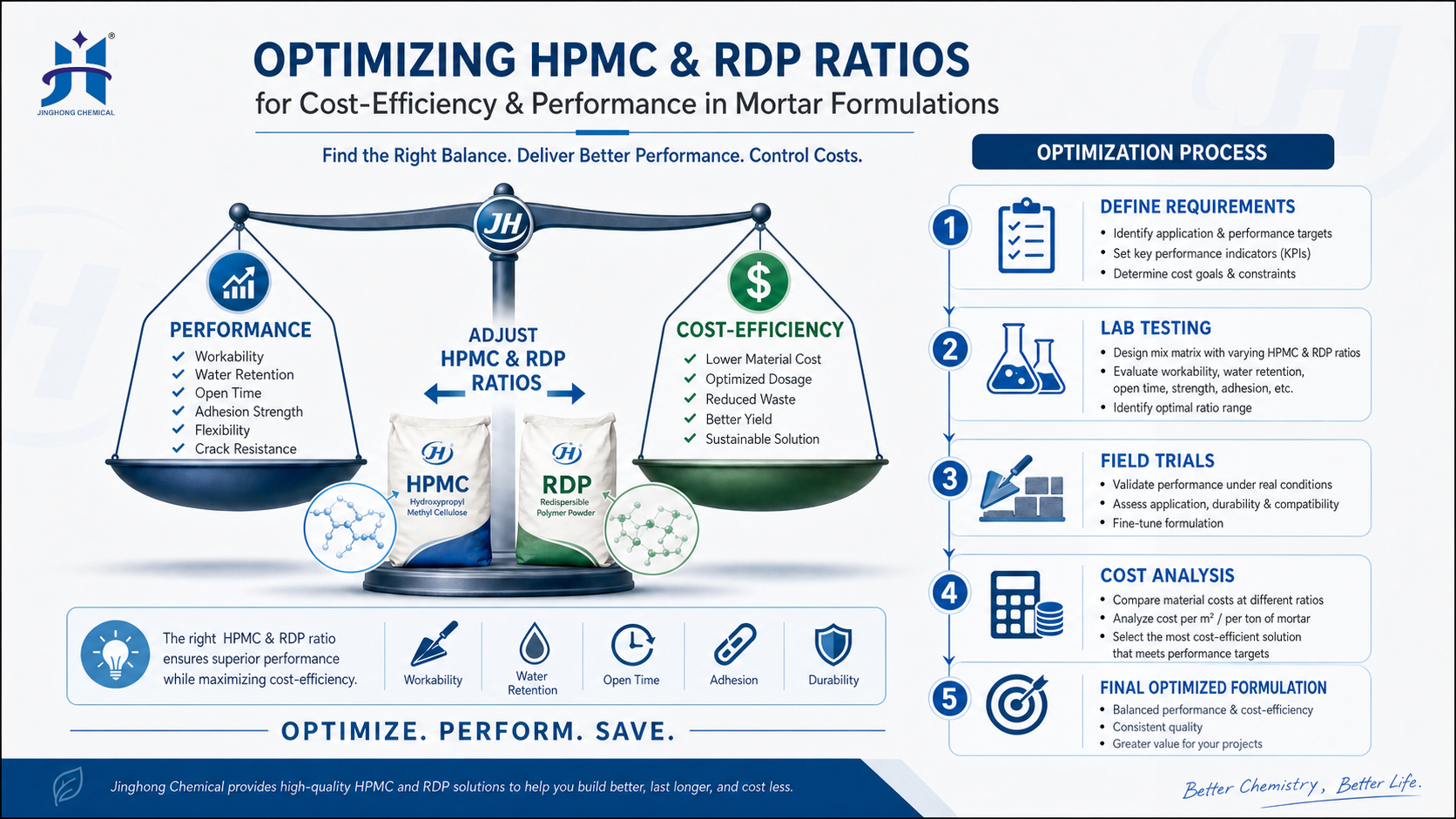
Infographic illustrating the process of optimizing HPMC and RDP ratios for cost-efficiency and performance.
3. Formulation Optimization: Finding the Ideal HPMC to RDP Ratio for Cost-Efficiency
While the synergistic benefits of HPMC and RDP are clear, achieving optimal performance in high-performance mortars also involves formulation optimization, particularly finding the ideal HPMC to RDP ratio. This balance is crucial for maximizing technical properties while maintaining cost-efficiency.
Understanding the Role of Ratio
The proportion of HPMC and RDP in a mortar formulation is not arbitrary; it directly influences the fresh and hardened properties of the mortar. A well-balanced ratio ensures that each additive contributes optimally without redundancy or deficiency.
-
Higher HPMC Ratio: Emphasizes water retention, workability, and open time. This might be preferred in formulations where extended workability is paramount, or in very porous substrates where rapid water loss is a concern. However, an excessively high HPMC content can lead to excessive air entrainment, reduced mechanical strength, and increased stickiness.
-
Higher RDP Ratio: Enhances adhesion, flexibility, impact resistance, and cohesion. This is critical for applications requiring superior mechanical performance, such as highly flexible tile adhesives or EIFS base coats. Too much RDP, however, can lead to increased material cost, reduced compressive strength, and potential issues with surface hardness or dustiness.
Achieving Cost-Efficiency Through Optimization
Cost-efficiency in mortar formulation is not about using the cheapest raw materials, but about achieving the desired performance at the most economical overall cost. This often means fine-tuning the HPMC to RDP ratio.
-
Performance-Driven Costing: For high-performance applications, investing in a higher RDP content might be necessary to meet stringent technical specifications. The added cost is justified by superior durability, reduced failure rates, and extended service life of the final product.
-
Balanced Approach for General Applications: For more general-purpose mortars, a balanced HPMC and RDP ratio can provide a good compromise between workability, adhesion, and cost. Here, the goal is to achieve acceptable performance without over-engineering the formulation.
Optimization Strategy:
- Define Performance Requirements: Clearly outline the desired fresh (workability, open time) and hardened (bond strength, flexibility, impact resistance) properties for your specific application.
- Start with Recommended Ratios: Most cellulose ether suppliers, like Jinghong Chemical, provide starting point formulations and recommended HPMC to RDP ratios for various applications. These serve as excellent baselines.
- Laboratory Testing: Conduct systematic laboratory tests, varying the HPMC and RDP ratios within a defined range. Evaluate key performance indicators (KPIs) such as tensile adhesion strength, flexural strength, water retention, and open time.
- Field Trials: Validate optimized lab formulations with real-world field trials to account for environmental factors and application methods.
- Cost Analysis: Integrate the performance data with raw material costs to determine the most cost-effective formulation that meets all technical requirements.
By following a systematic optimization process, formulators can precisely tailor the HPMC and RDP content, ensuring that every gram contributes effectively to the mortar’s performance and overall value. This approach not only enhances product quality but also provides a competitive edge in the market. For more on formulation best practices, consider resources from chemical engineering societies or industry forums.
Conclusion: Unlocking Superior Mortar Performance with HPMC and RDP Synergy
The journey to formulating high-performance mortars is a continuous quest for optimal material combinations. The synergistic relationship between Hydroxypropyl Methylcellulose (HPMC) and Redispersible Polymer Powder (RDP) stands as a testament to the power of intelligent additive selection. Their combined action transcends the limitations of individual components, delivering mortars with unparalleled workability, bond strength, flexibility, and durability.
- HPMC lays the foundation by ensuring precise water management, critical for cement hydration and the proper dispersion and film formation of RDP.
- RDP builds upon this foundation by forming a flexible polymer network that enhances adhesion, provides crack resistance, and boosts impact strength.
By understanding the intricate mechanisms of their interaction, recognizing their impact on key performance indicators in demanding applications like EIFS, and diligently optimizing their ratios, formulators can unlock the full potential of their mortar products. This not only leads to superior construction materials but also contributes to long-term cost-efficiency and enhanced project reliability.
Partner with Jinghong Chemical for Advanced Mortar Solutions
Are you ready to elevate your mortar formulations to the next level? Jinghong Chemical is your trusted partner in cellulose ether and polymer powder solutions. With 15 years of manufacturing excellence, ISO-certified quality, and a dedicated technical support team, we provide high-quality HPMC and RDP products designed to meet the most stringent performance requirements.
Our experts are here to assist you in:
- Selecting the optimal HPMC and RDP grades for your specific applications.
- Optimizing your formulations for superior performance and cost-efficiency.
- Providing technical insights and troubleshooting to overcome formulation challenges.
Contact us today to discuss your project needs, request technical data sheets, or obtain free samples for comprehensive testing. Let’s build better, together.
Email: hpmc@jinghonghpmc.com
WhatsApp: +8615733156958
Website: www.jinghonghpmc.com